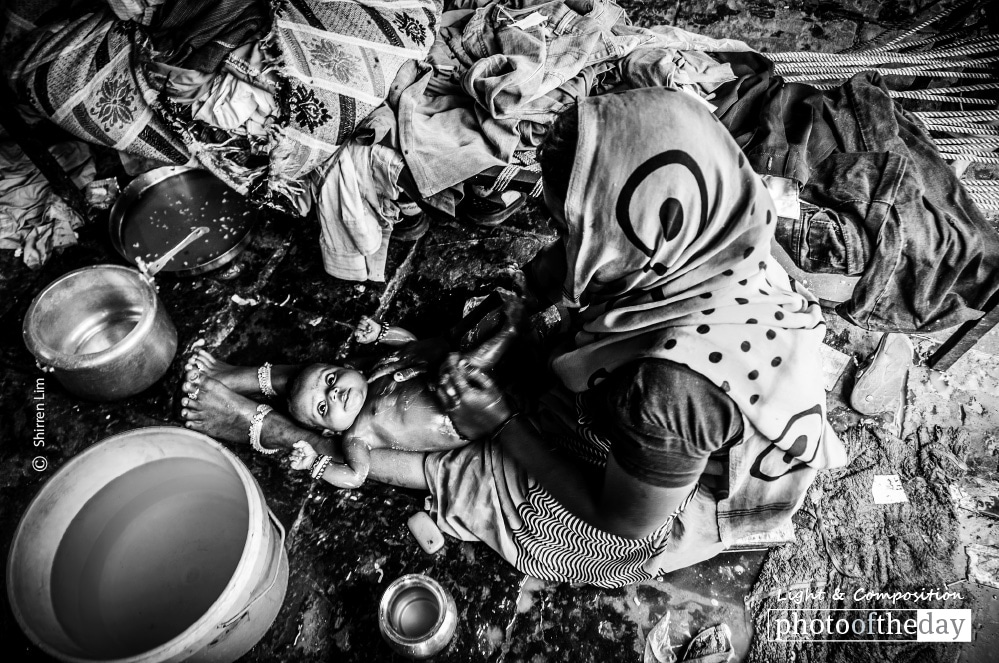
Bath Time by Shirren Lim
Captured during a work trip to the iconic Dhoby Ghaut open-air laundromat in Mumbai, this poignant image documents a quiet, intimate moment of daily life. The photographer, struck by the sight of a mother bathing her child amidst the bustling, industrial backdrop of the laundry facility, acted quickly to preserve the scene. The image is defined by the mother's total immersion in her task, unaware of the lens, which lends the photograph a raw, unposed sincerity. It is this authentic glimpse into the human condition, framed with empathy and observational precision, that makes the work a compelling and award-worthy piece of black and white photography.
Shirren Lim
Born on Penang Island, Malaysia, in 1970, Shirren Lim is a Jakarta-based photographer who discovered her true passion for the craft in 2009. Specializing in portraiture, she seeks to capture the uncovered sincerity and beauty of human expression, drawing inspiration from the evocative work of Steve McCurry. Her photography is characterized by an intense, earthy aesthetic and simple compositions that aim to cut to the heart of her subjects. Having seen her work featured in various international publications, Lim continues to pursue her goal of capturing profound, world-changing moments through her lens.
Resonance Score Breakdown
Transparency Note: The resonance score (11.0/20) is calculated based on social engagement metrics collected before the award announcement.
Expert Photography Reviews · 4
The Quietest Ritual
I was washing dishes this morning, just staring out the window at the neighbor’s overgrown hedge, when I realized I hadn't actually thought about anything for ten minutes. My hands were just moving in the warm, soapy water, repeating the same circular motion over and over.
Read the reflection →The Architecture of Care
We often mistake the grand gesture for the substance of a life. We look for the monuments, the declarations, the loud arrivals. Yet, if you sit long enough with the rhythm of a day, you realize that the world is held together by the quiet, repetitive labor of the hands.
Read the reflection →Reviews & Comments
Share your thoughts about this award-winning photograph. Your reviews contribute to the community engagement score.
Dhoby Ghaut is a brutal, rhythmic grid of concrete cells, yet here, the architecture recedes. Lim captures the threshold between the industrial datum and the domestic. The light rakes across the wet stone, defining the mass of the columns while softening the mother’s silhouette. It’s a rare, honest frame. I’m struck by how the void of the laundry stalls creates a sanctuary; it’s not just a space, but a quiet, human gravity amidst the concrete.
Dhoby Ghaut isn’t a backdrop; it’s a workplace. When Lim frames this mother bathing her child, does she see a person or a prop for an aesthetic of poverty? I find the voyeurism here deeply uncomfortable. Why does the mother’s lack of awareness grant the photographer permission to commodify her intimacy? It’s a technically sharp composition, but it feels like an extraction. Does the viewer’s empathy actually help the subject, or just soothe our own conscience?
The frame resolves into a rigorous grid of vertical concrete pillars, anchoring the mother and child within a precise 1:2 ratio of light to shadow. The diagonal vector of the basin cuts across the lower quadrant, creating a perfect tension against the vertical axis of the laundry lines. It’s a beautifully solved spatial equation. I’m genuinely moved by how the geometry traps their intimacy; it’s not just a moment, it’s a perfectly balanced, immutable mathematical truth.
The geometry of the Dhoby Ghaut provides a rigid grid that anchors the subjects. Vertical concrete pillars intersect the horizontal wash basins, creating a cellular structure that traps the figures in a precise, claustrophobic frame. It’s a brutalist cage for a tender act. The negative space around the mother’s bent spine creates a necessary fulcrum. I’m genuinely unsettled by how the architecture dictates the intimacy here. The composition holds, but it’s a cold, calculated embrace.