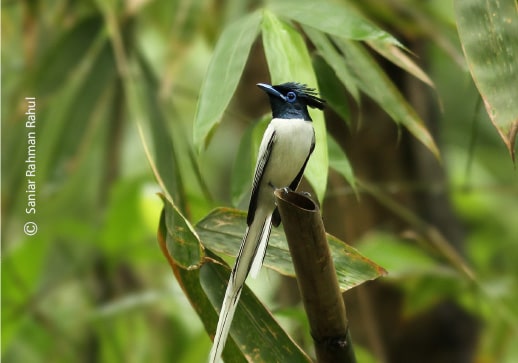
Asian Paradise-Flycatcher by Saniar Rahman Rahul
Captured in the lush landscapes of Gazipur, this striking portrait of a male Asian Paradise-Flycatcher highlights the bird's elegant, elongated tail feathers and vibrant plumage. The photographer skillfully observed the passerine in its natural habitat, waiting for the perfect moment as it hunted for insects beneath the dense forest canopy. This image is award-worthy for its sharp focus and the photographer's ability to document the intricate details of such a fast-moving, elusive subject, offering a rare and intimate glimpse into the life of a bird widely distributed across Asia yet rarely seen with such clarity.
Saniar Rahman Rahul
Based in Dhaka, Bangladesh, Saniar Rahman Rahul is an accomplished Art Director at Grey Worldwide with a deep-rooted passion for visual storytelling. His journey into photography began in childhood, inspired by his father, and was later refined through his extensive professional background in graphic design and advertising. Rahul’s work is characterized by a keen eye for detail and a creative approach to wildlife photography, earning him recognition as a distinguished talent in the international photography community.
Resonance Score Breakdown
Transparency Note: The resonance score (13.5/20) is calculated based on social engagement metrics collected before the award announcement.
Expert Photography Reviews · 5
The Weight of Grace
There is a peculiar physics to the way some things move through the world, as if they are not entirely subject to the gravity that anchors the rest of us.
Read the reflection →The Weight of a Ribbon
I keep a silk ribbon in a small wooden box, the kind that once held a child’s hair in place during a summer that felt like it would never end.
Read the reflection →Reviews & Comments
Share your thoughts about this award-winning photograph. Your reviews contribute to the community engagement score.
f/5.6 at 400mm, 1/800s, ISO 800. A calculated gamble against the canopy’s gloom. The shutter speed barely freezes the movement of those tail feathers, but it’s enough. I’ve spent hours in similar brush; getting this level of separation at 400mm is exhausting work. The focus is surgically precise on the eye. It’s a cold, clinical success. I find myself genuinely impressed by the restraint shown here. The technical execution justifies the bird’s presence.
The bird hangs in the air. It’s a ribbon of white against the deep, dark forest. I’ve spent minutes watching the tail feathers drift. They don’t just occupy space; they define it. The surrounding green isn’t merely background. It’s a heavy, velvet silence. Nothing here is accidental. The empty corner is not empty. It’s the breath between heartbeats. I feel my own pulse slow down. It’s rare to find such stillness in the wild.
The bird’s elongated tail feathers anchor the frame, creating a vertical axis that slices through the chaotic foliage. It’s a rigid geometry that forces the eye to track the plumage’s curve. The negative space isn’t merely empty; it’s a calculated buffer against the dense canopy. I’m genuinely unsettled by how the subject’s stillness defies the forest’s entropy. The composition holds because the weight of the tail balances the bird’s gaze. It’s precise, cold, and entirely necessary.
The forest canopy in Gazipur doesn’t give up its secrets easily. Saniar waited in that humid, filtered gloom, listening for the flutter of wings against the stillness. When the Flycatcher finally paused, it wasn’t just a bird; it was a ribbon of light caught in the shadows. I feel a sudden, quiet ache in my own shoulders just looking at it. He didn’t chase this moment; he let the bird arrive, and that’s everything.
The focal plane here is razor-thin, perfectly isolating the flycatcher’s eye from the chaotic bokeh of the Gazipur canopy. By stopping down just enough to avoid the diffraction limit, the lens resolves the iridescent barbs of those elongated tail feathers with startling clarity. I’ve spent years studying optics, yet seeing that precise intersection of light and biology still makes my pulse quicken. It’s a rare, beautiful triumph of glass over the blur of a fast-moving subject.