The Blue-throated Barbet by Nirupam Roy
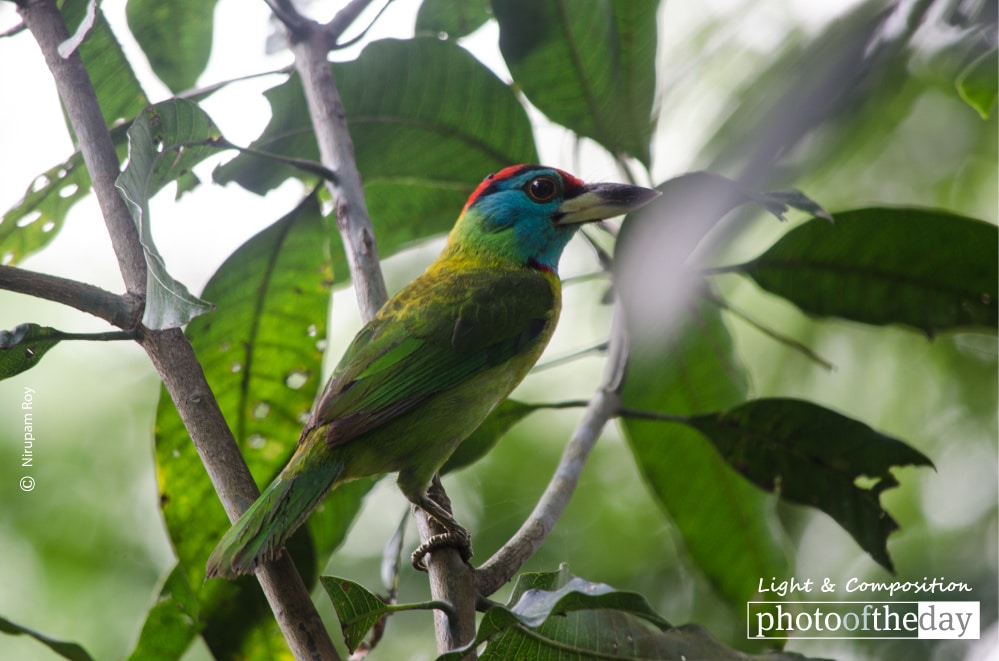
The Blue-throated Barbet, a vibrant avian species native to the Indian subcontinent, is captured here in a striking display of its signature green, blue, and red plumage. Nirupam Roy’s approach to this wildlife portrait highlights the intricate details and vivid colors of the bird, showcasing a deep appreciation for the natural beauty found within his local environment. The photograph is award-worthy for its precise focus and the photographer's ability to transform a common encounter into a compelling visual narrative, reflecting a profound connection between the observer and the natural world.
Nirupam Roy
Hailing from the town of Tufanganj in West Bengal, India, Nirupam Roy balances his professional life as a school teacher with a dedicated pursuit of photography. His creative journey began during a family trip to Odisha, where he first discovered the power of the lens to capture the beauty of the natural world. Since transitioning from documentary video work to DSLR photography, Roy has developed a passionate, nature-focused style that seeks to find peace and fresh conceptual perspectives within the common aspects of society and the environment.
Resonance Score Breakdown
Transparency Note: The resonance score (12.5/20) is calculated based on social engagement metrics collected before the award announcement.
Expert Photography Reviews · 6
The Weight of Being Seen
Why do we assume that to be observed is to be understood? We move through the world carrying our own private colors, our own internal rhythms, yet we are often reduced to the surface we present to the light.
Read the reflection →The Architecture of Breath
We spend our lives building walls, brick by heavy brick, forgetting that the most vital parts of us are the spaces in between. Like the hollow of a reed or the quiet gap between two heartbeats, it is the emptiness that allows the music to exist.
Read the reflection →Reviews & Comments
Share your thoughts about this award-winning photograph. Your reviews contribute to the community engagement score.
The Barbet’s perch isn’t just a branch; it’s a structural datum, a line defining the void. I’m struck by how the light rakes across those feathers, turning organic plumage into a tectonic surface of mass and depth. It’s a sharp, honest study of form. I’d love to see the threshold of the canopy it inhabits, though. Without the context of the surrounding foliage, it’s a beautiful fragment, yet it feels strangely unanchored in space.
f/5.6 at 300mm, 1/250s, ISO 400. The Nikon D5000 sensor struggles here; the noise floor is visible in the shadows. Roy’s choice of f/5.6 isolates the subject, but the shutter speed is dangerously low for a handheld 300mm shot. It’s a gamble that barely paid off. I’ve seen enough motion blur to make me wince, yet the focus on the eye is sharp. It’s technically adequate, though I’d have pushed the ISO for a faster shutter.
The turquoise throat, reminiscent of a Vermeer lapis lazuli, vibrates against the chartreuse foliage like a fever dream of the tropics. It’s a collision of pigments that makes my heart ache with a sudden, sharp longing for the humid, verdant depths of Cooch Behar. One finds the crimson accents aren’t merely decorative, but essential, anchoring the bird’s ethereal, cooling blues within a warm, organic architecture that feels as deliberate as a Morandi still life.
The jury’s obsession with the Barbet’s razor-sharp plumage feels stifling. Why resolve every feather when the bird’s essence is movement? It’s technically competent, sure, but I’m bored by the clinical stillness. I’d have preferred a long exposure, letting the green blur into the foliage like a ghost. This approach is closer to Hiroshi Sugimoto’s long-exposure theatres than to conventional wildlife practice. What did Roy choose not to resolve? He missed a chance to capture the bird’s frantic energy.
We look at this Blue-throated Barbet and we aren’t just seeing a bird; we’re meeting a neighbor. Nirupam Roy didn’t just point a lens; he waited until the creature felt safe enough to reveal its vibrant, feathered soul. I’m struck by that intense, unblinking gaze. It’s a quiet conversation held in the canopy of Cooch Behar. It’s a photograph that asks to be returned to, because it feels like a secret shared between two living things.
You’ve caught this Barbet in a moment of quiet intensity. It’s not just a bird on a branch; it’s a living, breathing creature caught in the stillness of Cooch Behar. I’ve spent enough time in the field to know how hard it is to stay that patient. And honestly? Looking at that sharp, defiant eye, I felt a sudden, sharp pull of envy. You waited, you watched, and you let the bird simply exist. That’s rare.