See Left by Ryszard Wierzbicki
Captured during a visit to a primary school near Luang Prabang, Laos, this photograph documents a poignant moment during a donation ceremony. As the children stood in a disciplined row, following the school principal's guidance, the photographer seized the opportunity to frame their collective gaze toward the left. The image is award-worthy for its authentic portrayal of childhood and cultural connection, highlighting the photographer's ability to find profound human stories within his travels. The composition balances the structured arrangement of the students with the natural, candid expressions of the children, resulting in a compelling narrative of community and education in rural Southeast Asia.
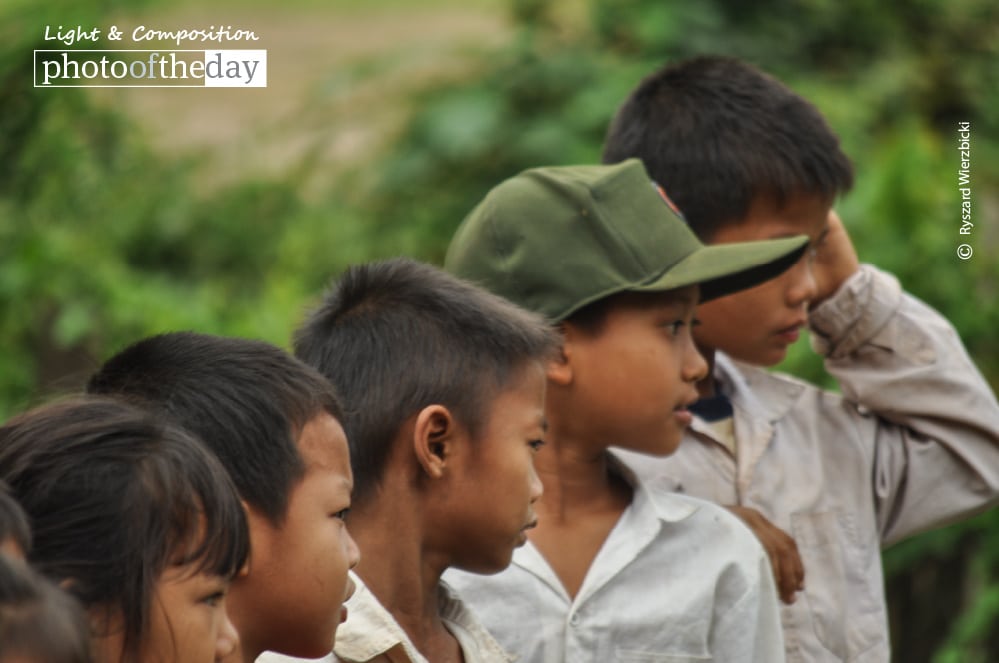
Exposure 1/500sec @ f/5.6 | ISO 320 | Focal Length 200mm
Ryszard Wierzbicki
Born in 1963, Ryszard Wierzbicki is a Polish-born photographer and educator now based in Swindon, United Kingdom. After a diverse career in social sciences, child care, and marketing, he transitioned into full-time travel photography and exploration, with a particular focus on Southeast Asia. His work is deeply influenced by his commitment to volunteering with orphanages and his passion for documenting global cultures. As the founder of the travel forums Instant Travelling and World Around, he actively contributes to the photography community by sharing his experiences from his extensive travels.
Resonance Score Breakdown
Transparency Note: The resonance score (13.2/20) is calculated based on social engagement metrics collected before the award announcement.
Expert Photography Reviews · 6
The Weight of a Shared Gaze
Why do we feel the need to look in the same direction as those beside us? From the earliest days of our lives, we are taught to align our vision with the collective, to find comfort in the shared focus of a group.
Read the reflection →The Architecture of Attention
We are taught from a young age that to be educated is to be directed. We learn to sit in rows, to face the front, and to synchronize our focus toward a singular point of authority.
Read the reflection →Reviews & Comments
Share your thoughts about this award-winning photograph. Your reviews contribute to the community engagement score.
The frame snaps shut, locking a collective breath. Twenty heads turn left, a rhythmic syncopation of curiosity that pulls the viewer right off the screen. It’s a masterclass in blocking; the 200mm compression flattens the space, turning the children into a single, breathing organism. I’ve seen thousands of school portraits, but this one feels like the perfect establishing shot before the scene cuts to chaos. It’s honest, disciplined, and honestly, it makes me miss the classroom.
1/500sec at f/5.6, 200mm. ISO 320. The shutter speed is sufficient to freeze the movement, but f/5.6 at 200mm on a DX sensor creates a razor-thin plane of focus. It’s a gamble that barely pays off. The background blur is aggressive, isolating the subjects effectively. I’ve seen enough soft focus to know when it’s a mistake, but here, it’s precise. It’s technically sound. I actually find the discipline in those eyes quite unsettling.
The ochre dust of Luang Prabang rises to meet the children’s uniforms, a dusty, sun-bleached saffron that recalls the quiet, chalky stillness of a Morandi study. It’s a palette of humid earth and fading light that I find utterly devastating. One feels the heat radiating from those fabric folds, a chromatic resonance so profound it’s as if the very air has thickened, suspending these young lives in a golden, amber-hued amber of pure, unadulterated grace.
Of the thousands of travel shots I’ve reviewed, most are just postcards. What separates this from the pack is the collective tension in those necks; that unified gaze toward the left creates a narrative of anticipation I find genuinely moving. It’s not just a school photo. By resisting the urge to center the subjects, Wierzbicki captures a fleeting, disciplined innocence. Thirty years from now, that shared curiosity will still feel like a profound, human truth.
The light here isn’t just illumination; it’s a soft, diffused presence filtering through the schoolyard, settling on those upturned faces. I’ve spent enough mornings waiting for such stillness to know he didn’t rush this. He stood in the quiet heat, watching them turn in unison. It’s a gentle, rhythmic grace. Looking at their collective gaze, I feel a sudden, sharp ache for the simplicity of their focus. It’s a beautiful, patient act of listening to the land.
The frame relies on a rigid horizontal vector, anchored by the children’s aligned shoulders. It’s a study in parallel lines interrupted by the rhythmic, vertical repetition of their heads. The 200mm compression flattens the depth, forcing a tight, geometric tension between the subjects. I’m genuinely captivated by how the collective gaze creates a singular, invisible diagonal line pulling the eye left. It’s a perfectly solved spatial equation where discipline meets the chaotic geometry of human expression.