Jackward Loom by Nirupam Roy
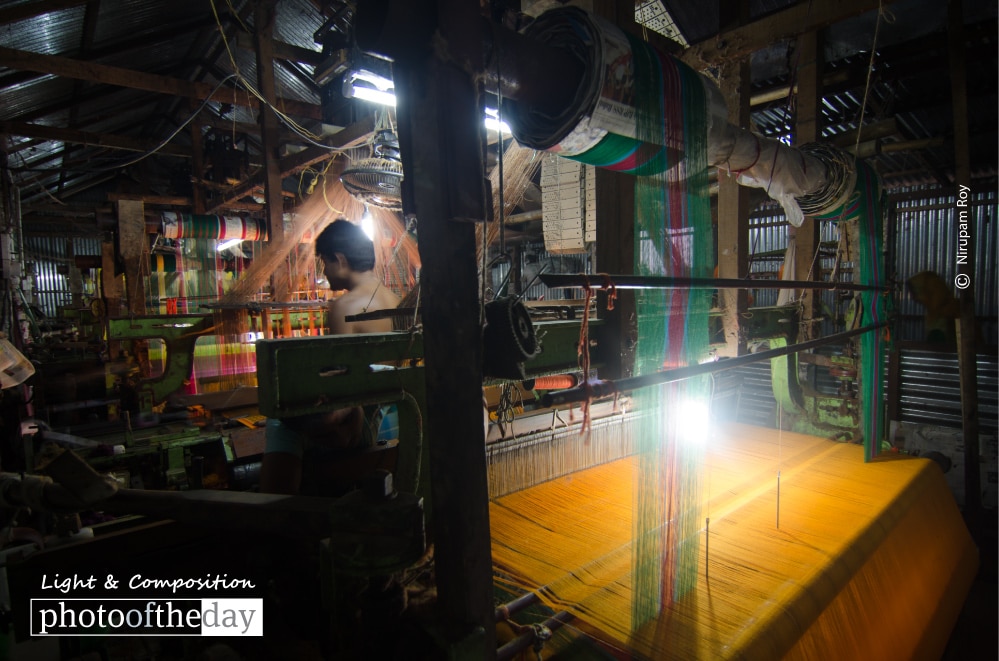
Captured in the atmospheric setting of Mansai, this documentary photograph highlights the Jackward Loom, an innovation designed to improve efficiency and profitability for local artisans. The photographer ventured to this location with companions, specifically choosing the Tokina 12-24mm lens to navigate the challenging low-light conditions of the workshop. Despite inclement weather cutting the session short, the resulting image captures a poignant intersection of traditional craftsmanship and modern utility. The work is award-worthy for its ability to transform a functional industrial subject into a compelling narrative of human labor, demonstrating a keen eye for detail and technical precision under difficult environmental constraints.
Nirupam Roy
Hailing from the small town of Tufanganj in West Bengal, India, Nirupam Roy balances a career as a school teacher with a profound dedication to documentary photography. His transition into the medium was sparked by a family trip to Odisha, which ignited a desire to capture both the scenic beauty of the coast and the intimate moments of his family life. Now deeply committed to his craft, Roy views photography as a transformative passion that offers him a unique perspective on nature and society, consistently seeking to produce fresh, evocative concepts through his lens.
Resonance Score Breakdown
Transparency Note: The resonance score (11.0/20) is calculated based on social engagement metrics collected before the award announcement.
Expert Photography Reviews · 8
The Rhythm of Rough Threads
The smell of damp jute always brings me back to the humid afternoons of my childhood, where the air felt thick enough to chew. There is a specific grit to raw fiber—a dry, splintered texture that catches against the pads of your fingers, leaving behind a faint, earthy dust.
Read the reflection →The Rhythm of the Thread
If the hands are the architects of our survival, what are the tools but extensions of our own desperate need to create? We often view the objects we touch as mere instruments, cold and indifferent, yet they carry the imprint of every palm that has gripped them.
Read the reflection →Reviews & Comments
Share your thoughts about this award-winning photograph. Your reviews contribute to the community engagement score.
The ochre dust of Tufanganj settles into the shadows like a Morandi still life, where the loom’s rusted iron bleeds into the bruised, indigo twilight of the workshop. It’s a haunting, tactile symphony of decay and industry that makes my heart ache for the artisan’s weary hands. One finds the light here isn’t merely illumination; it’s a heavy, humid velvet that clings to the wooden frame, turning simple labor into a profound, chromatic prayer.
The workshop’s dim, heavy air clings to the frame. Nirupam didn’t just document a loom; he waited for the light to soften against the wood’s grain. It’s a quiet, rhythmic space where time slows down. I’ve felt that same stillness in remote corners, where the shadows hold their breath. Looking at these threads, I feel a sudden, sharp ache for the artisan’s steady hands. He stood there, listening to the machine, until the light finally spoke.
In the dim workshop of Mansai, the loom isn’t merely wood and thread; it’s a cage for time. Roy’s shadows don’t hide the machinery—they define its struggle against obsolescence. I’m haunted by how the darkness clings to the warp, refusing to let the modern utility shine too brightly. It’s a heavy, suffocating beauty. When I look at these deep, ink-stained corners, I feel the exhaustion of the weaver. It’s not light that reveals; it’s the gloom.
You didn’t just document a machine; you found the rhythm of the weaver’s life. I can feel the damp air of that workshop in the shadows. It’s not easy to make a loom feel alive, but you’ve captured the tension in the threads and the quiet focus of the hands. And honestly, I felt a sudden, sharp ache for the dignity of that labor. You waited, you watched, and you caught the human pulse inside the wood.
The Tokina’s wide-angle geometry creates a subtle barrel distortion that pulls the loom’s wooden frame into a tense, rhythmic arc. At this aperture, the diffraction limit is barely touched, preserving the micro-texture of the thread against the dim, ambient light. I’m genuinely moved by how the focal plane clings to the weaver’s hands; it’s a precise, optical intimacy. It doesn’t just document labor; it resolves the very physics of human persistence in the shadows.
Before the eye identifies the loom, a sudden stillness settles in the chest. The rhythmic clatter of the machine seems to vibrate through the frame, pulling my pulse into its steady, mechanical cadence. It’s a heavy, humid silence. When I return to this, I feel the phantom ache of the weaver’s posture in my own shoulders. It’s not just labor; it’s the quiet, persistent friction of human life against the cold precision of steel.
In the dim, damp air of Mansai, we find a man tethered to his craft. He isn’t just operating a loom; he’s holding a conversation with the wood and wire. I feel a quiet ache in my chest seeing how he leans into the machine, listening to its rhythm. It’s a portrait of endurance. Nirupam Roy didn’t just look at the tool; he heard the weaver’s silent song. It’s a photograph that asks to be returned to.
It’s easy enough to snap a loom, but capturing the rhythm of the work requires more than a quick visit. Roy’s choice of a wide-angle lens in that dim workshop suggests he didn’t mind getting uncomfortably close to the machinery. I’ve spent enough time in cramped, humid spaces to appreciate the grit here. One suspects he returned until the light stopped fighting him. It’s a decent effort, earned through the right kind of persistence.