A Little Girl on Kata Beach by Ryszard Wierzbicki
Captured on the sun-drenched shores of Kata Beach, this candid portrait highlights a young girl lost in the simple joy of playing with sand. The photographer utilized a 160mm focal length to isolate the subject against the soft, blurred backdrop of the Andaman Sea, creating an intimate connection despite the distance. By focusing on the child's natural engagement with her environment, the image captures a fleeting moment of innocence and serenity. Its award-worthy quality lies in the masterful use of shallow depth of field and the authentic, unposed nature of the scene, which perfectly encapsulates the tranquil spirit of Phuket.
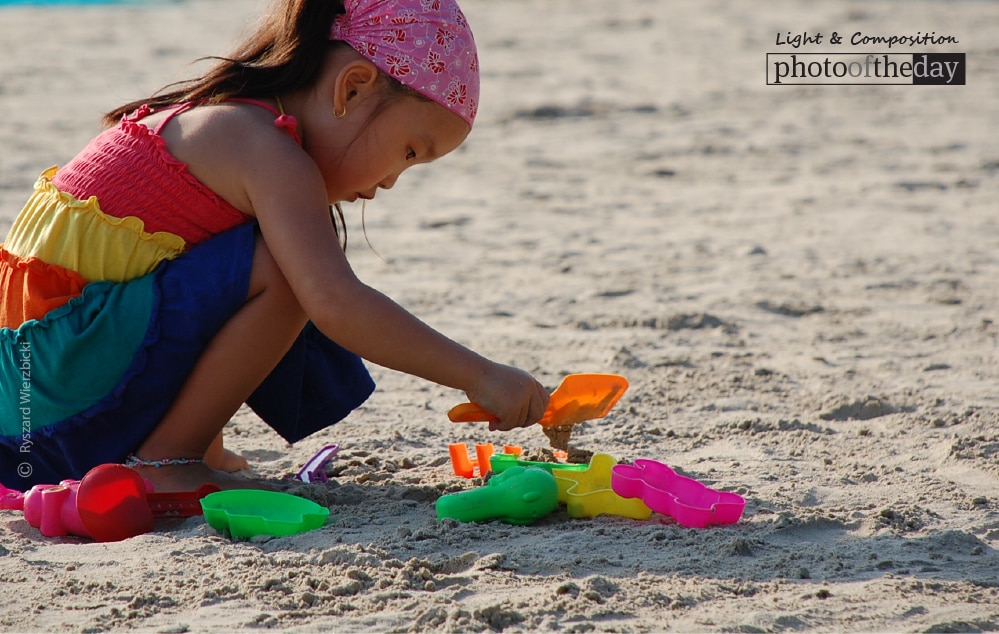
Exposure 1/250sec @ f/5.3 | ISO 450 | Focal Length 160mm
Ryszard Wierzbicki
Born in 1963, Ryszard Wierzbicki is a Polish-born photographer and educator currently based in Swindon, United Kingdom. After a diverse career spanning social sciences, marketing, and child care, he transitioned into a life of travel, scuba diving, and photography following his move to the UK in 2006. His work is deeply influenced by his extensive explorations of South-East Asia and his commitment to charitable causes, such as supporting orphans in Thailand and Burma. Through his photography forums, he shares his passion for documenting the world with a focus on authentic human experiences.
Resonance Score Breakdown
Transparency Note: The resonance score (11.6/20) is calculated based on social engagement metrics collected before the award announcement.
Expert Photography Reviews · 7
The Weight of Sand
There is a particular kind of wisdom found in the hands of a child at play. When we are young, the world is not something to be conquered or understood; it is something to be touched, sifted, and felt.
Read the reflection →The Grit of Childhood
The smell of salt always brings back the feeling of wet sand between my toes—that cool, heavy grit that clings to the skin long after you have left the shore. It is a stubborn texture, a reminder that the earth is constantly trying to claim us, grain by grain.
Read the reflection →Reviews & Comments
Share your thoughts about this award-winning photograph. Your reviews contribute to the community engagement score.
Before the eye identifies the child, a sudden stillness settles in the chest. It’s the weight of the sand, the way her small hands press into the grain, that triggers a phantom memory of my own childhood heat. I’ve returned to this frame three times today, and each time, the blurred Andaman blue feels more like a quiet room. It doesn’t just capture innocence; it demands I remember how it felt to be entirely unobserved.
We look at this girl on Kata Beach and we aren’t just seeing sand; we’re seeing the quiet rhythm of a childhood afternoon. Ryszard didn’t rush the frame. He waited, listening to the tide until the world blurred into a soft, blue hum behind her. It’s a gentle, honest stillness. I’ve found myself lingering on her hands, lost in the grains. It’s a photograph that asks to be returned to, again and again.
At 160mm, the focal plane is razor-thin, isolating the child from the Andaman’s chaotic bokeh. The Nikon’s sensor struggles slightly with the high-contrast sand, yet the diffraction limit remains well-managed. I’m genuinely moved by how the lens resolves those tiny, crystalline grains against her skin; it’s a tactile intimacy the naked eye simply misses. It’s not just a candid shot; it’s a precise optical capture of a fleeting, sun-drenched human frequency. I love that.
Sunlight here is a shallow lie. Ryszard’s lens isolates the girl, yet it’s the encroaching blur of the Andaman that haunts me. She plays in the sand, oblivious to the void creeping into the frame’s periphery. It’s a fragile, desperate serenity. I find myself shivering; the light doesn’t reveal her, it merely exposes her vulnerability to the coming tide. We aren’t watching innocence, but the precise moment before the darkness claims the play.
The beach acts as a vast, horizontal datum, yet here the architecture of the scene dissolves into bokeh. By compressing the space with a 160mm lens, Wierzbicki flattens the threshold between the child and the Andaman Sea. It’s a beautiful omission; he’s erased the built environment entirely to focus on the human scale. I’ve spent my career obsessing over solid and void, but looking at her, I’m struck by how quiet the world feels without walls.
A 160mm lens from a distance is a convenient way to avoid the sand, isn’t it? One suspects the photographer didn’t linger long enough to get his boots damp. It’s a pleasant enough snapshot, but it lacks the grit of a scene truly earned. I’ve spent hours waiting for a child to forget the camera exists; here, the distance feels like a barrier rather than a choice. It’s pretty, but it didn’t cost him much.
Sand. Skin. The blur of the Andaman. Wierzbicki pulls the girl from the noise of the beach. It’s a quiet isolation. I find myself holding my breath, waiting for the tide to pull back. The frame doesn’t crowd her. It lets her exist in the pause. Nothing here is accidental. The empty corner is not empty. It’s the weight of the sea, pressing against the smallness of a child. I’ve never felt such stillness.