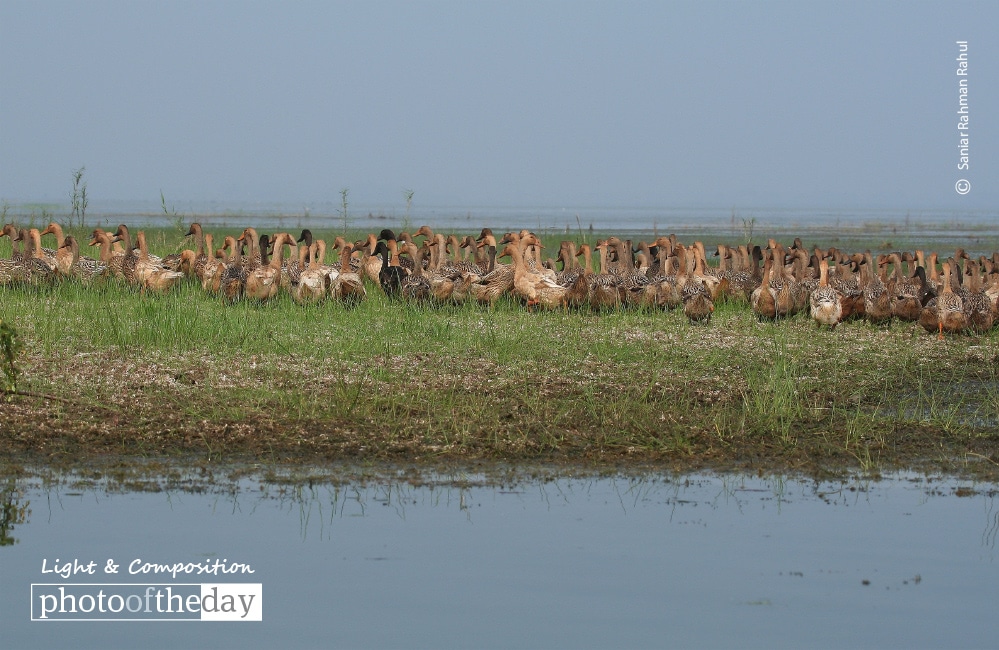
Domestic Ducks by Saniar Rahman Rahul
Captured within the remote and expansive Tanguar Haor wetland, this image documents the rhythmic movement of domestic ducks across the newly emerged winter landscape. The photographer journeyed eight hours by boat to reach this unique ecosystem, timing the visit to coincide with the peak season for migratory bird activity. The resulting composition highlights the vibrant, chaotic energy of the flock against the vast, serene backdrop of the haor. This photograph is award-worthy for its ability to transform a simple rural scene into a compelling narrative of life in one of Bangladesh’s most significant ecological sanctuaries, showcasing a keen eye for wildlife behavior and environmental storytelling.
Saniar Rahman Rahul
Based in Dhaka, Bangladesh, Saniar Rahman Rahul is an accomplished Art Director at Grey Worldwide with a career spanning decades in graphic design and advertising. His photographic journey began in childhood, inspired by his father’s work, and was later rekindled in 1997 as he integrated his professional design expertise with a passion for the lens. A decorated photographer, Rahul was the inaugural winner of the Photo of the Month Award in June 2010. His work reflects a deep-seated commitment to visual storytelling, shaped by his extensive background in the printing and advertising industries.
Resonance Score Breakdown
Transparency Note: The resonance score (11.4/20) is calculated based on social engagement metrics collected before the award announcement.
Expert Photography Reviews · 4
The Weight of Migration
I keep a small, tarnished brass key in a velvet pouch, though I have long since forgotten which door it once opened. It feels heavy in the palm, a cold anchor to a room that no longer exists, a threshold I can no longer cross.
Read the reflection →The Weight of the Flock
There is a quiet physics to the way a group moves across a surface. When we watch a gathering of creatures, we often mistake their collective motion for a single, unified intent, as if they are tethered by an invisible string.
Read the reflection →Reviews & Comments
Share your thoughts about this award-winning photograph. Your reviews contribute to the community engagement score.
Before the eye identifies the ducks, a sudden stillness settles in the chest. The vast, empty horizon of the haor pulls at my own sense of isolation, making the flock’s chaotic, rhythmic movement feel like a frantic heartbeat against the silence. It’s a strange, quiet ache. When I return to this, I’m no longer looking at birds; I’m feeling the cold, damp weight of that water, a memory of a place I’ve never actually been.
The horizon line bisects the frame with clinical indifference. It’s a rigid anchor for the chaotic distribution of the ducks. The negative space above the flock provides a necessary, cooling silence against the frantic, staccato rhythm of the birds below. I’m genuinely irritated by the lack of tighter geometry in the lower quadrant, yet the spatial tension holds. It’s a precarious balance. The frame doesn’t collapse, but it’s certainly straining under the weight.
The vastness of Tanguar Haor swallows these ducks, reducing them to mere punctuation in a landscape defined by human absence. Why does the photographer prioritize this serene, empty aesthetic over the actual labor of the farmers who own these birds? It’s a beautiful frame, sure, but I feel a sharp pang of irritation at how the rural reality is scrubbed clean for our consumption. Whose ecosystem are we really looking at here, and why does it feel so lonely?
f/5.6 at 1/1000s, ISO 200, 200mm. A tight shutter speed for a chaotic flock. It’s a calculated choice to freeze the motion, yet the depth of field is too thin for the subject’s spread. I’ve spent hours in similar wetlands; the focus fall-off here feels sloppy, not intentional. It’s technically competent, but the lack of sharpness on the trailing ducks irritates me. You’ve captured the movement, but you’ve missed the necessary precision.