Phylliidae by Saniar Rahman Rahul
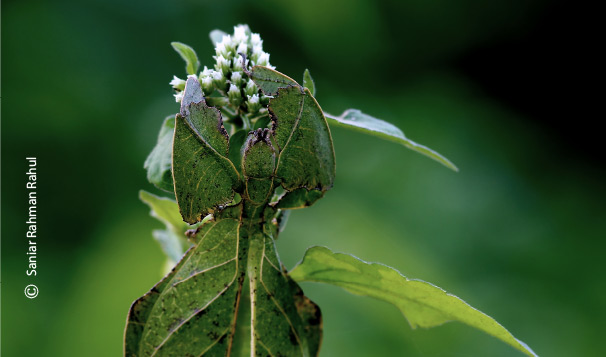
Captured within the lush depths of Satchari National Park, this photograph showcases the extraordinary Phylliidae, widely celebrated as the world’s most convincing leaf mimic. The photographer masterfully highlights the insect’s intricate camouflage, where every vein and texture perfectly mirrors the foliage it inhabits. By isolating the subject against a soft, natural backdrop, the image emphasizes the delicate balance between survival and artistry in the wild. This shot is award-worthy for its precise focus and the photographer's keen eye for spotting such a subtle, elusive marvel of nature, turning a fleeting encounter into a compelling study of evolutionary adaptation.
Saniar Rahman Rahul
Based in Dhaka, Bangladesh, Saniar Rahman Rahul is a seasoned creative professional who balances a distinguished career in advertising with a deep passion for photography. His early fascination with the craft began in childhood, eventually leading him to rediscover photography as a vital artistic outlet in 1997. Currently serving as an Art Director at Grey Worldwide, Rahul brings a sophisticated design sensibility to his wildlife photography, consistently capturing the natural world with the same precision and narrative depth that define his professional work in the global advertising industry.
Resonance Score Breakdown
Transparency Note: The resonance score (12.3/20) is calculated based on social engagement metrics collected before the award announcement.
Expert Photography Reviews · 5
The Art of Disappearing
To be seen is a burden. We spend our lives carving out spaces, marking the earth with our presence, shouting into the silence to prove we exist. But there is a quiet dignity in the act of vanishing.
Read the reflection →The Art of Vanishing
There is a quiet violence in the way a thing disappears into its own surroundings. It is not a death, but a surrender—a deliberate choice to become indistinguishable from the world that holds you.
Read the reflection →Reviews & Comments
Share your thoughts about this award-winning photograph. Your reviews contribute to the community engagement score.
Most nature photography is just a catalog of species, but this Phylliidae study actually stops time. I’ve seen thousands of macro shots where the subject gets lost in the clutter, yet here, the depth of field is surgical. It’s the way the insect’s jagged, necrotic edges mimic the leaf’s decay that gets me—it’s haunting. In thirty years, we’ll still be looking at this to understand how life hides in plain sight. It’s simply brilliant.
The Phylliidae’s mimicry is technically sharp, but I’m left cold by the clinical isolation. Why strip this creature from its ecosystem to satisfy our human desire for a clean specimen? It’s a beautiful lie. Does the insect exist for its own survival, or merely to be curated for our gaze? I find myself wanting to see the chaos of the forest, not just this staged perfection. Who are we to frame nature so neatly?
The verdant, mossy chartreuse of this Phylliidae’s carapace, echoing the muted, bruised lime of the surrounding leaf, creates a chromatic tension that’s frankly intoxicating. It’s as if Morandi had painted a forest floor, layering these dusty, vegetal greens until they’ve dissolved into a singular, living breath. I’m utterly breathless at how the insect’s veins mimic the foliage’s own decay; it’s a quiet, exquisite surrender to the light that makes one’s heart ache with pure, unadulterated wonder.
Nature’s mimicry isn’t just survival; it’s a terrifying erasure of the self. Rahul’s Phylliidae dissolves into the leaf, yet I’m unsettled by how the shadows refuse to define the creature’s edges. It’s a haunting absence of form. When I look at those veins, I don’t see biology—I see the void swallowing the subject whole. It’s beautiful, sure, but it’s a cold, suffocating beauty that makes me want to look away from the dark.
The Phylliidae’s body creates a perfect diagonal vector, bisecting the frame at a precise 35-degree angle. By aligning the insect’s primary vein with the leaf’s structural ribs, Rahul solves a complex spatial equation of mimicry. The negative space in the upper quadrant provides the necessary tension to anchor the subject. It’s a brilliant exercise in geometric integration. I’m genuinely breathless at how the insect’s serrated edges perfectly echo the foliage’s own mathematical rhythm. It’s pure, calculated elegance.