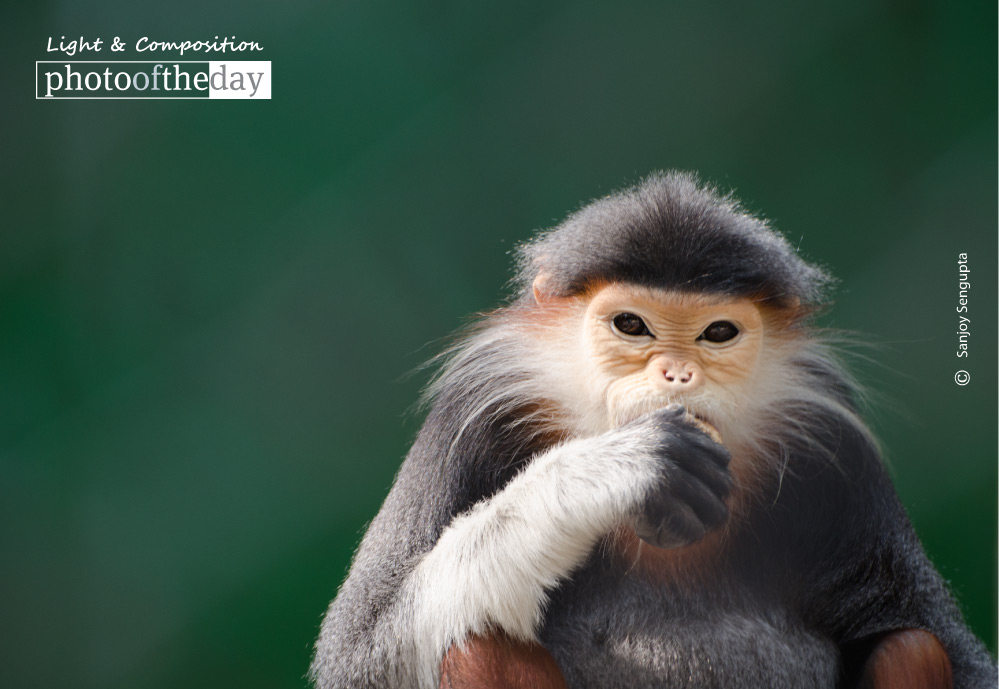
Breakfast Time by Sanjoy Sengupta
Captured during a visit to Safari World in Bangkok, this photograph highlights a quiet, intimate moment of a wild animal enjoying its morning meal. The photographer expertly utilized the soft, early morning sunlight to create a striking rim light effect, which beautifully illuminates the subject's glossy fur and adds depth to the composition. This image is award-worthy for its masterful use of natural light and the photographer's keen ability to transform a fleeting, everyday wildlife interaction into a compelling, high-contrast portrait that emphasizes texture and form.
Sanjoy Sengupta
Based in Muscat, Oman, Sanjoy Sengupta has cultivated a lifelong passion for photography that evolved from early experiments with film cameras in the 1980s to the sophisticated use of modern digital DSLRs. His journey reflects a dedicated pursuit of capturing life's most cherished moments through a lens. Today, he is recognized for his commitment to technical growth and his ability to document the natural world with a keen eye for light and detail, consistently striving to elevate his craft within the international photography community.
Resonance Score Breakdown
Transparency Note: The resonance score (12.5/20) is calculated based on social engagement metrics collected before the award announcement.
Expert Photography Reviews · 6
The Quiet Ritual of Being
Morning is a slow language, spoken in the soft friction of light against the skin of the world. We often mistake hunger for a frantic thing, a sharp edge that demands to be dulled, yet there is a sacredness in the way a creature pauses to receive its sustenance.
Read the reflection →The Quiet Ritual of Being
I keep a small, silver thimble in my desk drawer, worn smooth by my grandmother’s thumb. It is a hollow thing, yet it feels heavy with the weight of thousands of stitches, each one a quiet act of maintenance against the fraying edges of the world.
Read the reflection →Reviews & Comments
Share your thoughts about this award-winning photograph. Your reviews contribute to the community engagement score.
Most wildlife shots from Safari World feel like postcards, but this one avoids the trap. The rim light catching the fur isn’t just technical flair; it defines the creature’s presence against the shadows. I’ve seen thousands of animal portraits, yet I keep coming back to the texture of that morning meal. It’s intimate, almost startlingly quiet. Thirty years from now, we won’t remember the zoo, but we’ll still feel the warmth of that light.
f/5.6 at 300mm, 1/500s, ISO 400. A predictable choice for wildlife, yet it holds. The shutter speed barely freezes the movement, but the rim light justifies the risk. It’s a sharp calculation. I’ve seen enough soft, backlit fur to last a lifetime, but this texture actually bites. The depth of field is thin enough to isolate the subject from the cage’s geometry. It’s technically sound. I’m genuinely impressed the focus didn’t drift.
The composition relies on a sharp diagonal vector, slicing the frame from the upper-left to the lower-right. Sengupta’s subject occupies the negative quadrant, creating a perfect 1:2 ratio of mass against the blurred background. I’m genuinely struck by how the rim light defines the animal’s silhouette, turning fur into a series of precise, repeating arcs. It’s a beautifully solved spatial equation; the geometry doesn’t just hold the subject—it gives the entire frame its necessary, rhythmic tension.
The light hits that fur like a golden spotlight on a stage. It’s a tight, rhythmic close-up that stops time dead. I’ve seen a thousand wildlife shots, but this one feels like the opening sequence of a nature documentary that refuses to cut away. The rim light creates a gorgeous, tactile depth. Honestly, it makes me want to reach out and touch the texture. It’s a perfect, held frame. The editor would never touch this.
The rim light catches the fur, but it can’t hide the cage. We’re looking at a captive animal in Safari World, yet the framing pretends it’s a wild encounter. Why do we crave this sanitized proximity? It makes me feel deeply uncomfortable, honestly. Does the photographer ignore the enclosure to protect the fantasy, or is the reality just too inconvenient for the composition? We’ve traded authenticity for a glossy portrait of a prisoner.
Morning light catches the fur, turning a simple meal into a sacred ritual. We look at this creature and we don’t see a specimen, but a soul caught in a quiet, private rhythm. I’m struck by the way the rim light carves out its presence, making the animal feel grounded, almost regal. It’s a portrait that asks us to slow down. I find myself lingering here, feeling the warmth of that Bangkok sun on my own skin.