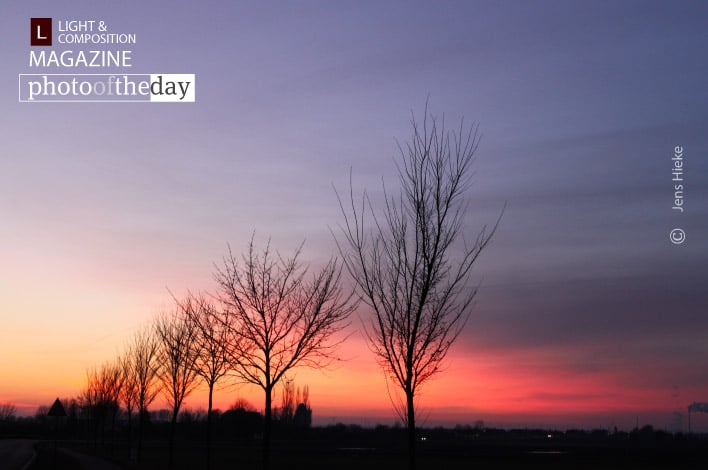
Evening Sky by Jens Hieke
Captured on a quiet side-road near Merseburg, this evocative landscape highlights the striking contrast between ancient cultural heritage and the imposing presence of modern industry. As the evening sky casts a dramatic glow over the horizon, these disparate elements momentarily merge into a singular, harmonious vision. The photographer’s keen eye for this juxtaposition transforms a local industrial scene into a poignant commentary on the changing face of the German landscape. This image is award-worthy for its masterful balance of light and composition, capturing a fleeting moment where history and modernity coexist under the vast, atmospheric sky.
Jens Hieke
Born in 1967, Jens Hieke is a photographer based in Leipzig, Saxony, Germany. A former librarian and media professional, he transitioned from a career in literature to the visual arts, finding in photography a profound medium to document the transient beauty of the world. His work often explores the intersection of human environments and natural light, reflecting a deep curiosity for the diverse subjects he encounters. Hieke continues to refine his craft, utilizing his technical background to capture the subtle narratives hidden within everyday landscapes.
Resonance Score Breakdown
Transparency Note: The resonance score (11.4/20) is calculated based on social engagement metrics collected before the award announcement.
Expert Photography Reviews · 6
The Weight of the Horizon
I keep a small, rusted iron key in a velvet-lined box, though I have long since forgotten which door it once opened. It is heavy for its size, cold to the touch, and carries the faint, metallic scent of a house that no longer stands.
Read the reflection →The Architecture of Exhaustion
We often mistake the skyline for a neutral backdrop, a mere canvas for the setting sun. But the horizon is never neutral; it is a ledger of our priorities. When we look at the silhouette of a city, we are reading a history of extraction and utility.
Read the reflection →Reviews & Comments
Share your thoughts about this award-winning photograph. Your reviews contribute to the community engagement score.
Merseburg’s industrial skyline isn’t exactly a postcard, but Hieke’s managed to find a moment where the smog and the sunset stop fighting. It’s a decent effort, though I wonder if he spent more than an hour waiting for that light. I’ve spent entire weeks shivering in similar fields for less. It’s a competent shot, certainly, but it lacks the grit of a truly earned landscape. It’s pleasant, but it didn’t cost him enough.
At f/5, the 41mm focal plane captures the Merseburg horizon with a crispness that defies the sensor’s age. I’m genuinely moved by how the diffraction of light across the industrial silhouettes creates such clean, sharp edges against the atmospheric haze. It’s a rare moment where the lens’s resolution perfectly aligns with the sky’s subtle gradients. You don’t often see this level of optical clarity from a 500D; it’s a beautiful, precise marriage of hardware and light.
The horizon line bisects the frame with clinical indifference. It’s a rigid anchor, yet the industrial silhouettes lack the necessary weight to balance the sky’s diffuse luminosity. The composition doesn’t quite resolve; the negative space feels hollow rather than intentional. I’ve stared at this for an hour, and it’s frustratingly static. The architecture of the scene fails to hold the eye. It’s a missed opportunity for structural cohesion. The frame simply doesn’t command the space.
We look at the Merseburg horizon and we don’t just see industry; we see a conversation between the old world and the new. Jens Hieke listened to the silence of that side-road before he ever clicked the shutter. The sky’s glow feels like a heavy, velvet blanket draped over the machinery. It’s haunting, really. I find myself shivering, wondering what stories those cooling towers have kept to themselves while the sun slipped away.
The light here doesn’t demand attention; it hums with a quiet, industrial grace. Jens waited until the sun dipped low, turning the Merseburg horizon into a bruised, violet prayer. I feel a strange, heavy ache in my chest looking at those cooling silhouettes against the sky. It’s a rare stillness, isn’t it? He stood there as the day exhaled, listening to the land reconcile its ancient roots with the steel giants looming in the fading glow.
Before the eye identifies the industrial silhouettes, something in the chest tightens. It’s the weight of that Merseburg horizon, a heavy, bruised violet that pulls the breath from my lungs. I’ve returned to this sky three times today, and each time, the silence feels more absolute. It doesn’t just document a landscape; it triggers a profound, lonely recognition of our own fleeting permanence. It’s the kind of quiet that follows you into sleep.