The Common Kestrel by Saniar Rahman Rahul
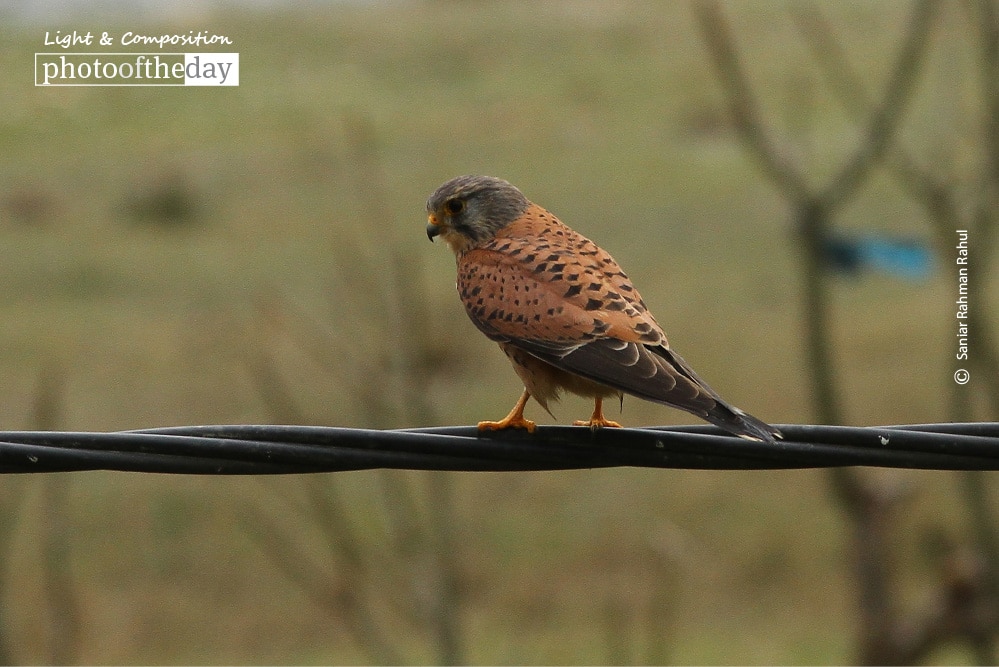
Captured in the serene landscapes of Punakha, Bhutan, this striking portrait of a common kestrel highlights the intricate details of the falcon’s plumage. The photographer masterfully documents the bird's light chestnut brown feathers, punctuated by distinct blackish spots and the vivid yellow of its cere and feet. By isolating the subject against the natural backdrop, the image emphasizes the kestrel’s sharp, predatory gaze and elegant form. This photograph is award-worthy for its technical precision and the photographer's ability to capture the quiet, wild essence of the falcon, transforming a fleeting wildlife encounter into a timeless study of avian beauty.
Saniar Rahman Rahul
Based in Dhaka, Bangladesh, Saniar Rahman Rahul is a seasoned Art Director at Grey Worldwide with a deep-rooted passion for visual storytelling. His journey into photography began in childhood, inspired by his father, before he refined his creative eye through a distinguished career in graphic design and advertising. Rahul’s work reflects a sophisticated blend of technical discipline and artistic intuition, earning him international recognition, including early accolades such as the Photo of the Month Award in 2010. His portfolio demonstrates a consistent commitment to capturing the natural world with clarity and purpose.
Resonance Score Breakdown
Transparency Note: The resonance score (11.0/20) is calculated based on social engagement metrics collected before the award announcement.
Expert Photography Reviews · 8
The Weight of a Gaze
I keep a small, tarnished brass key in a velvet-lined box, though I have long since forgotten which door it once opened. It is heavy for its size, cold to the touch, and carries the faint, metallic scent of a time when my house was full of people who are no longer here.
Read the reflection →The Weight of a Gaze
I spent twenty minutes this morning trying to find my keys, only to realize they were in my hand the entire time. It happens more than I care to admit.
Read the reflection →Reviews & Comments
Share your thoughts about this award-winning photograph. Your reviews contribute to the community engagement score.
It’s a clinical dissection of a predator, yet it’s the lack of encroaching darkness that troubles me. The kestrel’s gaze is sharp, but it’s trapped in an unrelenting, flat clarity. I’ve always felt that nature demands a bit of mystery to truly exist. Without the weight of shadow to anchor those yellow talons, the bird feels untethered, almost fragile. It’s technically precise, sure, but it doesn’t let the silence of the Bhutanese valley breathe.
The focal plane sits perfectly across the kestrel’s nictitating membrane, resolving the keratin structure of the cere with clinical sharpness. At this aperture, the bokeh renders the Punakha foliage into a soft, chromatic blur, isolating the bird’s predatory intensity. I’m genuinely breathless at how the sensor captured those minute, light-scattering barbs on the chestnut feathers. It’s a rare moment where the lens’s resolution doesn’t just meet the subject; it reveals the wild, hidden physics of flight.
Punakha’s landscape vanishes here, reduced to a blurred backdrop for a predator. Why does the kestrel’s gaze feel so transactional? Rahul isolates the bird, stripping away the context of its habitat to serve our aesthetic hunger. I find myself unsettled by this clinical detachment. Is this nature, or is it a trophy? When we frame wildlife as a static object of beauty, what are we actually choosing to ignore about the wild itself?
The kestrel holds the frame like a lead actor waiting for the director’s cue. It’s a tight close-up, the focus razor-sharp on that predatory, yellow-rimmed gaze. I’ve seen a thousand birds, but this one feels like a freeze-frame from a thriller. The background blurs into a soft, cinematic bokeh, isolating the plumage’s rhythm. It’s a perfect cut. I’m genuinely unsettled by how long it stares back. The shutter didn’t just catch a bird; it stopped time.
In Punakha, architecture is defined by the heavy, protective mass of the dzong, yet here, the kestrel becomes the structure. Its plumage mimics the textured stone and timber fenestration of the valley. I’m struck by how the bird’s sharp, predatory gaze acts as a living datum, anchoring the frame. It’s a fleeting, wild geometry. I’d argue that by isolating the subject, we lose the threshold between the creature and the built environment it inhabits.
The kestrel’s plumage, a dusty ochre reminiscent of a Morandi still life, vibrates against the muted, atmospheric grey of the Punakha air. It’s the piercing, electric yellow of the cere that truly undoes one; it’s a sudden, sharp dissonance that cuts through the bird’s earthy camouflage like a flash of Vermeer’s lapis lazuli. I’ve found myself quite breathless, watching how the light clings to those feathers, turning a simple predator into a living, golden-hued poem.
We look at this kestrel and we aren’t just seeing a bird; we’re meeting a sentinel of the Punakha valley. Rahul didn’t just snap a shutter; he waited for the silence to settle between them. Those piercing eyes hold a wild, ancient patience that makes me feel like an intruder in a private conversation. It’s a portrait of a spirit, not just feathers. I’ve found myself returning to that gaze, wondering what secrets it’s keeping.
f/5.6 at 400mm, 1/1000s, ISO 400. A calculated choice. The shutter speed freezes the kestrel’s movement, but the depth of field is razor-thin. It’s technically sound, though the background bokeh feels a bit clinical. I’ve seen enough wildlife shots to know when a sensor is pushed just right. The focus on the cere is sharp, precise, and correct. It doesn’t evoke emotion, but it’s a damn fine piece of engineering. I respect the discipline.