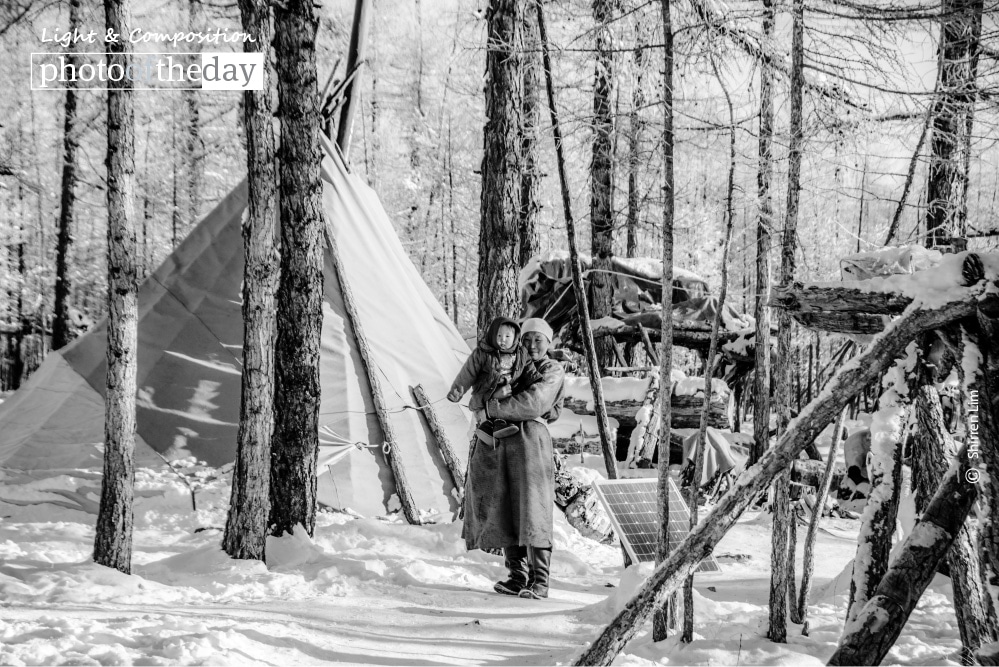
Tsaatan Nomad Village by Shirren Lim
After a grueling two-day journey into the remote East Taiga region of Mongolia, the photographer encountered a Tsaatan woman cradling her infant. The fleeting nature of the encounter required immediate action, capturing the pair in a brief, authentic moment before they retreated to their hut. The image is award-worthy for its raw, unposed intimacy and the profound connection established between the subject and the viewer. By documenting the quiet dignity of the Tsaatan people, the photographer successfully translates the harsh, isolated beauty of the Mongolian wilderness into a poignant portrait of human resilience and maternal tenderness.
Shirren Lim
Born in Penang Island, Malaysia, in 1970, Shirren Lim is a Jakarta-based photographer who discovered her true passion for the craft in 2009. She specializes in portraiture, driven by a desire to capture the sincere and telling expressions of humanity. Influenced by the iconic work of Steve McCurry, Lim’s photography is characterized by an intense, earthy aesthetic and a minimalist composition that cuts directly to the heart of her subjects. Her evocative work has been featured in various international web and printed publications.
Resonance Score Breakdown
Transparency Note: The resonance score (10.9/20) is calculated based on social engagement metrics collected before the award announcement.
Expert Photography Reviews · 6
The Weight of the Hearth
In the high, thin air of the world, where the wind carries the scent of pine and ancient ice, we often mistake survival for a cold, mechanical act.
Read the reflection →The Weight of the Unspoken
Can we ever truly know the weight of a life lived in the silence of the wild? We often measure existence by the noise we make, the marks we leave upon the earth, and the structures we build to keep the elements at bay.
Read the reflection →Reviews & Comments
Share your thoughts about this award-winning photograph. Your reviews contribute to the community engagement score.
The horizon doesn’t end. It just fades into the gray of the Taiga. The woman holds the child, but the vast, cold air holds them both. I’ve stared at this for an hour. It’s the silence that catches my throat. The empty corner isn’t empty. It’s a weight. A pause. Nothing here is accidental. She doesn’t look at the lens. She looks into the distance. She knows the value of leaving things unsaid.
The Tsaatan mother’s gaze feels heavy, yet I can’t tell if she’s looking at her child or through the lens at a tourist. Is this intimacy, or is it an extraction of her isolation for our consumption? The composition is tight, but it leaves me wondering why the hut’s interior remains so obscured. It’s a beautiful frame, sure, but I feel a sharp pang of discomfort. Whose narrative are we actually framing here?
Two days of travel for a single shutter press is a modest down payment, yet the result isn’t entirely cheap. I’ve spent enough time in the biting cold to recognize that look in the mother’s eyes; it’s the gaze of someone who doesn’t suffer tourists gladly. Lim clearly earned this intimacy by simply being present when the wind died down. It’s a rare, quiet honesty. I find myself shivering just looking at it. Well done.
Most travel photography is just tourism disguised as art, but this isn’t. Of the thousands of portraits I’ve reviewed, few capture such raw, unvarnished survival. The way the mother’s weathered hands cradle that infant against the biting Mongolian cold—it actually makes my chest ache. It’s the lack of artifice that secures its legacy. In thirty years, we won’t care about the gear; we’ll care that she let us see the quiet, brutal dignity of her existence.
We look at this mother and child, and we feel the biting wind of the East Taiga. Shirren didn’t just snap a shutter; she waited for the silence between breaths. It’s a rare, fleeting intimacy that catches in my throat. We see the weight of the wilderness in her eyes, yet she holds her infant with such quiet, fierce grace. I’m moved by how they exist in this frame, entirely unburdened by our gaze. It’s hauntingly beautiful.
The frame’s geometry is precarious. The subject’s placement against the chaotic texture of the hut creates a jarring spatial tension that nearly collapses the picture plane. It’s a struggle between the figure’s mass and the encroaching background noise. I’ve found myself frustrated by the lack of a clear fulcrum, yet the alignment of the infant’s gaze provides just enough structural discipline to keep the composition from dissolving entirely. It’s a near miss, but it holds.