Abandoned House by Hugo Baptista
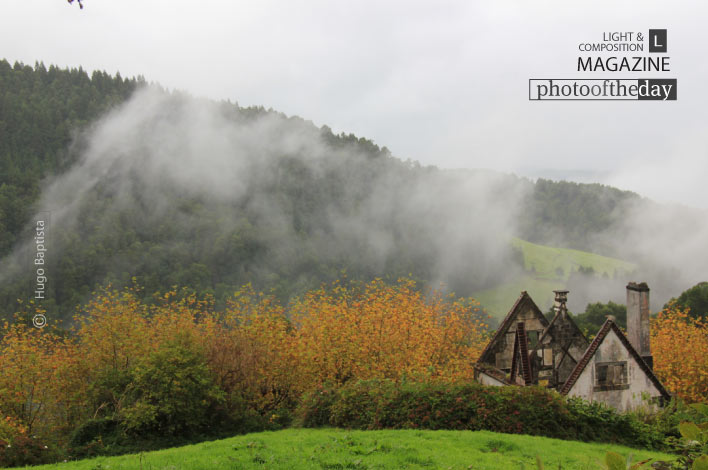
Captured during a journey across the island of São Miguel in the Azores, this photograph depicts an abandoned house set against a backdrop of volcanic activity. Despite the overwhelming scent of sulphur from nearby vents, the photographer was captivated by the scene, choosing to focus on the stark, weathered beauty of the structure. The image is award-worthy for its evocative composition and the way it balances the raw, natural intensity of the volcanic landscape with the quiet, decaying history of the architecture, transforming a challenging environment into a compelling visual narrative.
Hugo Baptista
Born in South Africa to Angolan parents and holding Portuguese nationality, Hugo Baptista is a versatile visual artist currently based in Voorburg, the Netherlands. As a freelance 3D animator, VFX artist, and photographer, he approaches his work as a pragmatic autodidact who constantly experiments across various media. His background in computer graphics informs his unique photographic style, where he treats every scene like a 3D canvas, applying his intricate professional understanding of light to create balanced, symmetrical, and thoughtful compositions.
Resonance Score Breakdown
Transparency Note: The resonance score (11.1/20) is calculated based on social engagement metrics collected before the award announcement.
Expert Photography Reviews · 3
The Quiet Left Behind
I walked past the old bookstore on the corner today and realized the windows were papered over. It had been there for years, a place where I once bought a worn copy of a book I still keep on my nightstand.
Read the reflection →The Architecture of Letting Go
There is a quiet dignity in the way things return to the earth. We build our walls to hold back the seasons, to claim a space as our own, yet time is a patient guest that eventually invites itself in.
Read the reflection →Reviews & Comments
Share your thoughts about this award-winning photograph. Your reviews contribute to the community engagement score.
The structure holds. The house anchors the frame, its verticality countering the volcanic horizon’s chaotic sprawl. It’s a rigid geometry against geological entropy. The negative space doesn’t merely exist; it exerts pressure, forcing the eye back to the decaying facade. I’ve rarely seen such precise spatial tension. It’s cold, it’s calculated, and it’s entirely necessary. The composition doesn’t ask for sympathy. It demands a rigorous accounting of every pixel within the frame. It’s a rare, disciplined success.
1/60sec at f/6.3, 35mm, ISO 100. A conservative choice for a static subject. The Sigma 18-250mm isn’t known for edge-to-edge sharpness, and f/6.3 doesn’t help it. It’s a safe, middle-of-the-road aperture that lacks the bite needed for decaying textures. I’ve spent too long looking at soft corners to find this compelling. It’s technically adequate, but it doesn’t push the glass. It’s frustratingly flat. The data suggests a photographer who didn’t want to risk a mistake.
At f/6.3, the Sigma’s focal plane renders the volcanic grit with surprising acuity. While the diffraction limit begins to soften the distant vents, the house’s weathered textures remain sharp enough to reveal the molecular decay of the stone. It’s a delicate optical balance. I’m genuinely moved by how the lens captures that harsh, sulfurous light; it’s as if the glass itself is breathing in the Azores’ raw, volatile atmosphere. It’s hauntingly precise.