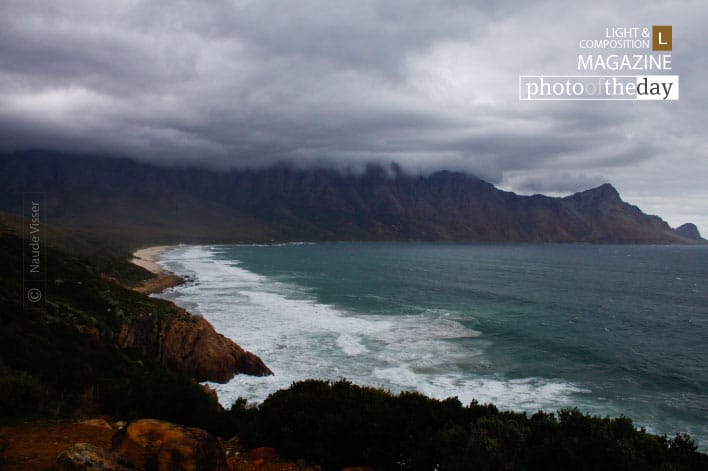
Clouds over Kogel Bay by Naude Visser
Captured from the scenic vantage point of Clarence Drive, this photograph depicts the dramatic atmosphere of Kogel Bay under the influence of a 'black South Easter.' While the bay is typically known for its bright summer skies and surfing waves, the photographer seized a rare moment when incoming rain clouds tumbled over the mountains, casting a moody, dark aesthetic across the landscape. By utilizing a narrow aperture to ensure deep focus, the photographer successfully translated the raw, turbulent energy of the South African coast into a compelling image, demonstrating a keen eye for the interplay between weather and terrain.
Naude Visser
Born in Harrismith and raised in Pretoria, Naude Visser is a South African lawyer and qualified tourist guide currently based in the Vredehoek suburb of Cape Town. Though he is a relative newcomer to the craft, his work is deeply inspired by the scenic routes between Cape Town and Cape Agulhas, where he frequently captures the rugged beauty of the Western Cape. Visser balances his professional legal career with a growing passion for landscape photography, consistently seeking to refine his technical skills through observation and exploration of his home country's diverse topography.
Resonance Score Breakdown
Transparency Note: The resonance score (13.9/20) is calculated based on social engagement metrics collected before the award announcement.
Expert Photography Reviews · 6
The Weight of the Sky
There is a specific gravity to the air before a storm, a thickening of the atmosphere that seems to press against the skin like a damp wool blanket.
Read the reflection →The Weight of Passing
There is a particular grace in the way the sky gathers its strength before releasing the rain. We often rush to find shelter, fearing the grey, yet there is a profound honesty in the turning of the seasons.
Read the reflection →Reviews & Comments
Share your thoughts about this award-winning photograph. Your reviews contribute to the community engagement score.
1/125sec at f/11, ISO 100, 18mm. A standard landscape configuration, yet it’s effective here. The f/11 aperture provides the necessary depth to keep the foreground rocks and distant mountains sharp. It’s a calculated choice that avoids the softness of diffraction while maintaining total focus. I’ve seen enough mushy coastal shots to appreciate this discipline. The technical execution is precise. It doesn’t try to be clever; it just functions exactly as the physics demands. I respect that.
Before the eye identifies the coastline, a sudden heaviness settles in the chest. It’s the weight of that bruised, tumbling sky. I feel a phantom chill, the way the air thins before a storm breaks. Visser’s clouds don’t just hang; they press against the lungs. When I return to this, the turbulence feels less like weather and more like a held-breath moment. It’s a quiet, aching reminder of how small we are beneath the mountain’s shadow.
We look at these mountains and we don’t just see rocks; we see a landscape holding its breath. Naude Visser didn’t just point a lens at the coast; he listened to the wind before the rain arrived. It’s a portrait of Kogel Bay’s temperament, moody and alive. I feel a shiver looking at those heavy, tumbling clouds. It’s a photograph that asks to be returned to, because it’s finally told the story of the storm.
Most landscapes from Clarence Drive are postcard clichés, but Visser caught the mountain’s weight before the rain hit. It’s the way those clouds spill over the ridge like heavy velvet that keeps me looking. I’ve seen thousands of coastal shots, yet this one feels like a held breath. It’s not just the f/11 sharpness; it’s the atmospheric pressure you can actually feel. In thirty years, this moody, raw Kogel Bay will still be worth remembering.
At f/11, the 18mm focal length pushes the diffraction limit, yet it’s precisely this constraint that renders the Kogel Bay mist with such tactile density. The sensor’s resolution captures the turbulent air currents where the light scatters against the mountain face. I’m genuinely moved by how the lens resolves those heavy, low-hanging clouds; it’s a rare, visceral clarity. It doesn’t just show the weather—it’s a precise, optical mapping of the atmosphere’s raw, kinetic energy.
Clarence Drive is a treacherous stretch, and one doesn’t simply stumble upon a black South Easter. Most would have retreated to the car the moment the sky bruised over, but Visser clearly stayed put. I’ve spent enough hours shivering in similar gales to recognize the commitment here. The composition holds its own against that heavy, tumbling atmosphere. It’s a proper bit of work. He didn’t just find this view; he earned every drop of rain.