Tomb of Hatshetput by Sanjoy Sengupta
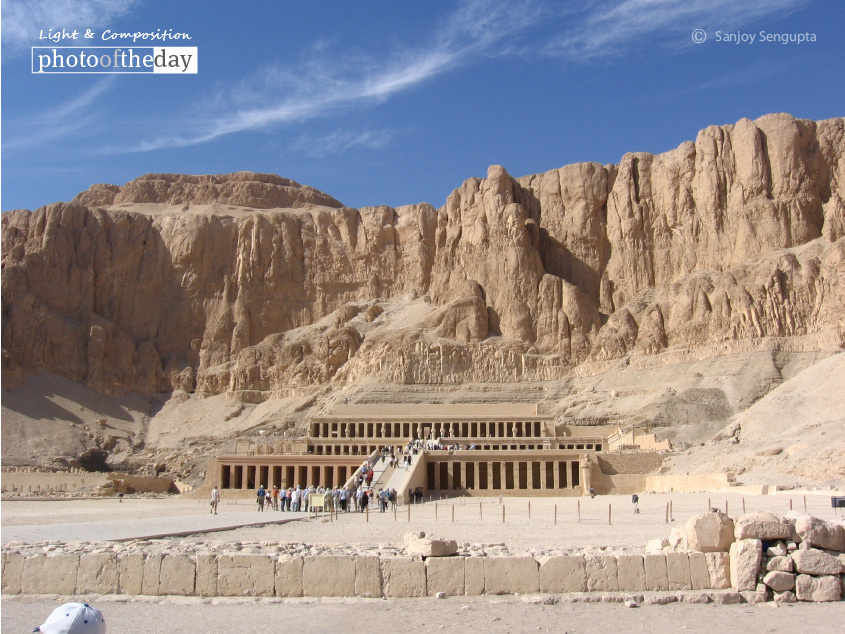
Captured during a journey through the historic Valley of the Kings, this photograph immortalizes the majestic Tomb of Hatshepsut. The photographer skillfully framed the ancient structure against the dramatic, arid landscape, utilizing the crisp daylight to highlight the architectural precision of the mortuary temple. This image is award-worthy for its ability to convey the sheer scale and timeless atmosphere of Deir el-Bahari, transforming a travel memory into a compelling architectural study. By balancing the stark textures of the limestone cliffs with the rhythmic geometry of the temple’s colonnades, the photographer invites viewers to experience the profound historical weight of this iconic Egyptian site.
Sanjoy Sengupta
Based in Muscat, Oman, Sanjoy Sengupta developed his photographic eye through a lifelong evolution of equipment, transitioning from early film cameras like the Nikon FM10 to modern digital systems. His work is defined by a deep-seated passion for capturing fleeting moments of life, a pursuit that has taken him across the globe to document diverse landscapes and cultures. Through years of dedicated practice and a commitment to mastering the technical nuances of his craft, Sengupta has refined a style that seeks to transform everyday observations into cherished, lasting memories.
Resonance Score Breakdown
Transparency Note: The resonance score (11.3/20) is calculated based on social engagement metrics collected before the award announcement.
Expert Photography Reviews · 8
The Architecture of Silence
We often mistake permanence for something solid, something that refuses to yield. We build our lives like stone monuments, stacking days upon days, hoping the weight of our efforts will anchor us against the erosion of time.
Read the reflection →The Weight of Stone
I remember sitting in a small cafe in Luxor, watching a man trace the lines of a postcard with his thumb. He told me he had spent his life working in construction, building glass towers that would likely be replaced in fifty years.
Read the reflection →Reviews & Comments
Share your thoughts about this award-winning photograph. Your reviews contribute to the community engagement score.
The horizontal strata of the limestone cliffs create a rigid 3:1 ratio against the temple’s rhythmic colonnades. It’s a masterclass in repetition; the vertical pillars act as vectors that anchor the frame’s chaotic negative space. I’m genuinely struck by how the shadows solve the equation of depth here. By aligning the terrace lines with the horizon, Sengupta turns ancient stone into a precise grid. It’s a satisfying, perfectly balanced spatial proof that I’ve rarely seen captured so cleanly.
The limestone cliffs here don’t just hold the temple; they breathe with it. Sanjoy stood in the harsh, unforgiving glare of the Egyptian noon, waiting for the shadows to find their rhythm against those colonnades. It’s a quiet, heavy stillness. I’ve felt that same dry heat on my own skin, that sense of being small before such ancient, stone-carved patience. He didn’t rush the light. He listened until the geometry finally settled into place.
Most architectural shots of Deir el-Bahari fall into the trap of postcard symmetry. What separates this from the thousands I’ve reviewed is how the limestone cliffs physically crush the colonnades, forcing a tension between nature and ego. It’s a brutal, honest look at power. I’ll admit, it makes me feel small, which is exactly what a thirty-year legacy requires. It doesn’t just document a tomb; it captures the terrifying weight of history pressing down on us.
We look at these limestone cliffs and we don’t just see stone; we see a queen’s ambition carved into the earth. Sanjoy didn’t just photograph a temple; he listened to the silence of the desert. It’s a portrait of a landscape that remembers its ruler. I feel a strange, heavy ache in my chest when I trace those colonnades. It’s a photograph that asks to be returned to, because it’s still telling its story.
Before the eye identifies the limestone, something in the chest tightens. It’s the sheer, crushing weight of those colonnades against the cliffside. I’ve looked at this for weeks, and each time, my breath hitches in that same rhythmic, hollow space. It doesn’t just show a tomb; it forces a confrontation with our own transience. When I close my eyes, the heat of that desert sun still pulses behind my lids. It’s hauntingly, perfectly still.
The limestone here doesn’t merely reflect light; it exhales a parched, bone-dry ochre that reminds me of Morandi’s dustiest palettes, vibrating against the sky’s relentless, pale cerulean. It’s a chromatic austerity that makes my own heart ache with the sheer, crushing weight of antiquity. One finds the shadows aren’t truly black, but rather a bruised, bruised violet, clinging to the colonnades like a secret, turning this architectural study into a profound, sun-drenched meditation on time itself.
The limestone cliff looms. It doesn’t crowd the temple; it breathes with it. I’ve spent minutes staring at that sliver of shadow between the columns. It’s quiet there. The scale is vast, yet the frame feels held. Nothing here is accidental. The empty corner is not empty. It’s a pause. I feel a sudden, sharp ache for that stillness. It’s rare to find a frame that knows when to stop. Sengupta let the desert speak.
A Canon Powershot A520 against the limestone of Deir el-Bahari? It’s a brave, if slightly stubborn, choice of kit. One suspects Sanjoy didn’t just wander by at noon for a quick snap. The shadows within those colonnades suggest he waited for the sun to bite deep into the rock. I’ve spent enough hours baking in that desert heat to respect the commitment here. It’s not perfect, but it’s certainly earned. He stayed until the light behaved.