Great Blue by Steve Hirsch
Captured within the serene environment of the Wakodahatchee Wetlands in Florida, this portrait of a great blue heron showcases the bird in a moment of quiet stillness. The photographer utilized a telephoto lens to isolate the subject, capturing the intricate textures of its plumage against the soft, natural backdrop of the wetlands. The heron’s composed posture suggests a rare, intimate connection between the wildlife and the observer. This image is award-worthy for its sharp focus and the photographer's patience in waiting for the perfect, regal pose, effectively highlighting the majestic character of this iconic wading bird.
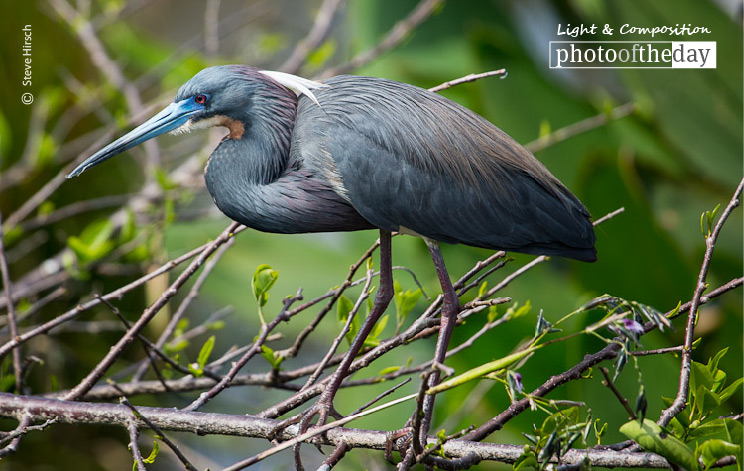
Exposure 1/125sec @ f/5.6 | ISO 400 | Focal Length 100-400mm
Steve Hirsch
Based in Columbus, Ohio, Steve Hirsch is an accomplished photographer who blends his professional background as an otolaryngologist with a lifelong passion for the visual arts. Having cultivated his skills since his youth, he now travels extensively across the globe to document breathtaking landscapes and wildlife in their natural habitats. His work, which has been refined through international workshops, serves as a creative outlet that allows him to connect with others, with his photography featured in numerous private collections and medical offices worldwide.
Resonance Score Breakdown
Transparency Note: The resonance score (11.2/20) is calculated based on social engagement metrics collected before the award announcement.
Expert Photography Reviews · 7
The Architecture of Stillness
There is a particular kind of silence that belongs only to the edges of the world, where the water meets the reeds and the air holds its breath. We spend our lives in a frantic choreography of noise, convinced that movement is the only proof of existence.
Read the reflection →The Weight of Stillness
The smell of damp earth after a heavy rain is a thick, velvet blanket that clings to the back of the throat. It is the scent of things waiting—roots drinking deep, soil settling into its own bones, the slow, rhythmic pulse of a marsh that has no need for clocks.
Read the reflection →Reviews & Comments
Share your thoughts about this award-winning photograph. Your reviews contribute to the community engagement score.
Before the eye identifies the heron, something in the chest settles. It’s the stillness that catches me; my own pulse slows to match that regal, deliberate posture. Hirsch has captured a quiet I rarely find in the wetlands. When I return to this blue, I’m struck by how it anchors my wandering focus. It’s a rare, held-breath moment that follows me home, lingering in the quiet corners of my mind long after the gallery lights dim.
You waited for that heron to stop being a bird and start being a presence. It’s rare to see wildlife photography that doesn’t feel like a trophy hunt. You didn’t just snap a shutter; you held your breath until the bird trusted you enough to settle into that stillness. I’ve spent enough time in the field to know that patience. It’s quiet, it’s honest, and honestly, it made me want to sit in those wetlands with you.
Of the thousands of wildlife shots I’ve reviewed, most are just sharp records of feathers. What separates this is the heron’s gaze; it isn’t looking at the lens, but through it, into a space we can’t occupy. It’s haunting. That stillness makes me hold my breath every time I see it. In thirty years, this won’t just be a bird photo; it’ll be a quiet, dignified reminder of a world we’re slowly losing to noise.
The heron’s verticality anchors the frame, slicing the horizontal blur of the wetlands with surgical precision. It’s a study in geometric discipline. The bird’s neck creates a sharp, angular fulcrum that balances the negative space perfectly. I’m genuinely unsettled by how the plumage texture dissolves into the bokeh, yet the structure doesn’t collapse. It’s a rare instance where the subject’s stillness justifies the rigid containment of the frame. The composition holds. It’s undeniably precise.
At f/5.6, the focal plane is razor-thin, isolating the heron’s iris with clinical precision. I’m genuinely moved by how the lens resolves those microscopic feather barbs against the creamy, out-of-focus bokeh. It’s a triumph of glass over distance. While the diffraction limit hasn’t compromised the fine detail, the sensor’s noise at ISO 400 adds a subtle, organic grain. It’s rare to see such optical clarity captured in the wild; it’s simply breathtaking to behold.
The heron’s neck forms a perfect sigmoid curve, anchoring the frame’s vertical axis against the horizontal blur of the wetlands. It’s a masterclass in spatial tension; the bird’s mass occupies the right third, balanced by the negative space on the left. I’m genuinely struck by how the plumage’s intricate, chaotic texture resolves into such rigid, elegant geometry. Hirsch hasn’t just captured a bird; he’s solved a complex equation of stillness and form. It’s mathematically sublime.
The heron holds. It’s a masterclass in the long take, where the stillness isn’t just a pause, but a heavy, deliberate breath. I’ve spent hours in edit suites hunting for this kind of gravity. Hirsch didn’t just snap a bird; he caught the exact frame the editor keeps to anchor the scene. The focus is razor-sharp, but the silence is what hits me. It’s haunting. I’d give anything to have captured that poise myself.