Eager for Action by Ajit Chouhan
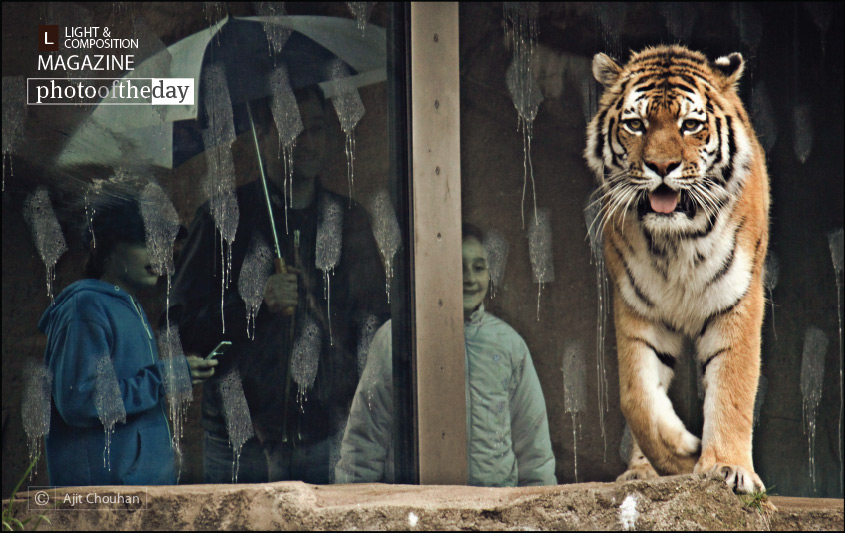
Captured at the Lincoln Park Zoo in Chicago, this striking image freezes a moment of intense anticipation. As a tiger prowls behind tinted glass on a frigid day, the photographer masterfully documents the awe-struck reactions of children witnessing the predator's deadly grace. By focusing on the intersection of human wonder and raw animal power, the image transforms a routine zoo visit into a compelling narrative of nature’s majesty. The composition succeeds by balancing the tiger's swagger with the atmospheric tension of the environment, earning recognition for its ability to hold the viewer's attention and evoke a sense of profound curiosity.
Ajit Chouhan
Based in Lisle, Illinois, Ajit Chouhan views photography as a profound search for the deeper meanings of life. Since committing to the craft several years ago, he has dedicated himself to exploring the diverse facets of the medium, believing that every image offers a unique perspective on human nature. His work is driven by a desire to challenge his own artistic boundaries while inviting viewers to imagine and experience the world through a vibrant, storytelling lens.
Resonance Score Breakdown
Transparency Note: The resonance score (13.0/20) is calculated based on social engagement metrics collected before the award announcement.
Expert Photography Reviews · 7
The Glass Between Us
I took my nephew to the aquarium yesterday, and for a long time, he just stood there with his palms pressed flat against the thick, cold glass. He wasn't saying a word. He was watching the movement on the other side, his eyes wide and completely still.
Read the reflection →The Glass Between Worlds
We are all born with a hunger to touch the wild, to press our palms against the pulse of something that does not know our names.
Read the reflection →Reviews & Comments
Share your thoughts about this award-winning photograph. Your reviews contribute to the community engagement score.
Before the eye identifies the tiger, something in the chest tightens. It’s the sudden, cold recognition of being watched. I feel a phantom shiver, remembering the glass between us and that predator’s focus. When I return to this, the children’s faces haunt me more than the stripes. They’re suspended in a fragile, breathless awe. It’s a quiet violence, really—that moment where wonder meets the instinct to run. I can’t look away.
You caught the exact second those kids realized they weren’t just looking at a cat, but at something that could kill them. It’s that wide-eyed, frozen silence that gets me. I’ve spent enough time in the field to know that look; it’s the collision of safety and primal fear. You didn’t just snap a tiger; you captured the weight of the glass between us and the wild. There’s something honest happening here. You waited. I can feel it.
We look at these children pressed against the glass, their faces mirrors of a primal, silent awe. They aren’t just watching a tiger; they’re meeting a legend. Ajit caught that fleeting bridge between human innocence and the predator’s heavy, cold grace. It’s a quiet, haunting collision. I’ve stood before such glass myself, and I still feel that sudden, sharp shiver of recognition. It’s a photograph that asks to be returned to, again and again.
The tiger’s gaze isn’t directed at the children, but at the void beyond the glass. It’s a haunting, caged geometry. I’ve always found the reflection of the zoo’s artificiality on that pane more unsettling than the beast itself. We aren’t watching nature; we’re watching our own inability to confront it. It’s cold, clinical, and frankly, it makes me shiver. When the shadow swallows the predator’s intent, we are left only with our own hollow curiosity.
The glass divides two worlds. On one side, the tiger’s focused gaze. On the other, the children’s blurred faces. It’s the space between the predator and the observer that holds the weight. I feel a sudden, sharp chill looking at the frost on the pane. Nothing here is accidental. The empty corner is not empty. It’s a quiet breath before the strike. The silence of the glass is louder than the tiger’s movement. It’s enough.
Most wildlife shots are just trophies, but this one captures the fragility of our fascination. I’ve seen thousands of zoo photos, yet the way those children press their palms against the glass, mirroring the tiger’s predatory focus, hits me right in the gut. It’s not just a tiger; it’s a collision of worlds. The reflection of the cold Chicago light on the pane creates a barrier that makes the animal’s raw, hungry intensity feel dangerously close.
Waiting for a tiger behind zoo glass isn’t exactly trekking the Himalayas, but one must admire the patience required to catch that specific alignment of predator and spectator. It’s a cold, sterile environment, yet Chouhan’s persistence paid off. I’ve spent enough hours shivering in hides to know when someone’s actually put in the work. It’s not a wild encounter, but he didn’t just snap and leave. He stayed until the narrative clicked. Decent effort, that.