Hide and Seek by Sanjoy Sengupta
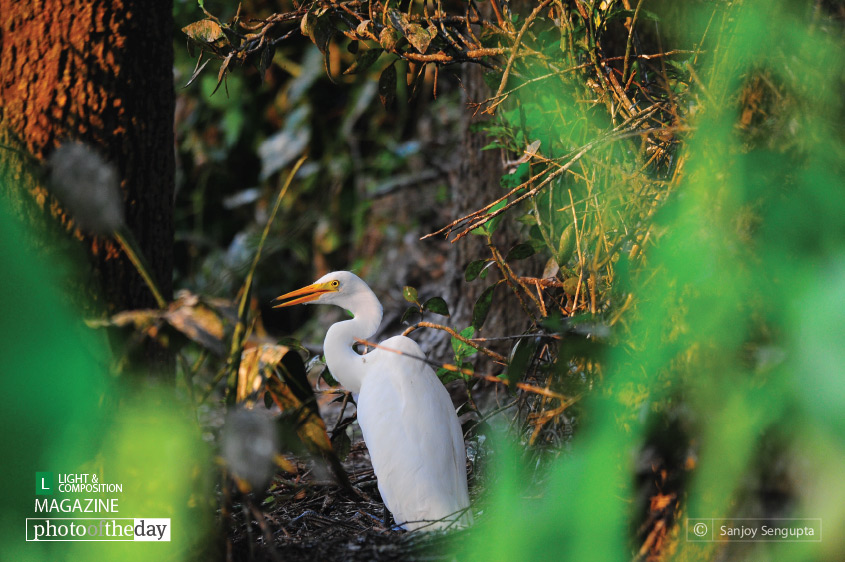
In the quiet corners of his village, Sanjoy Sengupta captured a fleeting moment of natural stillness as a white egret waited patiently for its prey behind a bush. The photograph highlights the delicate balance of wildlife, utilizing a long focal length to isolate the subject against the natural foliage. This image is award-worthy for its impeccable timing and the photographer's ability to remain unobtrusive, allowing the egret to reveal its natural hunting behavior. The composition emphasizes the bird's focused intent, turning a simple observation into a compelling study of patience and survival in the wild.
Sanjoy Sengupta
Currently based in Muscat, Oman, Sanjoy Sengupta has cultivated a lifelong passion for photography that evolved from early experiments with film in the 1990s to a sophisticated mastery of digital DSLR systems. His journey reflects a dedicated pursuit of capturing life's fleeting moments, transitioning from point-and-shoot cameras to professional Nikon equipment. Sengupta’s work is defined by his commitment to learning the technical nuances of his craft, allowing him to document the natural world and human experience with increasing precision and artistic depth.
Resonance Score Breakdown
Transparency Note: The resonance score (12.5/20) is calculated based on social engagement metrics collected before the award announcement.
Expert Photography Reviews · 7
The Art of Waiting
I remember sitting on a wooden bench in a park in Kyoto, watching an old man watch a koi pond. He didn't move for nearly an hour. When I finally asked him if he was waiting for something specific, he just smiled and pointed to the water.
Read the reflection →The Art of Becoming Invisible
There is a peculiar power in the act of disappearing. We spend our lives shouting to be seen, carving out spaces in the world to prove we exist, yet the most profound truths are often found by those who know how to dissolve into the background.
Read the reflection →Reviews & Comments
Share your thoughts about this award-winning photograph. Your reviews contribute to the community engagement score.
It’s easy to snap a bird in flight, but capturing this egret’s calculated stillness requires a different sort of commitment. One suspects Sengupta spent hours in the damp heat of Jhargram, becoming part of the scenery until the wildlife forgot he was there. I’ve spent enough mornings shivering in a blind to recognize that level of discipline. He didn’t just find this shot; he earned it by simply refusing to leave. A quiet, honest piece of work.
You waited. I can feel it in the way that egret holds its breath behind the leaves. It’s not just a bird; it’s a study in pure, quiet intent. I’ve spent enough time in the brush to know that stillness isn’t easy, but you found it. And honestly, it makes me miss the silence of the woods. You didn’t force the moment, you just let the hunter be. There’s something truly honest happening here.
Before the eye identifies the egret, something in the chest tightens. It’s the stillness of the hunt, that held-breath moment where the world narrows to a single, white point of intent. I find my own pulse slowing, mimicking the bird’s rigid patience behind the leaves. When I return to this, I’m struck by how it doesn’t just capture a bird; it captures the exact, quiet tension of waiting for life to reveal its next move.
We look at this egret and we aren’t just seeing a bird; we’re witnessing a silent, ancient conversation between predator and prey. Sanjoy waited, listening to the rhythm of the bush until the world held its breath. It’s a portrait of pure intent. I find myself leaning in, holding my own breath, afraid to break the spell. It’s a quiet, beautiful reminder that patience is the most essential tool in any storyteller’s kit. I’m truly moved.
Most wildlife shots are just trophies, but this one lingers. Of the thousands I’ve reviewed, it’s the egret’s obscured eye—peering through that chaotic tangle of twigs—that anchors the frame. It doesn’t just show a bird; it captures the agonizing, quiet tension of the hunt. I’ve spent decades looking for this kind of restraint. It’s rare to see a photographer let the foliage do the heavy lifting. Honestly, it makes me want to hold my breath.
The egret’s neck creates a sharp, vertical fulcrum against the chaotic texture of the foliage. It’s a rigid geometry that anchors the frame. The negative space doesn’t quite resolve, leaving the bird’s intent suspended in a messy, cluttered periphery. I’d prefer a tighter crop to force the tension, but the structural discipline holds. It’s a cold, calculated geometry. The weight of the bird is perfectly offset by the dense, dark brush. It’s technically sound, if slightly restless.
At 500mm, the Sigma’s focal plane is razor-thin, yet it’s captured the egret’s ocular reflection with startling clarity. The f/6.3 aperture creates a bokeh that doesn’t just blur the foliage; it renders the light as soft, atmospheric diffraction. I’m genuinely moved by how the lens resolves the bird’s plumage against that chaotic background. It’s a rare moment where the physics of glass perfectly aligns with the stillness of the hunt. It’s simply beautiful optics.