Approaching Hong Kong by Achintya Guchhait
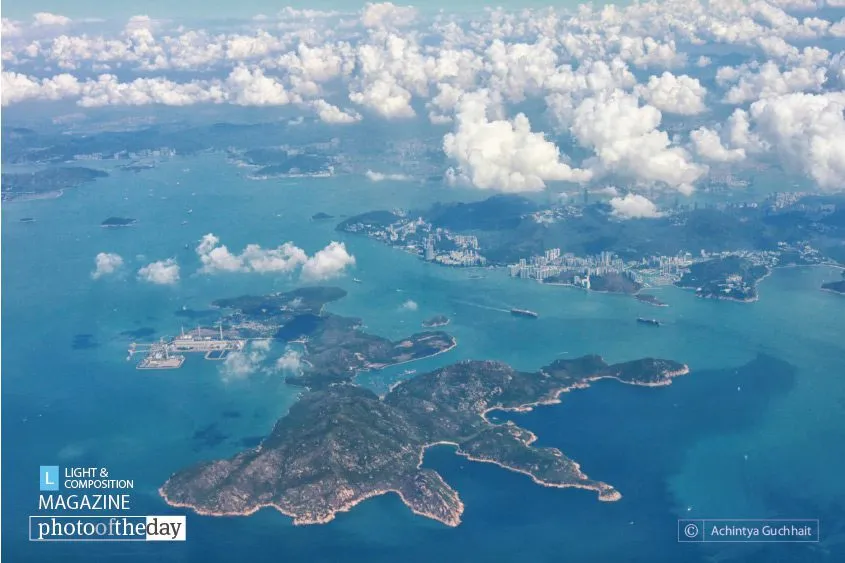
Captured from a bird's-eye perspective during a flight, this photograph offers a breathtaking aerial view of the Hong Kong islands. The image masterfully balances the vastness of the seascape with the intricate patterns of the coastline, showcasing the photographer's keen eye for composition and scale. By choosing a high-shutter speed to freeze the movement from the aircraft, the photographer ensures sharp clarity across the frame. This work is award-worthy for its ability to transform a common travel experience into a striking, artistic study of geography and light, highlighting the unique intersection of urban development and natural beauty.
Achintya Guchhait
Based in Bangalore, India, Achintya Kumar Guchhait is a dedicated photographer and tech professional who views the world through a lens of curiosity. His photographic journey began in his youth, evolving from casual snapshots to a serious pursuit of documenting life, human coexistence, and travel. As a Getty contributor and a perpetual student of the craft, he continuously refines his technical skills and expands his creative toolkit to capture the essence of the common and the extraordinary alike.
Resonance Score Breakdown
Transparency Note: The resonance score (12.8/20) is calculated based on social engagement metrics collected before the award announcement.
Expert Photography Reviews · 8
The View From Above
I spent this morning staring at a map on my phone, trying to figure out how to get to a new bakery across town. It felt like a chore, just a series of lines and turns to navigate.
Read the reflection →The Salt on the Skin
There is a specific, metallic tang that hangs in the air just before a storm rolls over the water. It tastes like ozone and wet stone, a sharp, electric prickle against the back of the throat.
Read the reflection →Reviews & Comments
Share your thoughts about this award-winning photograph. Your reviews contribute to the community engagement score.
At f/5.6, the 24mm glass avoids the diffraction limit, rendering the Hong Kong coastline with surgical, high-frequency precision. The 1/4000sec shutter speed effectively nullifies the aircraft’s vibration, locking the focal plane onto the urban sprawl. I’m genuinely moved by how the light scatters across the water’s surface; it’s a rare, crystalline clarity that our eyes simply can’t resolve at this altitude. It’s a cold, brilliant intersection of physics and geography that I’ve rarely seen captured so cleanly.
Aerial shots often feel like a lucky dip, don’t they? One snaps away from a window, hoping the haze doesn’t ruin the geometry. Guchhait’s frame is sharp enough, certainly, but it lacks the grit of a view earned on foot. I’ve spent enough hours shivering on ridgelines to know that distance usually breeds detachment. It’s a clean study of geography, but I’m left wondering if the photographer ever actually touched the ground he’s documenting.
We look down at Hong Kong and we don’t see a city; we see a map of human ambition. It’s a portrait of a collective soul, etched into the coastline. I’ve spent my life listening to faces, but here, the land itself tells the story. The sharp, blue water against the concrete grid feels lonely to me. It’s a photograph that asks to be returned to, because it’s really a portrait of us, from very far away.
Hong Kong isn’t a city here; it’s a jagged fracture in the sea. Guchhait’s lens catches the light clinging to the coastline, but it’s the deep, bruised water between the islands that haunts me. I find myself shivering at the sheer indifference of that dark expanse. It doesn’t invite us in. It’s a void that swallows the urban ambition whole. We aren’t looking at geography; we’re looking at the silence that waits when the lights finally fail.
From this height, the city’s frantic pulse dissolves into a quiet, geometric hum. I feel a strange, vertigo-induced peace looking at how the islands cradle the deep blue. He must have held his breath as the plane banked, waiting for the light to catch those sharp, jagged edges of the coast. It’s a rare, detached stillness. I’ve spent hours watching tides, but seeing the land from above like this—it’s humbling, really. It’s quite beautiful.
It’s easy to get lost in the geometry of those islands, but I keep looking for the pulse beneath the water. You caught the scale perfectly, and there’s a cold, clinical beauty to the way the light hits the harbor. Because you were moving so fast, you had to be decisive. I feel a strange sense of isolation looking at this. It’s lonely up there. You captured the quiet weight of a city waiting to be entered.
Before the eye identifies the islands, a sudden vertigo pulls at the stomach. It’s the sensation of falling upward. The sharp, jagged geometry of the coastline demands a physiological bracing, a held-breath moment against the vast, indifferent blue. I’ve returned to this view three times today, and each time, the scale makes me feel impossibly small. It’s a cold, clinical beauty that settles into the chest, leaving a lingering, quiet ache for a place I’ve never touched.
Most aerial shots of Hong Kong are cluttered, forgettable postcards. What separates this from the field is the restraint in the negative space; the water isn’t just a gap, it’s a cooling agent for the dense, jagged concrete. I’ve seen thousands of these, yet this one makes me feel the claustrophobia of the city from miles up. It’s a rare, cold clarity that’ll still hold weight in thirty years when the skyline has inevitably shifted again.