Water Lilies by Masudur Rahman
Captured at Chittagong University, this photograph highlights the delicate elegance of the water lily, or 'Shapla,' the national flower of Bangladesh. The photographer utilized a 400mm focal length to isolate the bloom, emphasizing its intricate textures against the serene surface of the water. Beyond its aesthetic appeal, the image serves as a cultural tribute to a plant deeply rooted in local worship and symbolism. The composition is award-worthy for its masterful balance of natural light and subject placement, transforming a common aquatic plant into a poignant symbol of life, love, and national identity.
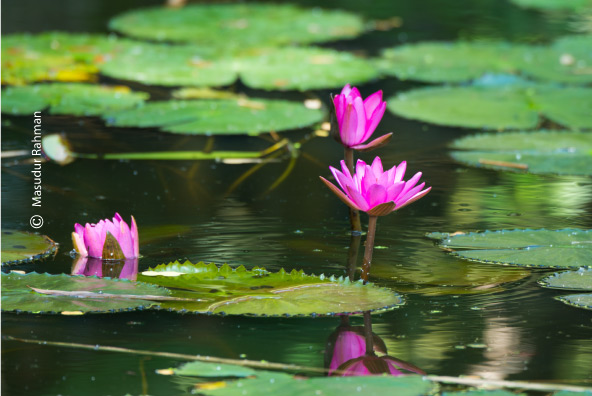
Exposure 1/60sec @ f/7.1 | ISO 200 | Focal Length 400mm
Masudur Rahman
Born in 1967, Masudur Rahman Mamoon is a dedicated photographer based in Chittagong, Bangladesh, who began his artistic journey with film portraiture in 1998. After establishing his own business in 2007, he shifted his focus toward wildlife and bird photography, eventually becoming an active member of the Chittagong Bird Club. A post-graduate in Marketing, Mamoon views photography as a vital tool for social change and personal expression. His work, which frequently appears in local weekly publications, reflects a deep commitment to documenting the natural beauty of his country.
Resonance Score Breakdown
Transparency Note: The resonance score (11.1/20) is calculated based on social engagement metrics collected before the award announcement.
Expert Photography Reviews · 5
The Quiet Surface of Being
There is a profound wisdom in the way a flower rests upon the water. It does not struggle against the current, nor does it seek to rise above its environment. It simply exists, anchored in the depths while opening its heart to the sky.
Read the reflection →Quiet Bloom in the Stillness
I remember sitting by a pond in a small village outside of Chittagong, watching an old man clear debris from the water’s edge. He moved with a deliberate, slow grace, careful not to disturb the floating leaves.
Read the reflection →Reviews & Comments
Share your thoughts about this award-winning photograph. Your reviews contribute to the community engagement score.
The surface tension holds the bloom. It’s a quiet suspension. I’ve spent minutes watching the dark water press against the white petals. There’s no clutter here. Just the weight of the flower and the vast, still depth beneath it. It makes me hold my breath. Nothing here is accidental. The empty corner is not empty. It’s the space where the silence lives. Rahman trusts the void. It’s enough.
At 400mm, the Nikkor’s focal plane is razor-thin, isolating the Shapla’s delicate anatomy from the water’s chaotic micro-reflections. The f/7.1 aperture avoids the diffraction limit while maintaining enough depth to render the petal’s cellular structure with clinical clarity. It’s breathtaking. I’ve spent years studying how glass resolves light, yet seeing the subtle chromatic aberration at the petal’s edge against that soft, creamy bokeh still makes my heart race. It’s a triumph of optical precision.
A 400mm lens is a lazy man’s shortcut, yet here, it’s used with surprising restraint. One wonders how many mornings Rahman spent swatting mosquitoes at Chittagong University before the light hit those petals just so. It’s a quiet, disciplined study. I’ve spent enough damp hours in waders to recognize the stillness required for this shot. He didn’t just find this lily; he waited until it finally decided to reveal itself. It’s a respectable bit of work.
You’ve captured the Shapla with such quiet reverence that I can almost smell the damp earth of Chittagong. It’s not just a flower; it’s a piece of home. Because you pulled it so close with that 400mm lens, I feel the stillness of the water. I’ve spent years chasing stories, but you found a story in a single bloom. There’s something honest happening here. You waited for the light to settle, and it shows.
The lily occupies a precise off-center coordinate, anchoring the frame’s lower-right quadrant. Its radial symmetry disrupts the horizontal plane, creating a tension between the bloom’s complex geometry and the water’s flat, negative space. I’m genuinely struck by how the 400mm compression flattens the depth, turning the petals into a series of repeating arcs. It’s a perfectly solved spatial equation. The math here doesn’t just hold the frame together; it makes the flower feel infinite.