Tour of Oman by Sanjoy Sengupta
Captured during the final laps of the Tour of Oman near the Muttrah Corniche, this image masterfully utilizes the panning technique to convey the high-speed intensity of professional cycling. By slowing the shutter speed to 1/60sec, the photographer successfully blurred the background while maintaining sharp focus on the athlete, creating a dynamic sense of motion that places the viewer directly in the heart of the race. This photograph stands out for its technical precision in a challenging environment, transforming a fleeting moment of athletic endurance into a compelling, artistic narrative that highlights the energy and rhythm of the international cycling season.
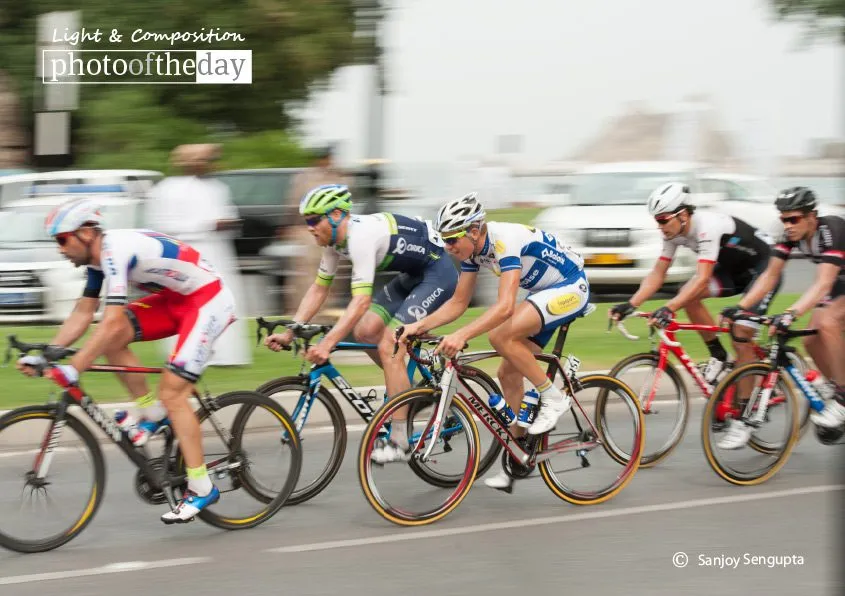
Exposure 1/60sec @ f/10 | ISO 200 | Focal Length 70mm
Sanjoy Sengupta
Based in Muscat, Oman, Sanjoy Sengupta has cultivated a lifelong passion for photography that began with film cameras in the 1990s and evolved alongside the digital revolution. His journey from early experimentation with manual film to mastering professional Nikon DSLR systems reflects a deep commitment to capturing the fleeting, cherished moments of life. Sengupta is recognized for his dedication to technical growth and his ability to translate the vibrant energy of his surroundings into evocative, award-winning imagery.
Resonance Score Breakdown
Transparency Note: The resonance score (11.1/20) is calculated based on social engagement metrics collected before the award announcement.
Expert Photography Reviews · 7
The Rhythm of Passing
There is a quiet grace in the way things move past us. We often believe that to truly see, we must stand perfectly still, yet there is a wisdom in the blur.
Read the reflection →The Velocity of Breath
We spend so much of our lives trying to hold the world still, pinning moments to the page like dried leaves in a ledger. Yet, there is a profound honesty in the blur.
Read the reflection →Reviews & Comments
Share your thoughts about this award-winning photograph. Your reviews contribute to the community engagement score.
The heat of the Corniche radiates through the frame. He stood there, tracking the blur, listening to the rhythmic hum of tires against asphalt. It’s a frantic, fleeting energy, yet I find a strange stillness in the way the light catches the cyclist’s jersey. I’ve spent enough hours waiting for the sun to move to know that feeling—the moment the world finally aligns. It’s not just speed; it’s the land holding its breath for a second.
1/60sec at f/10, 70mm. A calculated risk. At f/10, the diffraction limit on a D700 is negligible, but the depth of field is unforgivingly thin for a panning shot. Sengupta’s tracking is precise; the cyclist’s face is sharp, the background a coherent smear. I’ve spent years watching motion blur fail, but this works. It’s technically sound. The decision to stop down to f/10 was bold. It’s rare to see such discipline in sports photography.
The frame is dominated by a sharp horizontal vector, bisected by the cyclist’s diagonal posture. By locking the subject at a 1/60sec shutter speed, Sengupta creates a perfect ratio of kinetic blur to static focus. It’s a rigorous spatial equation. I’m genuinely thrilled by how the background’s vertical streaks compress the depth, forcing the eye to track the athlete’s trajectory. It’s not just a race; it’s a beautifully solved problem of velocity and linear alignment.
At 1/60sec, the sensor’s integration time perfectly matches the cyclist’s velocity, rendering the background into a beautiful, linear blur. By stopping down to f/10, Sengupta navigates the diffraction limit while keeping the athlete’s face within the focal plane. It’s a precise calibration of motion and optics. I’m genuinely moved by how the light catches the spokes; it’s not just a race, it’s a rhythmic, optical dance that the human eye simply can’t resolve this cleanly.
The shutter drag at 1/60th is a gamble that pays off. It’s pure kinetic energy. The background smears into a rhythmic blur, yet the cyclist remains locked in the frame’s center, a razor-sharp anchor against the chaos. I’ve spent years watching pelotons fly by, but this frame catches the exact heartbeat of the race. It’s the shot the editor keeps because it doesn’t just show speed; it forces you to feel the wind.
You nailed the panning, but that’s just the mechanics. What hits me is the cyclist’s eyes. You caught that singular, hollow focus of a man pushing past his own breaking point. I’ve seen that look in the eyes of soldiers and laborers alike. Because you held your nerve at 1/60th, you didn’t just capture a race; you captured the exhaustion. There’s something honest happening here. You waited, and I can feel the weight of his effort.
Before the eye identifies the cyclist, a sudden tension pulls at the chest. The blur of the Muttrah Corniche mimics the way my own pulse quickens during a frantic commute. It’s a kinetic ache, a vibration that doesn’t settle. When I return to this, I’m struck by the isolation of the rider against that smeared, golden heat. It’s exhausting to look at, yet I can’t look away. It’s the feeling of being left behind.