Father’s Day for Rani by Shahnaz Parvin
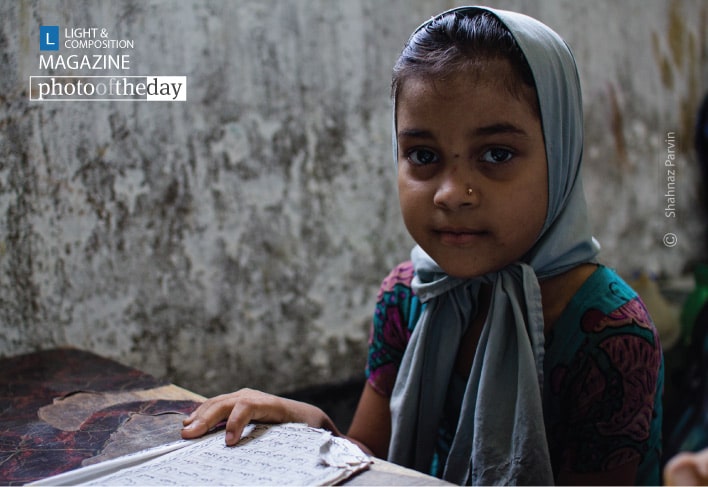
On Father’s Day, which coincided with her father’s death anniversary, the photographer chose to spend the day at an orphanage in Dhaka rather than observing traditional rituals. There, she met five-year-old Rani, an orphan who had lost her own parents two years prior. The image captures a profound moment of connection as the young girl prays for the photographer’s late father and for the photographer herself. This portrait is award-worthy for its raw emotional honesty and the poignant, quiet dignity it grants to a child navigating loss, transforming a personal moment of grief into a universal testament of empathy.
Shahnaz Parvin
Shahnaz Parvin is an award-winning photojournalist based in Dhaka, Bangladesh. While balancing a professional career as a system administrator, she dedicates her creative energy to documentary photography, aiming to capture the diverse culture and people of her homeland. As a highly decorated contributor to Light & Composition and the organization's Media Head for Asia, she is recognized for her evocative storytelling that spans themes of conflict, social upheaval, and the human condition.
Resonance Score Breakdown
Transparency Note: The resonance score (13.6/20) is calculated based on social engagement metrics collected before the award announcement.
Expert Photography Reviews · 8
The Architecture of Kinship
We often mistake the city for a collection of structures—steel, glass, and concrete—forgetting that its true foundation is the invisible network of human care.
Read the reflection →The Weight of a Whisper
I was folding laundry this morning when I found one of my father’s old handkerchiefs tucked into a coat pocket. I haven't worn that coat in years. Holding it, I didn't feel the sharp sting of grief I used to expect; instead, it felt like a quiet, heavy warmth.
Read the reflection →Reviews & Comments
Share your thoughts about this award-winning photograph. Your reviews contribute to the community engagement score.
The frame holds. It’s a quiet, devastating close-up that refuses to cut away. Rani’s hands are pressed together, a gesture of prayer that anchors the entire composition. At f/2.5, the background dissolves into a soft, blurred hum, leaving only her focused, heavy eyes. It’s a scene that feels like the final shot of a long, difficult film. I’ve seen a thousand portraits, but this one actually stopped my breath. It’s a perfect, still sequence.
Most portraits I see are just faces; they’re hollow. What separates this from the thousands of orphanage shots I’ve reviewed is the specific, heavy stillness in Rani’s hands. She isn’t posing; she’s performing a duty for a stranger. It’s a quiet, devastating exchange of grief. I’ll admit, it made me look away for a second. In thirty years, we won’t remember the technical specs, but we’ll still feel the weight of that small, folded prayer.
You didn’t just take a picture; you sat in the quiet with a child who understands loss better than most adults. I’m looking at Rani’s hands, and it’s hitting me hard. You waited for that exact second of stillness. It’s not about the camera settings or the orphanage walls. It’s about the weight of a prayer shared between two strangers. You felt something true here, and because you did, I can feel it too. Respect.
Rani’s hands. They hold the stillness of the room. The background doesn’t intrude. It recedes, leaving her prayer to occupy the air. I’ve spent years looking for this kind of weight. It’s heavy. It’s quiet. Nothing here is accidental. The empty corner is not empty. It’s where the grief lives, unforced and honest. I find myself holding my breath. It’s a rare grace, finding such vastness in a child’s small, folded palms.
The frame’s geometry hinges on the child’s lowered gaze, anchoring the vertical axis. It’s a tight, claustrophobic composition that forces the viewer into the subject’s immediate spatial tension. The shallow depth of field isolates the figure, stripping away the orphanage’s noise. I’ve rarely seen such brutal economy in a portrait. The negative space doesn’t offer relief; it traps the eye. It’s a cold, calculated arrangement that finally forces me to look away.
We look at little Rani and we see the weight of two souls meeting in the quiet of a Dhaka orphanage. She isn’t just posing; she’s listening to a grief she shares with the photographer. It’s a heavy, beautiful exchange. When I see her small hands pressed in prayer, I feel a lump in my throat. Shahnaz didn’t just look at this child; she sat with her. It’s a photograph that asks to be returned to.
1/125sec at f/2.5, ISO 400, 30mm. The aperture choice is precise. It isolates the subject’s expression while keeping the background context readable. At 30mm on a crop sensor, the field of view is tight, intimate. It’s a calculated risk that pays off. I’ve seen enough blurred portraits to know this focus is sharp where it matters. It’s technically sound. Honestly, the clarity of that gaze caught me off guard. It’s a rare, disciplined execution.
The ochre shadows clinging to Rani’s skin possess the dusty, melancholic warmth of a Morandi still life, grounding her grief in a palette of sun-baked earth and fading light. It’s a chromatic ache that I find deeply unsettling, as if the very air in Dhaka has turned to amber. When the light catches her eyes, it’s not merely illumination; it’s a soft, bruised violet resonance that makes my own heart stutter with a quiet, sudden recognition.