Portrait of An Old Lady by Badrul Alam Shamim
Captured near the Kaouraid bridge in Gazipur, Bangladesh, this portrait highlights the quiet dignity of a local hotel owner. The photographer utilized a 55mm focal length to isolate the subject, ensuring the focus remains on her expressive features and resilient spirit. The image serves as a poignant study of daily life, documenting the woman’s active role in sustaining her family’s livelihood. Her contented demeanor, despite the demands of her work, is rendered with technical precision, making this a compelling and award-worthy exploration of human simplicity and cultural tradition.
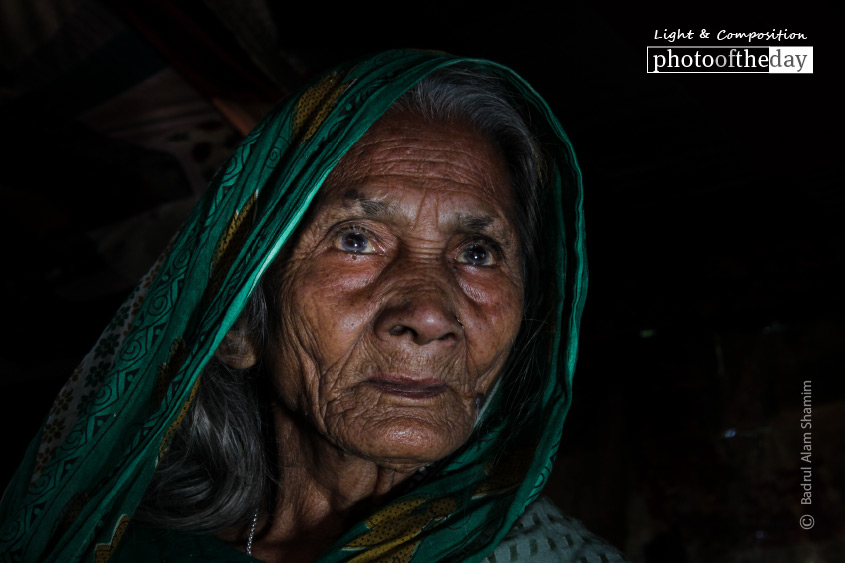
Exposure 1/40sec @ f/11 | ISO 400 | Focal Length 55mm
Badrul Alam Shamim
Born and based in Dhaka, Bangladesh, Badrul Alam Shamim is a dedicated photographer whose artistic journey began in 2010. Heavily influenced by the work and ideology of renowned photographer GMB Akash, Shamim transitioned from travel photography to a deeper focus on the human condition, capturing the nuances of lifestyle, culture, and tradition. His work is defined by an appreciation for the simplicity of everyday people, a passion that has evolved from a personal pursuit into his professional calling.
Resonance Score Breakdown
Transparency Note: The resonance score (13.3/20) is calculated based on social engagement metrics collected before the award announcement.
Expert Photography Reviews · 8
The Archive of the Skin
To age is to become a map of the seasons. Each line etched into the skin is a record of a sun that rose and set, a winter that bit, or a harvest that brought relief.
Read the reflection →The Texture of Time
The smell of dry earth after a long drought is a scent that clings to the back of the throat, tasting faintly of iron and ancient dust.
Read the reflection →Reviews & Comments
Share your thoughts about this award-winning photograph. Your reviews contribute to the community engagement score.
1/40sec at f/11, ISO 400, 55mm. Stopping down to f/11 on a kit lens at 55mm is a tactical error. It forces a slow shutter speed, risking motion blur, and introduces diffraction that softens the subject’s skin texture. I’ve seen sharper results from this sensor. It’s frustrating. The intent was isolation, but the aperture choice flattened the background into a distracting, noisy mess. The technical execution doesn’t support the subject’s dignity. It’s a missed opportunity.
The frame holds a face. Lines of skin. A gaze that doesn’t ask for anything. I’ve spent minutes looking at the blurred background near the bridge. It’s quiet. The space around her isn’t just air; it’s the weight of a life lived in Kaouraid. I feel a sudden, sharp ache in my chest. Nothing here is accidental. The empty corner is not empty. It’s the pause that lets her breathe. It’s enough.
The subject’s placement within the frame creates a precarious spatial tension. It’s a rigid geometry that forces the eye toward the weathered texture of the skin. The background’s soft blur doesn’t distract; it anchors the figure against the picture plane. I’ve found myself staring at the way the light hits her brow—it’s a rare, sharp clarity. The composition holds its weight, refusing to collapse into sentimentality. It’s a disciplined study of form, nothing more.
The ochre of her weathered skin, reminiscent of Morandi’s dustiest pigments, anchors this frame against the muted, atmospheric grey of the Gazipur light. It’s a quiet, aching harmony that I find deeply moving, as if the very air around her has been stained by a lifetime of labor. One doesn’t merely see her; one feels the cool, bruised violet shadows clinging to her sari, a subtle, melancholic counterpoint to the warmth radiating from her tired, resilient gaze.
Before the eye identifies the texture of her skin, something in my own chest tightens. It’s the weight of that gaze, a quiet gravity that pulls at my pulse. I’ve returned to this portrait three times today, and each time, the lines around her eyes feel like a map of my own unspoken fatigue. It’s not just a face; it’s a mirror. I find myself holding my breath, waiting for her to finally speak.
She stood in the soft, diffused light of a Gazipur afternoon, where the shadows don’t bite but merely linger. I feel a strange, quiet ache looking at her hands; they’ve held the weight of a life lived close to the earth. It’s not just a portrait, but a conversation with time itself. He waited for the light to settle on her face, listening until the land and the woman became one. It’s deeply, beautifully still.
You waited for the light to settle on her face, and it paid off. I’ve spent enough time in the field to know that look—it’s not just a portrait, it’s a life held in the creases of her skin. You didn’t force the moment; you let her be. And honestly, looking at her eyes, I felt a sudden, quiet ache for home. You captured a dignity that doesn’t need a backdrop. There’s something truly honest happening here.
At f/11, the diffraction limit begins to soften the micro-contrast, yet the 55mm focal plane captures the topography of her skin with startling honesty. I’m genuinely moved by how the lens resolves the fine, weathered texture of her face against the ambient light of Gazipur. It’s a rare instance where the optics don’t just record a subject; they map a life. The light’s behavior across those deep lines is, in the strictest physical sense, extraordinary.
Like It.
No offence, guys, but this photo could have been a winner if he knows how to set the light metering.
Good
Yes, with right combination of exposure Canon 600D could be a good camera.
Well captured.
Not a bad photo, but for a shot like this why did you use f/11?
I like it.
Amazing portrait
Nice
Good photograph