The Giant Leap by Sanjoy Sengupta
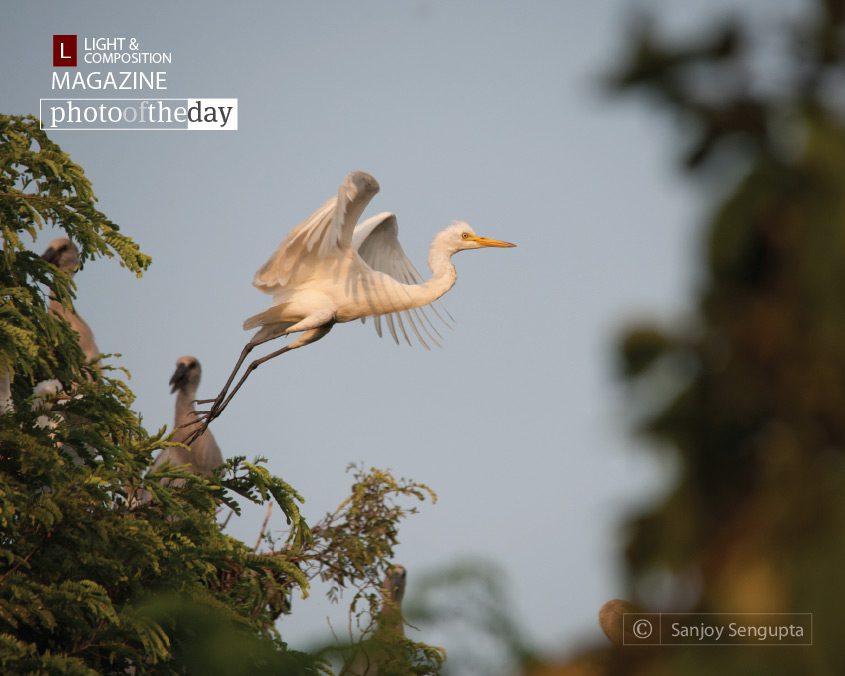
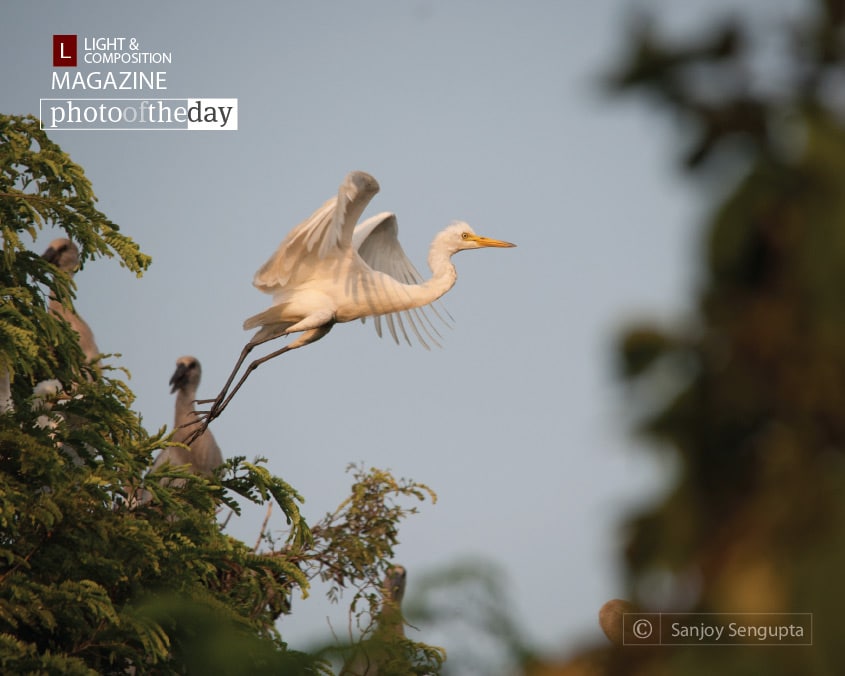
In a serene village near Chilka Garh, West Bengal, Sanjoy Sengupta captured a remarkable moment of coexistence between nature and humanity. The frame features ancient Neem and Tamarind trees serving as a bustling sanctuary for hundreds of Egrets, Storks, and Herons that nest in harmony with the local villagers. By utilizing a long focal length, the photographer isolated the avian activity against the lush backdrop, emphasizing the scale and vitality of the colony. This image is award-worthy for its poignant documentation of wildlife thriving within a human-inhabited landscape, showcasing both technical precision and a deep respect for the natural world.
Sanjoy Sengupta
Based in Muscat, Oman, Sanjoy Sengupta is a dedicated photographer whose journey began with film cameras in the late 1980s. After years of refining his craft through various digital platforms and hybrid models, he transitioned to professional DSLR equipment to pursue his passion for capturing life's fleeting moments. His work reflects a persistent commitment to learning and a deep appreciation for the beauty found in both wildlife and everyday existence.
Resonance Score Breakdown
Transparency Note: The resonance score (11.3/20) is calculated based on social engagement metrics collected before the award announcement.
Expert Photography Reviews · 7
The Weight of Flight
I remember sitting on a rusted bench in a park in Kyoto, watching a single heron navigate the wind. It didn't fight the gusts; it seemed to negotiate with them, folding its wings just enough to let the air carry it where it needed to go.
Read the reflection →The Weight of Wingbeats
The air before a storm has a specific, metallic thickness. It presses against the skin like a damp wool blanket, heavy and expectant. I remember standing in a field as a child, listening to the sudden, frantic rustle of leaves as the birds took flight all at once.
Read the reflection →Reviews & Comments
Share your thoughts about this award-winning photograph. Your reviews contribute to the community engagement score.
At 500mm, the Sigma’s focal plane is razor-thin, yet Sengupta’s f/8 aperture keeps the egrets’ plumage remarkably crisp. I’m genuinely moved by the way the diffraction limit softens the distant canopy, creating a creamy bokeh that isolates the avian movement. It’s a delicate balance; the optics don’t just record the colony, they resolve the chaotic geometry of flight into something almost architectural. It’s rare to see such technical discipline applied to the messy, beautiful reality of West Bengal.
The air in Chilka Garh must have been heavy with the scent of damp earth and ancient bark. He stood there, waiting for the birds to find their rhythm among the Neem branches. It’s a quiet, sacred chaos. I’ve spent enough dawns in the field to know that feeling of stillness before the wings take flight. Watching these egrets, I feel a sudden, sharp ache for the simplicity of their sanctuary. It’s a beautiful, patient exhale.
The birds collide with the canopy, yet the darkness beneath those ancient branches remains strangely hollow. It’s a frantic, white noise of wings struggling against the heavy, suffocating gloom of the foliage. I’ve stared at these shadows for an hour, and they don’t offer sanctuary; they swallow the movement whole. It’s unsettling. Sengupta captures the chaos of life, but he’s forgotten that silence is the only thing that truly gives a shadow its weight.
Most wildlife shots are just trophies, but this one captures a rare, fragile equilibrium. I’ve seen thousands of bird photos, yet the way these egrets navigate the chaotic branches against that dense, dark foliage feels like a genuine historical record of a vanishing coexistence. It’s the tension between the sharp, white plumage and the deep, tangled shadows that makes me stop and breathe. In thirty years, this frame will matter because the village sanctuary likely won’t.
Before the eye identifies the birds, a sudden stillness settles in the chest. It’s the weight of those ancient trees, I think. Sengupta’s frame forces a held-breath moment, a suspension of the frantic pace of life. When I return to this, I feel the humidity of West Bengal against my skin. It’s not just wildlife; it’s a quiet, rhythmic pulse of coexistence that lingers in my mind long after I’ve walked away from the screen.
1/1600sec at f/8.0, 500mm, ISO 720. The shutter speed is aggressive, freezing the wing beats with clinical efficiency. At 500mm, f/8.0 is a necessary compromise for depth, yet it keeps the background foliage from dissolving into mush. I’ve seen enough soft wildlife shots to appreciate this sharpness. It’s a cold, calculated capture. The ISO 720 is a bit noisy for my taste, but it’s a functional trade-off. It’s technically sound, and frankly, I respect that.
The shutter snaps at 1/1600, freezing the chaos of wings into a perfect, suspended sequence. It’s a frantic, beautiful rhythm. I’ve spent hours in editing suites chasing this kind of kinetic energy, but Sengupta caught it in a single blink. The long lens flattens the depth, turning the canopy into a dense, living wall. It’s breathless. I honestly feel the humidity of that West Bengal afternoon just looking at the frame. It’s the shot the editor keeps.