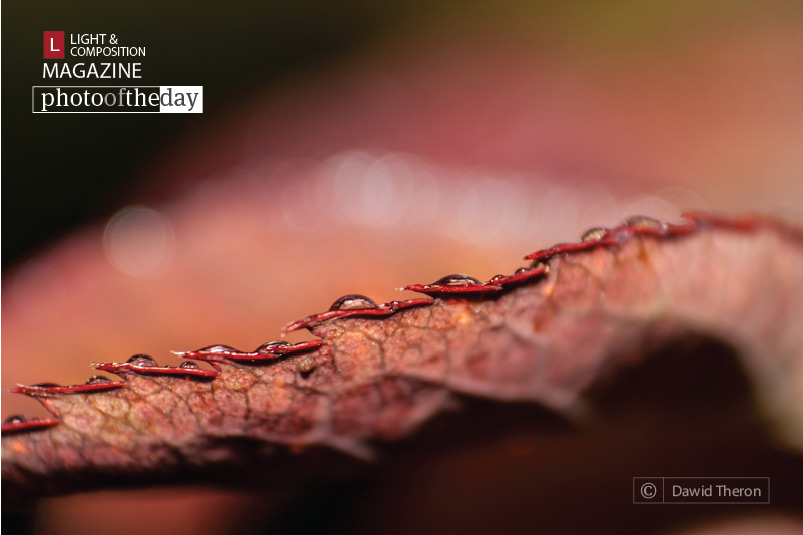
The Edge of a Rose’s Foliage by Dawid Theron
In this striking macro study, the photographer explores the intricate textures found at the edge of a rose’s foliage. By experimenting with a reversed kit lens, the artist achieves a unique perspective that transforms a common garden element into a complex, abstract landscape. This technical choice highlights the delicate veins and organic contours of the leaf, revealing beauty that often goes unnoticed by the casual observer. The image is award-worthy for its masterful use of unconventional equipment to elevate a simple subject into a compelling piece of fine art, demonstrating a keen eye for the hidden details of the natural world.
Dawid Theron
Based in Tulbagh, South Africa, Dawid Theron is a dedicated fine art photographer who views the world as a vast canvas. He specializes in capturing the overlooked details of nature, such as the delicate textures of flora and the rhythmic flow of water, while also finding inspiration in the lines and shapes of architectural subjects. By utilizing his camera as a primary artistic tool, Theron seeks to translate his personal vision into evocative imagery that invites viewers to appreciate the hidden beauty within their everyday surroundings.
Resonance Score Breakdown
Transparency Note: The resonance score (12.6/20) is calculated based on social engagement metrics collected before the award announcement.
Expert Photography Reviews · 8
The Veins of Quiet
The smell of damp earth after a long drought is a heavy, velvet thing that settles deep in the lungs. It is the scent of secrets kept by the soil, a cool, dark musk that clings to the skin like a damp wool sweater.
Read the reflection →The Veins of Quietude
We walk past the small things as if they are merely background noise to our own busy lives. Yet, if we stop and lower our gaze, we find that the world is built upon a foundation of quiet, intricate architecture.
Read the reflection →Reviews & Comments
Share your thoughts about this award-winning photograph. Your reviews contribute to the community engagement score.
Reversed kit lenses usually suggest a photographer who’s spent more time fiddling with gear than waiting for the world to reveal itself. Yet, Theron has coaxed a surprising, jagged geometry from these veins. It’s a quiet, disciplined study. I’ve spent hours shivering in the Tulbagh mist, and I find myself begrudgingly impressed by this patience. One suspects he didn’t just stumble upon this leaf; he likely sat with it until the light finally behaved.
The leaf edge curves. It’s a sharp, serrated line against a void. I’ve spent minutes watching the light catch those veins. It’s quiet here. The green doesn’t shout. It breathes. I feel a sudden, sharp ache for the garden in Tulbagh. Nothing here is accidental. The empty corner is not empty. It’s the space where the rose ends and the silence begins. Theron knows when to stop. That’s the rarest skill of all.
Before the eye identifies the leaf, a sudden stillness settles in the chest. Theron’s macro work triggers a strange, tactile phantom sensation; I can almost feel those serrated edges grazing my skin. It’s an unsettling intimacy. When I return to it, the jagged veins feel less like botany and more like a map of a nervous system. It’s quiet, sharp, and leaves a lingering, rhythmic hum in my pulse that I haven’t quite shaken off.
It’s easy to rush past a garden, but Dawid didn’t. He stood in the quiet of Tulbagh, listening to the veins of a leaf as they drank the morning. Using that reversed lens, he’s turned a simple edge into a vast, rolling topography. I felt a sudden, sharp ache of recognition looking at those intricate contours; it’s a reminder that the divine isn’t just in the mountains, but in the smallest, most patient breath of green.
Reversing a kit lens pushes the focal plane into a microscopic realm where diffraction limits usually soften the edges. Yet, Theron’s capture of these serrated leaf margins is razor-sharp. The chromatic aberration is remarkably suppressed, revealing veins that look like topographical maps. I’m genuinely breathless at how the bokeh, a function of that extreme magnification, renders the background into a soft, ethereal wash. It’s a rare moment where optics and biology collide to reveal such hidden, structural elegance.
Most macro work is just technical vanity, but Theron’s leaf edge feels like a topographical map of a world I’ve never visited. It’s the jagged, serrated rhythm of those veins that caught me; they don’t just exist, they command the frame. I’ve seen thousands of botanical studies, yet this one lingers because it treats biology like architecture. It’s not just a rose; it’s a landscape that’ll still feel alien and vital thirty years from now.
Reversed kit lens, f/unknown, likely wide open. It’s a gamble that paid off. The magnification ratio is aggressive, forcing a razor-thin plane of focus that isolates the cellular structure of the leaf edge. Most would reach for a macro prime, but this hack forces a raw, uncorrected perspective. It’s technically precarious, yet the sharpness holds. I’ve spent years dismissing kit glass, but looking at these veins, I’m actually impressed. The optics didn’t fail the vision.
We look at these veins and we aren’t just seeing a leaf; we’re seeing a life story written in green. Dawid Theron didn’t just point a lens; he listened to the quiet pulse of the Tulbagh garden. It’s an intimate portrait of endurance, where every serrated edge feels like a scar earned in the sun. I find myself holding my breath, feeling the fragility of it all. It’s a photograph that asks to be returned to.