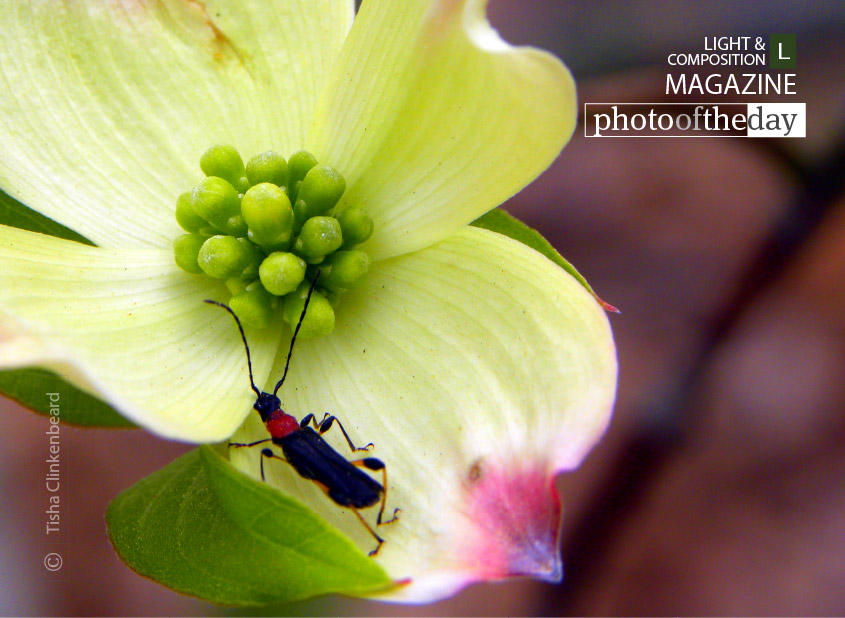
Lunch on the Dogwood by Tisha Clinkenbeard
Captured during the vibrant spring season on her own land, Tisha Clinkenbeard’s photograph highlights the delicate, unfolding beauty of dogwood blossoms. By focusing on the crimson-tipped petals and their intricate, textured centers, the photographer creates a striking study in contrast and natural elegance. This image is award-worthy for its intimate perspective and the photographer's ability to transform a common seasonal bloom into a compelling macro composition, showcasing the quiet, fleeting splendor of nature through a thoughtful and precise lens.
Dipanjan Mitra
Being a software professional since 1999, Dipanjan Mitra always had an intense desire to travel across the Indian terrains. It was long inhibited till 2006 when his journey began with a small digital camera in the state of Karnataka. The world of photography really got him going when he moved on to a relatively higher end digital camera in the form of Canon S5 IS which he had used for around 2 years, trying to learn the magic of shutter and aperture until the real journey began with a Rebel T1i in May 2010. Fascinated by the magic of being behind the lens keeps amazing him every day. He wishes this journey never ends. Award Winner Photo of the Day Camera Canon EOS 60D and EOS 7D Lenses: EF-S 15-85mm and EF-S 10-22mm Tripod: Vivitar Current Location Calcutta, India Website http://www.dipanjan-mitra.com/ Gallery http://500px.com/dipanjan/ Flickr http://www.flickr.
Resonance Score Breakdown
Transparency Note: The resonance score (12.5/20) is calculated based on social engagement metrics collected before the award announcement.
Expert Photography Reviews · 6
A Quiet Invitation
I spent an hour this morning trying to fix a loose hinge on my kitchen cabinet. It was a small, annoying task I had been ignoring for weeks. I kept dropping the tiny screws, and my patience was wearing thin.
Read the reflection →The Architecture of the Small
We often speak of nature as a grand, sweeping theater—the mountain range, the canyon, the forest that swallows the horizon. But there is a different kind of truth found in the miniature, in the way a single stem holds the weight of the morning.
Read the reflection →Reviews & Comments
Share your thoughts about this award-winning photograph. Your reviews contribute to the community engagement score.
There’s a stillness here that only comes when the wind finally dies down. She must have waited for that exact breath of air to steady the dogwood. I’ve spent hours in similar fields, and it’s that quiet, crimson-tipped patience that moves me. The light doesn’t just hit the petals; it seems to listen to them. It’s a gentle, unfolding grace. I find myself wanting to reach out, just to see if the bloom is as soft as it looks.
Most macro work today is just clinical documentation, but Clinkenbeard’s dogwood study avoids that trap. The crimson tips against the soft, blurred foliage create a genuine tension between the bloom and its environment. I’ve seen thousands of floral close-ups, yet this one lingers because it captures a specific, fragile moment of spring. It’s honest. Looking at those textured centers, I actually feel the quiet humidity of a Texas afternoon. That’s why it’ll still matter in thirty years.
The crimson tips pull the eye inward. Then, the center. It’s a quiet geometry. I’ve spent minutes watching how the light rests on these petals. It doesn’t crowd the frame. It leaves room for the air to circulate. Nothing here is accidental. The empty corner is not empty. It’s a breath. I feel a sudden, sharp ache for spring. It’s a rare discipline, knowing exactly when to stop. Clinkenbeard knows. She lets the silence remain.
At f/4.5, the Nikon P90’s small sensor struggles against the diffraction limit, yet the focal plane here captures the dogwood’s cellular architecture with surprising intimacy. I’m genuinely moved by how the crimson-tipped petals resolve against the soft, out-of-focus background; it’s a delicate dance of optics. While the lens doesn’t quite resolve the finest stamen textures, it’s captured a fleeting, organic geometry that feels almost microscopic. It’s a quiet, beautiful triumph of light over glass.
The dogwood’s crimson tips don’t merely bloom; they bleed into the surrounding void. I’m struck by how Tisha’s lens forces the light to surrender, carving out a cavernous depth within the petals. It’s a somber, claustrophobic intimacy. Most photographers fear this darkness, but here, the shadows aren’t empty. They’re the heavy, silent anchors of the frame. It’s unsettling, really—the way the flower refuses to be pretty, choosing instead to exist in that profound, thinking gloom.
The frame’s geometry is compromised. While the crimson tips provide a necessary anchor, the central mass lacks the structural tension required to hold the eye. It’s too soft, drifting toward the periphery without purpose. I’m frustrated by the wasted negative space; it doesn’t serve the subject, it merely dilutes it. The composition demands a tighter, more aggressive fulcrum. It’s a missed opportunity for rigor. Without a disciplined architecture, the bloom simply collapses into decorative noise.