Facing History by Sanjoy Sengupta
Captured at the ancient temple of Angkor Wat, this photograph documents a serendipitous sunrise that transformed the landscape into a vibrant spectacle. Arriving in the pre-dawn darkness, the photographer waited patiently as the first light revealed a stunning, symmetrical reflection of the temple across the water. The image is award-worthy for its masterful use of natural light and composition, perfectly balancing the historic architecture with the ephemeral, colorful glow of the morning sky. It serves as a poignant reminder of how spontaneous decisions often lead to the most breathtaking photographic opportunities.
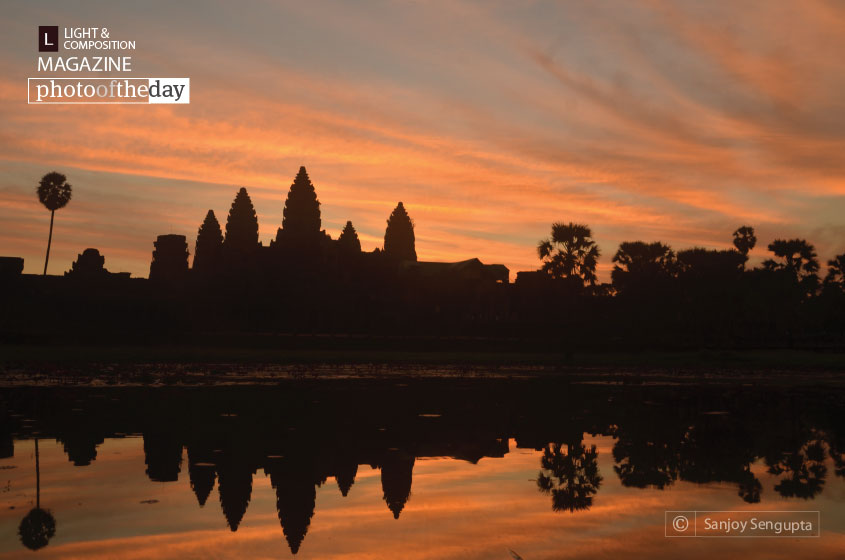
Exposure 1/15sec @ f/8 | ISO 100 | Focal Length 18mm
Sanjoy Sengupta
Based in Muscat, Oman, Sanjoy Sengupta has cultivated a lifelong passion for photography that evolved from early experiments with film to the precision of modern digital systems. His journey reflects a dedicated pursuit of capturing the fleeting moments of life, transitioning through various camera formats to master the technical nuances of his craft. Today, he focuses on documenting the beauty of the world around him, consistently refining his artistic vision to produce evocative imagery that resonates with audiences globally.
Resonance Score Breakdown
Transparency Note: The resonance score (11.8/20) is calculated based on social engagement metrics collected before the award announcement.
Expert Photography Reviews · 8
The Weight of Stone and Sky
We often speak of time as a river, something that flows past us, carrying our days toward an inevitable sea. But standing before the ruins of an old civilization, one begins to suspect that time is not a river at all, but a sediment.
Read the reflection →The Architecture of Echoes
We are all architects of our own ruins, building monuments to moments that have already slipped through our fingers like dry sand. There is a quiet violence in how time works—it erodes the sharp edges of our grief until they become smooth, river-worn stones.
Read the reflection →Reviews & Comments
Share your thoughts about this award-winning photograph. Your reviews contribute to the community engagement score.
The pre-dawn chill must have seeped into his bones while he waited for the stone to wake. It’s a quiet miracle when the sky finally bleeds into the reflection, turning the temple into a bridge between centuries. I’ve stood in that same humid dark, and I can feel the stillness he captured here. It isn’t just a sunrise; it’s the land exhaling. He didn’t force the light—he simply listened until the temple was ready to speak.
The light hits the water and the frame locks. It’s a long take, a steady shot that refuses to blink. I’ve stood in that pre-dawn chill, and honestly, it makes my chest ache to see it captured this perfectly. The symmetry isn’t just geometry; it’s the rhythm of a heartbeat. Sengupta didn’t rush the cut. He held the shutter open, letting the sunrise breathe. It’s the frame the editor keeps because the silence is deafening.
The water holds the temple. It’s a mirror, still and heavy. I’ve spent hours watching the light crawl across stone, but here, the silence is what pulls me in. The sky doesn’t shout. It waits. Nothing here is accidental. The empty corner is not empty. It’s a breath held in the dark. I feel a sudden, sharp ache for that stillness. It’s rare to find a frame that knows when to stop.
At f/8, the 18mm focal plane holds the temple’s stone texture with clinical sharpness, yet it’s the diffraction of light across the water’s surface that truly arrests me. The Nikon’s sensor resolves the subtle chromatic transitions of the sunrise beautifully. I’ve spent years studying how glass interprets dawn, but this reflection’s clarity feels almost impossible. It’s a rare moment where the lens’s resolution perfectly matches the scale of the architecture. I’m genuinely breathless looking at it.
Before the eye identifies the temple, something in the chest tightens. It’s the stillness of that water, a mirror holding a sky that hasn’t quite decided on its color. I find my own breath syncing with the slow, deliberate exposure. When I return to this, I don’t see stone; I feel the weight of centuries pressing against the morning air. It’s a quiet ache, the kind that lingers long after you’ve walked away.
Angkor Wat at dawn is a crowded theater, yet one senses Sanjoy found a quiet corner here. The reflection is crisp, suggesting he didn’t just stumble upon this light; he likely stood in the damp dark while the tourists were still at breakfast. I’ve spent enough mornings shivering in temple shadows to appreciate that stillness. It’s a clean, disciplined frame. He didn’t just take a picture; he sat with the stones until they finally spoke back.
We arrive at Angkor before the light, waiting for the stone to wake. In this reflection, we don’t just see architecture; we see the temple’s long, silent conversation with the sun. It’s a portrait of time itself, breathing against the water. I find myself holding my breath, feeling the weight of centuries pressing into the frame. It’s a quiet, sacred dialogue. This is a photograph that asks to be returned to, again and again.
1/15sec at f/8, 18mm, ISO 100. A tripod was mandatory here, and Sengupta didn’t miss. The f/8 aperture keeps the temple’s stonework sharp while the slow shutter renders the water’s reflection with clinical precision. It’s a calculated, stable exposure. I’ve seen enough blurry Angkor shots to appreciate this discipline. He didn’t gamble on handheld stability; he chose the math. It’s a cold, correct execution. I’m actually impressed by the lack of noise in those deep shadows.