Masukiye Waterfall by Zahraa Al Hassani
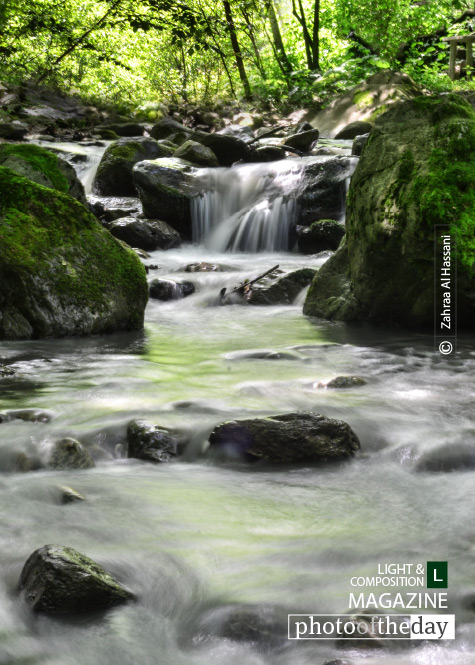
The Masukiye Waterfall, a site whose name translates to a place for lovers, serves as the enchanting backdrop for this nature photograph. Captured with a long exposure of half a second at f/22, the image masterfully translates the fluid motion of the cascading water into a silky, ethereal veil. The photographer’s decision to use a narrow aperture highlights the intricate textures of the surrounding rocks and lush greenery, grounding the ethereal water in the raw, tactile beauty of the Turkish landscape. This composition stands out for its serene atmosphere, effectively capturing the romantic essence of a location that feels both timeless and deeply inviting.
Zara Otaifah
Based in Baghdad, Iraq, Zahraa Al Hassani is a dedicated photographer and senior graphic designer at Zain Telecommunications. A graduate of the University of Technology Baghdad, she leverages her extensive background in visual design to refine her photographic perspective and enhance corporate aesthetics. Balancing a professional career with family life, she continuously seeks to expand her artistic horizons, transitioning from early equipment to Nikon systems to better capture the world around her. Her work reflects a commitment to learning and a deep appreciation for the principles of purist photography.
Resonance Score Breakdown
Transparency Note: The resonance score (12.8/20) is calculated based on social engagement metrics collected before the award announcement.
Expert Photography Reviews · 7
The Persistence of Flow
If a river could remember its own beginning, would it still choose to rush toward the sea? We often mistake the stillness of a moment for the absence of change, yet everything we touch is in a state of quiet, relentless departure.
Read the reflection →The Pulse of Cold Stone
The smell of wet moss always brings me back to the underside of a bridge in mid-autumn, where the air is thick with the scent of damp earth and crushed ferns.
Read the reflection →Reviews & Comments
Share your thoughts about this award-winning photograph. Your reviews contribute to the community engagement score.
The water doesn’t rush. It breathes. A half-second shutter turns the flow into a veil of stillness. I’ve spent minutes watching the moss cling to the wet stone. It’s quiet here. The frame holds a deliberate absence. Nothing here is accidental. The empty corner is not empty. It’s a pause. I feel my own pulse slow down in the presence of this silence. It’s a rare, honest restraint. I’d stay here, if I could.
Shooting at f/22 on a D3100 invites the diffraction limit to soften those fine rock textures, yet it’s a necessary trade-off for that half-second exposure. The light’s path through the aperture creates a silky, laminar flow that feels almost tactile. I’m genuinely moved by how the water’s motion blurs while the moss remains sharp. It’s a delicate balance; she’s pushed the sensor’s resolution to its edge, capturing a serenity that’s physically, and emotionally, quite profound.
Water at half a second becomes a ghost, a shroud draped over the jagged indifference of stone. It’s technically precise, yet I’m troubled by the lack of true darkness here. By smoothing the torrent into silk, the photographer has sanitized the violence of the fall. It’s pretty, sure, but it’s afraid of the abyss beneath the foam. I’d trade all this ethereal clarity for one patch of honest, impenetrable shadow where the water actually hides.
Half a second at f/22 is a tidy bit of arithmetic, but it doesn’t tell me if Zahraa stood in the spray until her boots leaked. The water’s silky enough, I suppose, but the composition feels a bit like a tourist’s lucky break. I’ve spent days waiting for the light to turn on a waterfall; this one feels like it was captured on the first pass. It’s pretty, but I’m not convinced it’s earned.
Of the thousands of waterfall shots I’ve reviewed, most are merely technical exercises. Zahraa’s work avoids that trap because the half-second exposure doesn’t just blur the water; it anchors the flow against the sharp, jagged moss of the rocks. It’s a quiet, tactile tension that makes me want to reach out and touch the stone. In thirty years, this won’t feel like a dated digital file, but a genuine, cooling breath of Turkish air.
The mossy, verdant depths of the Masukiye gorge possess a Morandi-esque restraint, where the water’s bleached, glacial white—the colour of a winter shroud—collides with the damp, bruised emerald of the stones. It’s a chromatic sigh, really; I’ve found myself breathless before such quietude. One feels the temperature drop, the light filtered through a canopy of deep, melancholic jade, turning the entire scene into a liquid, shivering meditation on the fragility of light itself.
Before the eye identifies the waterfall, a sudden stillness settles in the chest. The long exposure turns the water into a ghost, a soft, white silence that slows my pulse. It’s the texture of the rocks that pulls me back, though; they feel heavy, grounding the ethereal blur. I’ve returned to this twice today, and each time, the damp, cool air of Sakarya seems to cling to my skin. It’s a quiet, aching invitation.