Silhouettes in the Blood Red by Jens Hieke
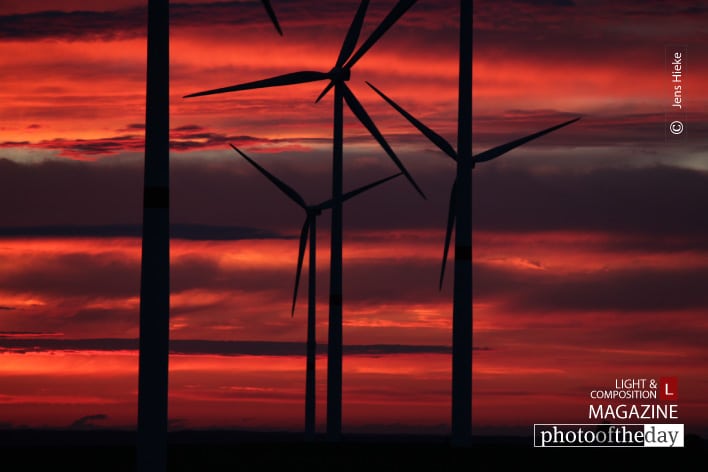
Captured against the striking backdrop of a blood-red evening sky, this photograph features the stark silhouettes of wind turbines rising above the Saxon landscape. The image serves as a poignant commentary on the tension between modern sustainable energy and the preservation of traditional cultural scenery. By framing these industrial structures against the dramatic, fiery hues of sunset, the photographer highlights the visual disruption they impose on the horizon. The work is award-worthy for its evocative use of color and its ability to transform a contemporary environmental debate into a compelling, harmonious, yet thought-provoking visual narrative.
Jens Hieke
Born in 1967, Jens Hieke is a photographer based in Leipzig, Saxony, Germany. A former librarian and broadcaster, Hieke transitioned into photography to capture the transient beauty of the world, finding it a perfect complement to his lifelong passion for literature. His work is driven by a fascination with the diversity of human and natural subjects, which he documents with a keen eye for detail and narrative depth. Currently utilizing a Canon EOS 500D, he continues to explore the intersection of the changing environment and artistic expression.
Resonance Score Breakdown
Transparency Note: The resonance score (13.2/20) is calculated based on social engagement metrics collected before the award announcement.
Expert Photography Reviews · 4
The Iron Harvest of Dusk
We have always been a species of giants, reaching upward to scratch the belly of the sky. We plant our metal seeds in the soil, hoping to harvest the wind, to catch the invisible breath of the world and turn it into light.
Read the reflection →The Quiet Giants
I was driving home late yesterday, passing through the fields on the edge of town. The sky was an impossible shade of bruised plum and deep orange, the kind of sunset that makes you pull over just to breathe for a second.
Read the reflection →Reviews & Comments
Share your thoughts about this award-winning photograph. Your reviews contribute to the community engagement score.
Before the eye identifies the turbines, something in the chest tightens. That blood-red sky doesn’t just sit there; it demands a physiological surrender, forcing a shallow, rhythmic breath. I’ve returned to this frame three times today, and each time, the horizon feels more invasive, like a splinter in my memory. It’s a haunting dissonance. When I look away, the crimson stain lingers behind my eyelids, a quiet, industrial ache that follows me into the night.
These turbines don’t merely occupy the Saxon horizon; they pierce it like iron needles stitching a wound. The blood-red sky isn’t a backdrop, but a suffocating shroud. I’ve always found these industrial skeletons unsettling, yet here, the shadow is the only thing that feels honest. It’s a cold, mechanical intrusion into the sunset’s dying warmth. It doesn’t invite us to admire the view; it forces us to confront the heavy, encroaching silence of our own progress.
At 163mm, the compression of the Saxon horizon is striking. Hieke’s choice of f/5.6 avoids the diffraction limit, keeping the turbine edges razor-sharp against the atmospheric scattering of the sunset. I’m genuinely moved by how the sensor’s Bayer filter rendered those deep, saturated crimsons without losing micro-contrast in the silhouettes. It’s a rare moment where the lens’s resolving power perfectly captures the physics of light bleeding across the landscape. It’s technically precise, yet hauntingly beautiful.
The sky is undeniably dramatic, but one wonders if Hieke simply caught a lucky break on a Tuesday commute. It’s a striking palette, yet I’m left searching for the grit of a long vigil. Did he return to this horizon until the turbines felt like ghosts rather than intruders? I’ve spent enough freezing nights in Saxony to know the difference. It’s a decent shot, but I’m not convinced he paid the full price for it.