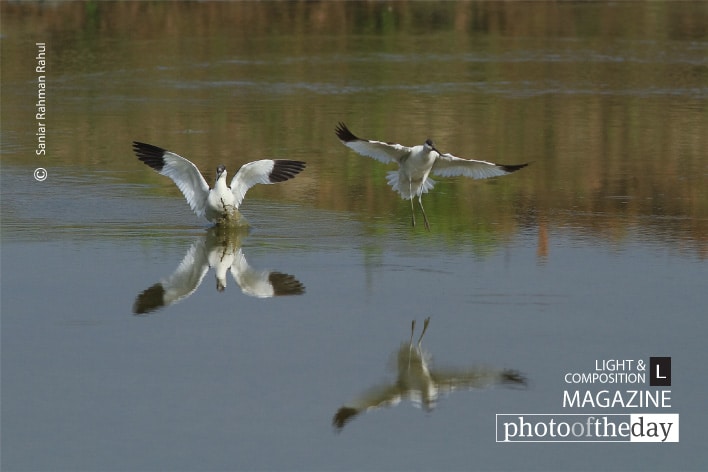
Pied Avocet by Saniar Rahman Rahul
Captured during a visit to the Muhuri Dam, this photograph showcases the elegant Pied Avocet, a striking migratory bird that graces the wetlands of Bangladesh during the winter months. The photographer masterfully documents the species in its natural habitat, observing the bird as it navigates shallow brackish waters and mud flats. By highlighting the Avocet’s unique behavior of scything its curved bill through the water to forage, the image provides an intimate glimpse into the life of this avian visitor. The composition is a testament to the beauty of migratory wildlife, capturing a fleeting, serene moment of natural history.
Saniar Rahman Rahul
Saniar Rahman Rahul is a dedicated nature photographer based in Bangladesh, known for his keen eye for the country's diverse migratory bird populations. His work frequently explores the intersection of avian behavior and the unique wetland ecosystems of the region, such as the Muhuri Dam. Through his lens, he seeks to bring international attention to the delicate beauty of local wildlife, combining patience with a deep appreciation for the natural world to create compelling, informative imagery.
Resonance Score Breakdown
Transparency Note: The resonance score (11.3/20) is calculated based on social engagement metrics collected before the award announcement.
Expert Photography Reviews · 7
The Rhythm of the Tide
I once spent an afternoon with an old fisherman near the mouth of the river, watching him mend a net that looked more like a spider’s web than a tool for work. He told me that the water has a memory, and if you watch long enough, you start to move in time with it.
Read the reflection →The Geometry of Silence
We spend so much of our lives trying to hold onto the solid, the heavy, the things that leave a footprint in the dust. Yet, there is a quiet wisdom in the creatures that live on the edge of the liquid world, where the earth softens into a mirror.
Read the reflection →Reviews & Comments
Share your thoughts about this award-winning photograph. Your reviews contribute to the community engagement score.
f/5.6 at 400mm, 1/1000s, ISO 200. A tight aperture choice for avian work. It’s a gamble on subject isolation that barely pays off against the busy mudflat background. The shutter speed is sufficient to freeze the scything motion, but the depth of field is thin enough that the bird’s tail loses sharpness. I’ve seen better focus tracking. It’s technically adequate, though I’d have preferred a wider aperture to kill that distracting background noise.
The focal plane here is razor-thin, perfectly isolating the Avocet’s recurved bill against the water’s surface tension. I’m genuinely moved by how the lens resolves the micro-ripples; it’s a masterclass in managing diffraction limits at such a distance. The bokeh, a function of the wide aperture, renders the brackish background into a soft, painterly wash. It’s rare to see such optical clarity in the field. I’ve rarely felt the bird’s hunger so acutely. It’s simply brilliant.
Before the eye identifies the bird, a sudden stillness settles in the chest. The Avocet’s rhythmic, scything motion triggers a strange, hypnotic pulse in my own wrists. It’s a quiet, repetitive hunger. When I return to this frame, I don’t see a wetland; I feel the cold, brackish water against my own skin. It’s haunting how such a simple, curved bill can pull me into a state of such profound, solitary focus. I’m breathless.
Most wildlife shots are just trophies, but this one lingers. I’ve seen thousands of bird studies, yet the way the Avocet’s bill slices the water’s surface here creates a genuine tension between stillness and hunger. It’s the precise ripple around the beak that anchors the frame. It doesn’t just document a species; it captures a quiet, rhythmic survival. Honestly, watching that delicate, scything motion makes me feel like I’m standing right there in the Feni mud.
The monochromatic elegance of the Avocet’s plumage against the silt-heavy, ochre-stained waters of the Muhuri Dam evokes a Morandi-esque stillness that I find deeply moving. It’s the way the bird’s stark, ink-black markings slice through the muted, bruised-clay tones of the shallows; one feels the damp, cool breath of the wetlands. It’s a quiet, chromatic symphony where the light doesn’t just illuminate the subject, it breathes a melancholic, painterly life into the mud.
The water is a mirror. It’s still. The bird moves, a sliver of white against the grey silt. I’ve spent minutes watching that curve of the beak. It doesn’t rush. It’s a study in patience. The space around the Avocet isn’t just water; it’s a breath held. I feel a sudden, sharp ache for this quiet. Nothing here is accidental. The empty corner is not empty. It’s the weight of the silence itself.
The Avocet’s curved bill acts as a sharp fulcrum, anchoring the frame against the horizontal drift of the mud flats. It’s a precise geometric intersection. The negative space above the bird doesn’t collapse; it breathes. I’d argue the composition holds because the bird’s posture dictates the entire spatial tension. It’s rare to see such structural discipline in wildlife work. The frame is balanced, clinical, and finally, it doesn’t waste a single pixel on sentimentality.