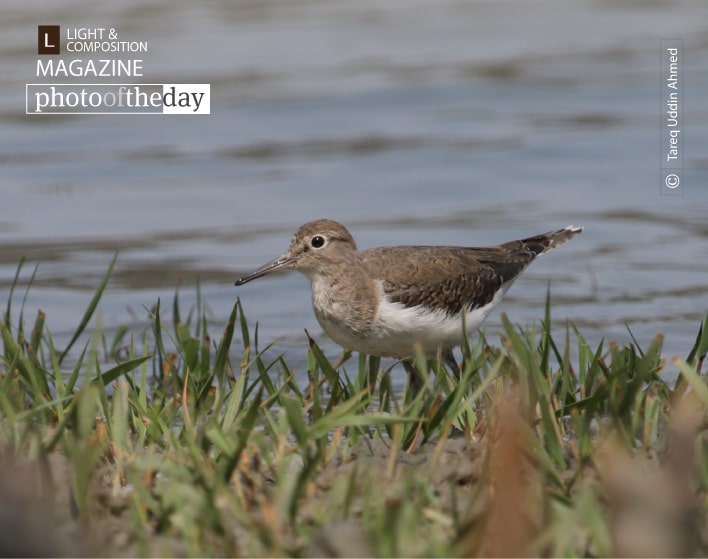
Common Sandpiper by Tareq Uddin Ahmed
The Common Sandpiper is a small, agile wader often found foraging along the water's edge. While walking near a muddy seaside field, the photographer observed this bird diligently searching for insects. The image captures the sandpiper in its natural element, highlighting the delicate textures of its plumage against the muted tones of the shoreline. This photograph is award-worthy for its sharp focus and the intimate, observational quality that brings the viewer into the bird's quiet, daily struggle for survival in the wild.
Tareq Uddin Ahmed
Born in Bangladesh in 1980, Tareq Uddin Ahmed is a Chittagong-based photographer who has gained significant recognition for his wildlife imagery since beginning his practice in 2011. As a founding member of the Chittagong Bird Club, he has traveled extensively across the country to document avian life, while also earning local acclaim for his detailed macro photography of flowers and butterflies. With his work previously featured in local newspapers, Ahmed is now focused on bringing his distinct perspective on nature to a global audience.
Resonance Score Breakdown
Transparency Note: The resonance score (14.2/20) is calculated based on social engagement metrics collected before the award announcement.
Expert Photography Reviews · 5
The Edge of Silence
We are drawn to the margins. The place where the solid earth gives way to the uncertainty of water. It is a thin line, shifting with the tide, indifferent to who stands upon it.
Read the reflection →The Quiet Business of Living
I spent this morning watching a neighbor tend to her small garden patch. She was hunched over, moving with such deliberate, rhythmic care, clearing away dry leaves and checking the soil. She didn't look up once, even when a car honked or a group of children ran past.
Read the reflection →Reviews & Comments
Share your thoughts about this award-winning photograph. Your reviews contribute to the community engagement score.
The frame’s geometry relies on the sandpiper’s placement against the shoreline’s horizontal grain. It’s a rigid, calculated alignment. The negative space doesn’t merely exist; it forces the eye toward the subject’s sharp, singular focus. I’m struck by how the muted tonality anchors the composition, preventing the bird from drifting into chaos. It’s a disciplined study of mass. The structure holds perfectly. It’s rare to see such cold, architectural precision in wildlife work. It’s quite satisfying.
The sandpiper doesn’t merely forage; it negotiates with the mud. I’m struck by how the muted shoreline swallows the bird’s periphery, forcing us to confront the creature’s isolation. It’s a stark, ontological solitude. When light fails to penetrate the darker silt, we’re left with the bird’s relentless, rhythmic survival. It’s haunting. Tarkovsky understood that time is the only material we truly possess, and here, in the stillness of Foillatoli, that time feels heavy, cold, and utterly unforgiving.
Of the thousands of wildlife shots I’ve reviewed, most are just technical exercises. What separates this from the rest is the mud. By keeping the horizon low, Tareq forces us to confront the grit of the shoreline, not just the bird. It’s a quiet, honest portrait of survival. I felt a genuine pang of empathy for that small creature. It’s not just a sharp capture; it’s a document of a life that will matter in thirty years.
Before the eye identifies the sandpiper, a sudden stillness settles in the chest. It’s the weight of that muddy shoreline, the way the bird’s frantic, singular focus pulls your own pulse down to match its rhythm. I’ve returned to this frame three times today; it’s the isolation that haunts me. You don’t just see the plumage; you feel the damp, cold grit of Foillatoli. It’s a quiet, persistent ache that follows you long after you look away.
We look at this sandpiper and we don’t just see a bird; we see a life lived in the margins. Tareq didn’t just point his lens; he waited until the creature felt safe enough to reveal its rhythm. I’m struck by the quiet dignity in its posture against the mud. It’s a portrait of persistence. When I see those sharp, watchful eyes, I feel a sudden, profound kinship with this small, busy traveler. It’s truly beautiful.