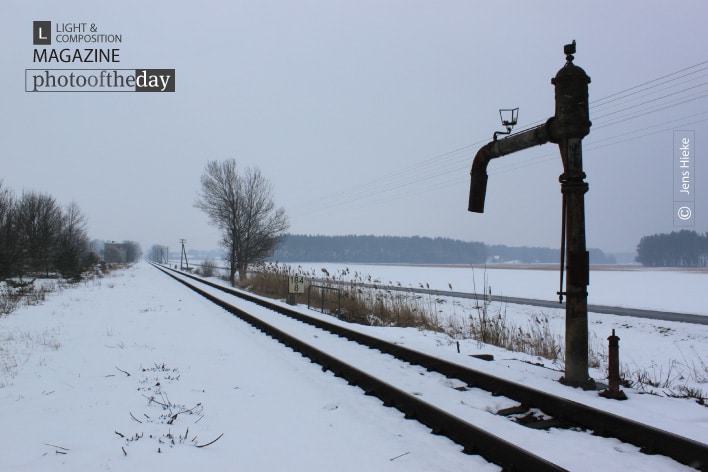
19th Century Standpipe by Jens Hieke
The 19th-century water standpipe, situated near the historic Berlin-to-Gorlitz railroad line, serves as a poignant relic of a bygone industrial era. The photographer captures this structure against the backdrop of a landscape marked by history, where the absence of a second track—removed as war reparations—creates a visual bridge to the past. By focusing on the standpipe’s stark silhouette and the vanishing perspective of the tracks, the image evokes a sense of quiet melancholy. Its award-worthy quality lies in the masterful use of documentary composition to transform a simple piece of infrastructure into a profound narrative about time, loss, and the enduring remnants of history.
Jens Hieke
Born in 1967, Jens Hieke is a Leipzig-based photographer and former librarian who transitioned from a career in broadcasting to the visual arts. Drawing inspiration from his deep-seated passion for literature, he approaches photography as a medium to document the transient beauty of the world, from human subjects to architectural remnants. Hieke balances his life as a man of words with a growing portfolio of documentary work, utilizing his Canon EOS 500D to capture the evolving landscapes of his native Germany.
Resonance Score Breakdown
Transparency Note: The resonance score (12.7/20) is calculated based on social engagement metrics collected before the award announcement.
Expert Photography Reviews · 4
The Iron Taste of Time
There is a specific, metallic tang that clings to the back of the throat when you stand near old, rusted iron. It tastes like cold rain on a winter morning and the dry, brittle scent of oxidized history.
Read the reflection →Echoes of the Iron Road
I found an old postcard in a thrift shop this morning. It was tucked inside a book I didn't mean to buy, showing a train station that doesn't exist anymore.
Read the reflection →Reviews & Comments
Share your thoughts about this award-winning photograph. Your reviews contribute to the community engagement score.
The standpipe’s verticality anchors the frame, slicing the horizon with clinical precision. It’s a rigid fulcrum against the receding geometry of the tracks. The negative space to the left isn’t just emptiness; it’s a calculated void that forces the eye back to the iron mass. I’ve rarely seen such disciplined spatial tension. It doesn’t rely on sentimentality. The structure holds, and honestly, the sheer austerity of the composition is enough to stop me cold.
The frame pulls you into a long, lonely tracking shot. That standpipe isn’t just iron; it’s a character waiting for a train that’s never coming back. I feel a genuine ache in my chest looking at those empty tracks. The 163mm compression flattens the history, locking the silence in place. It’s a perfect cut. The editor would keep this shot forever because it understands that the most powerful motion is the kind that refuses to move.
It’s a bleak, lonely bit of ironwork, isn’t it? One can almost feel the biting wind off the Saxon plains. I’ve spent enough hours shivering by rusted tracks to know that Hieke didn’t just stumble upon this. He waited for that precise, flat light to strip the scene of sentimentality. It’s a cold, honest frame. I find myself wanting to pull my coat tighter just looking at it. He clearly returned until the sky surrendered.
The light here is thin, the flat, grey exhaustion of a day that’s forgotten its purpose. He stood by those rusted rails when the silence felt heavy, waiting for the standpipe to reveal its loneliness. I’ve felt that same ache, that stillness where the land refuses to speak. It’s not just a relic; it’s a ghost of industry. Looking at it, I feel a sudden, sharp cold in my own chest. It’s hauntingly beautiful.