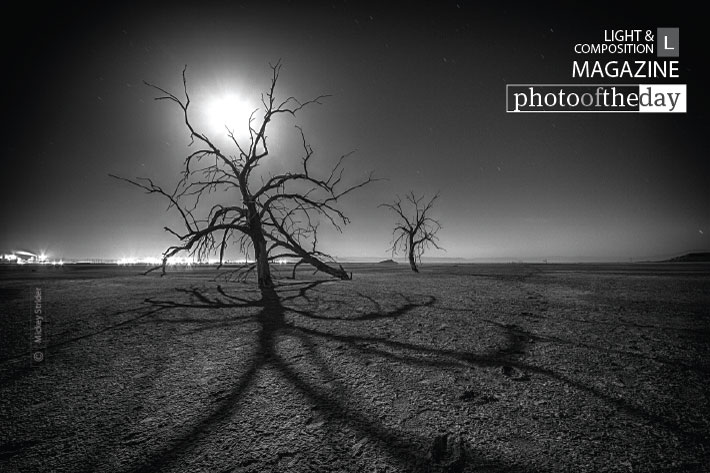
Red Hill Three and the Supermoon by Mickey Strider
Captured at 3:30 a.m. on the night of a Supermoon, this long-exposure photograph features the iconic dead trees at Red Hill Marina on the Salton Sea. The photographer sought to capture the dramatic moon shadows cast across the landscape, utilizing a long exposure to pull detail from the darkness. The decision to convert the final image to black and white emphasizes the stark, haunting textures of the trees against the celestial glow. This work stands out for its technical patience and the photographer's ability to transform a desolate, nocturnal environment into a compelling, ethereal narrative.
Mickey Strider
Born and raised in Baltimore, Maryland, Mickey Strider developed an early passion for visual storytelling, earning honors at the Baltimore County Film Festival before studying art at the Maryland Institute College of Art. His extensive career spans advertising, film production, and directing, including notable work on CGI television specials and award-winning short films screened at festivals nationwide. Now based in Encinitas, California, Strider brings a seasoned cinematic perspective to his photography, blending technical precision with a deep understanding of narrative composition honed through years of professional experience in the film and advertising industries.
Resonance Score Breakdown
Transparency Note: The resonance score (12.7/20) is calculated based on social engagement metrics collected before the award announcement.
Expert Photography Reviews · 5
The Salt on the Tongue
The air at three in the morning has a specific, metallic bite, like licking a cold iron gate in the middle of winter. It tastes of dry earth and ancient, evaporated tides.
Read the reflection →The Watcher in the Dark
There is a particular kind of grace found only in the deepest hours of the night, when the world has finished its frantic pace and surrendered to the quiet. In this stillness, the earth seems to exhale, shedding the weight of the day to reveal something ancient and unadorned.
Read the reflection →Reviews & Comments
Share your thoughts about this award-winning photograph. Your reviews contribute to the community engagement score.
A fantastic composition of light and shadow, coherent. Perfect!
Beautiful photograph
Shadow isn’t merely the absence of light; it’s where the landscape confesses its mortality. In these skeletal trees at Red Hill, I feel a sudden, cold ache in my chest. Strider hasn’t just captured a moonlit desert; he’s forced the darkness to articulate the silence of the Salton Sea. It’s a brutal, monochromatic reckoning. When we strip away color, we’re left with the raw geometry of ghosts. It doesn’t invite us in; it demands we endure it.
The wide-angle distortion pulls the horizon into a precarious arc, anchoring the dead trees against a bloated lunar disc. It’s a rigid geometry. The negative space doesn’t merely exist; it exerts pressure on the skeletal branches. I’m genuinely unsettled by how the long exposure flattens the depth, turning the Salton Sea into a void. The frame holds, though the composition teeters on the edge of chaos. It’s a calculated, cold architecture of light.
Stripping away the chromatic spectrum feels like a betrayal of the Salton Sea’s bruised, saline soul, yet one can’t deny the haunting silver-grey of these skeletal trees. It’s a monochrome Morandi, where the absence of colour forces the eye to ache for the missing ochre of the desert floor. I’ve stared at these gnarled, lunar-lit branches until my own skin felt brittle, mourning the vibrant, toxic decay that’s been silenced by this stark, celestial, and lonely exposure.
We look at these skeletal trees and we don’t see a landscape; we see a congregation. Mickey Strider didn’t just wait for the moon; he sat in the dark and listened to the silence of the Salton Sea until the earth began to speak. It’s haunting, how those branches reach up like desperate, arthritic hands. I find myself shivering, feeling the weight of their long, lonely vigil. It’s a portrait of a place that’s forgotten how to breathe.
Of the thousands of night shots I’ve reviewed, most rely on cheap gimmicks. Strider’s work survives because of that 120-second exposure. By dragging the shutter, he turned the Salton Sea’s decay into a velvet void. I’ll admit, the silence in this frame actually makes me hold my breath. It’s the decision to strip away color that saves it; without the distraction of hue, the skeletal trees become permanent, haunting anchors against that impossible, glowing moon.