Muttrah Corniche at Blue Hour by Sanjoy Sengupta
Captured during the tranquil transition of the blue hour, this photograph highlights the vibrant energy of the Muttrah Corniche as evening descends. The photographer utilized a long exposure to transform the movement of passing traffic into ethereal light trails, creating a dynamic contrast against the static, iconic Oudh incense burner structure in Riyam Park. This composition masterfully bridges the gap between Oman’s modern urban pulse and its deep-rooted cultural heritage. The image is award-worthy for its technical precision in low-light conditions and its evocative ability to capture the warm, welcoming spirit of Omani hospitality through a sophisticated, long-exposure lens.
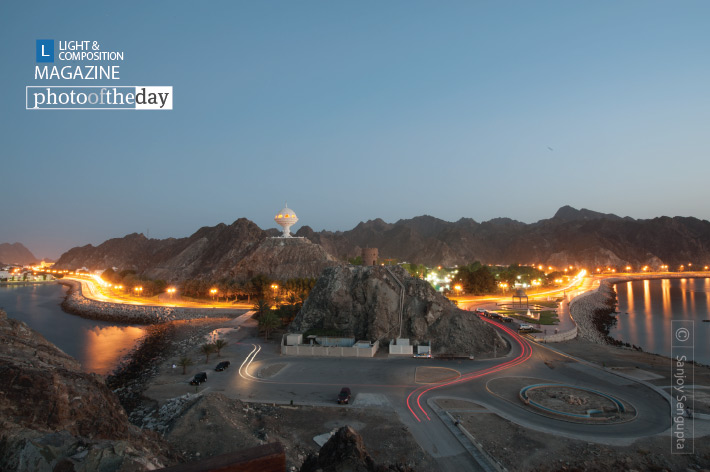
Exposure 44sec @ f/22 | ISO 200 | Focal Length 19mm
Sanjoy Sengupta
Based in Muscat, Oman, Sanjoy Sengupta is a dedicated photographer whose journey began with film cameras in the late 1990s. After years of refining his craft through various digital point-and-shoot and hybrid models, he transitioned to professional Nikon DSLR equipment, which marked a significant turning point in his technical development. His work is defined by a persistent passion for documenting the fleeting, beautiful moments of life, consistently seeking to capture the essence of his surroundings with both patience and an evolving artistic vision.
Resonance Score Breakdown
Transparency Note: The resonance score (13.1/20) is calculated based on social engagement metrics collected before the award announcement.
Expert Photography Reviews · 7
The Rhythm of Returning
There is a quiet rhythm to the day that we often overlook in our rush to arrive.
Read the reflection →The Salt on the Wind
The air at dusk has a specific weight, a damp coolness that clings to the skin like a damp linen sheet. I remember the smell of the harbor—a sharp, metallic tang of cooling asphalt mixed with the brine of a restless sea.
Read the reflection →Reviews & Comments
Share your thoughts about this award-winning photograph. Your reviews contribute to the community engagement score.
The blue hour doesn’t just fall here; it breathes. Sanjoy waited for the light to soften into that deep, velvet indigo, letting the traffic blur into ribbons of gold. I feel a sudden, quiet ache in my chest looking at that incense burner, anchored against the restless motion of the city. It’s a patient dialogue between the ancient stone and the fleeting present. He stood there, holding his breath, until the world finally settled into stillness.
Forty-four seconds at f/22 is a bold gamble with diffraction, yet it’s paid off here. One suspects Sengupta didn’t just stumble upon this; he’s clearly spent the evening shivering while the traffic blurred into those ribbons of light. I’ve spent enough nights chasing the blue hour to know the discomfort involved in getting that incense burner perfectly still. It’s a disciplined, quiet piece of work. He earned this view, and frankly, I’m rather jealous of it.
Before the eye identifies the incense burner, something in the chest settles. The long exposure turns traffic into a rhythmic pulse, a steady hum that slows my own breathing. I’ve returned to this blue hour three times today, and each time, the static architecture feels like a quiet anchor in a rushing world. It’s the stillness of the light trails that catches me; they don’t feel like movement, but like a long, held breath.
Most long exposures of traffic are just gimmicks, but here, the light trails don’t just blur; they anchor the incense burner. I’ve seen thousands of blue hour shots, yet this one avoids the usual digital sterility. It’s the way the warm glow of the architecture fights the encroaching dark that gets me—it feels like a memory I’m actually glad to hold onto. In thirty years, this quiet, steady pulse of Muttrah will still feel entirely alive.
The incense burner anchors the frame, providing a necessary fulcrum against the kinetic light trails. It’s a rigid geometry that prevents the composition from dissolving into mere blur. The long exposure forces a spatial tension between the static architecture and the fluid traffic. I’ve grown weary of such predictable long exposures, yet the weight here holds. The frame doesn’t collapse. It’s a disciplined study of mass, even if the blue hour tonality feels somewhat conventional.
We look at the incense burner standing guard over the Corniche and we feel the weight of history. Sanjoy didn’t just capture light trails; he listened to the city’s heartbeat. The long exposure turns the traffic into a restless ghost, yet the Omani spirit remains anchored, patient, and warm. It’s a quiet conversation between the ancient and the fleeting. I’ve stared at this for hours, and honestly, it makes me ache for a home I’ve never visited.
The incense burner holds the horizon. It’s a static anchor in a sea of motion. I’ve spent minutes watching the light trails blur into ghosts. They don’t clutter the frame; they define the silence around them. It’s a rare restraint. The blue hour isn’t just a time of day here. It’s a breath. Nothing is accidental. The empty corner isn’t empty. It’s where the quiet lives. I feel my own pulse slow down.