Ying Yang by Shirren Lim
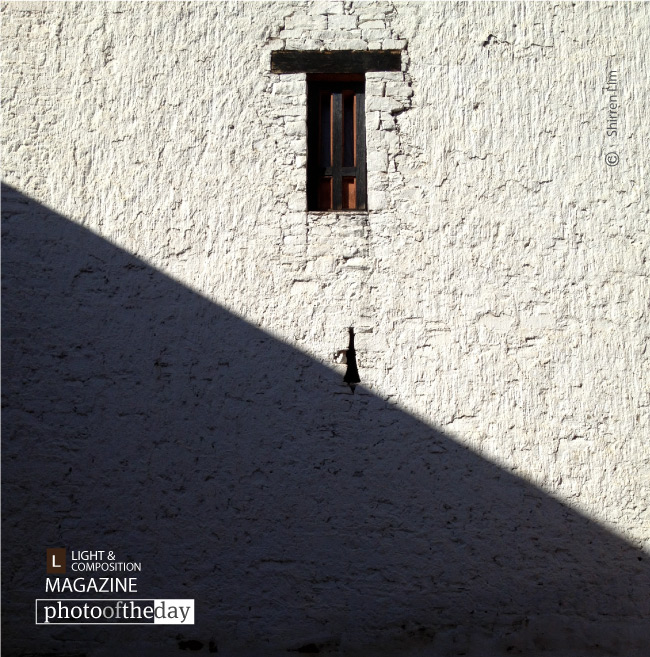
While exploring the historic Paro Dzong in Bhutan, the photographer encountered a striking architectural moment where the sun’s position perfectly bisected a wall, creating a natural duality. The inclusion of a small, solitary window added a layer of intrigue, transforming a simple structural element into a compelling study of light and shadow. This photograph is award-worthy for its minimalist composition and the photographer’s keen eye for geometric balance, effectively capturing the interplay of light that defines the scene's unique character.
Shirren Lim
Born in Penang Island, Malaysia, in 1970, Shirren Lim is a Jakarta-based photographer who discovered her true passion for the craft in 2009. Known for her intense and earthy portraiture, she strives to capture the raw sincerity of human expression, drawing deep inspiration from the iconic work of Steve McCurry. Her evocative imagery, which seeks to document the depth of the human experience, has been featured in various international web and print publications.
Resonance Score Breakdown
Transparency Note: The resonance score (13.9/20) is calculated based on social engagement metrics collected before the award announcement.
Expert Photography Reviews · 4
The Weight of Divided Light
The smell of old stone is always the same—a cold, mineral dampness that clings to the back of the throat like moss. When I press my palm against a wall that has stood for centuries, I feel the slow, rhythmic pulse of the earth beneath the mortar.
Read the reflection →The Architecture of Balance
In the quiet corners of old houses, there is often a seam where the day splits in two. We tend to think of light as a singular force, a wash that covers everything equally, but if you sit long enough in a room with thick walls, you begin to notice the division.
Read the reflection →Reviews & Comments
Share your thoughts about this award-winning photograph. Your reviews contribute to the community engagement score.
The ochre of this wall, reminiscent of a weathered Morandi still life, doesn’t merely sit; it breathes, caught in a violent, sun-drenched bisection that feels almost sacred. One finds the shadow’s edge—a crisp, obsidian void—so sharp it’s startling, slicing through the warmth like a blade. I’m truly breathless at how the light’s intensity renders that solitary window a mere ghost, a pale, haunting whisper of white against the heavy, earthen weight of the Bhutanese stone.
The sun doesn’t merely bisect this wall; it interrogates the stone. In the Paro Dzong, Lim captures a silence so heavy it feels like a physical weight against my chest. That solitary window isn’t just an aperture; it’s an eye peering into the void. I’ve always believed that shadows are where the image thinks, and here, the darkness is profound. It doesn’t invite us in. It demands we acknowledge the gravity of what remains hidden.
Before the eye identifies the geometry of Paro Dzong, something in the chest tightens. It’s the sudden, sharp bisection of light that triggers a physiological stillness. I find myself holding my breath, waiting for the shadow to shift. When I return to this, I don’t see architecture; I feel the weight of that solitary window against the void. It’s a quiet, haunting ache—the kind that follows me into sleep, long after the screen goes dark.
1/2100sec at f/2.4, ISO 50. A mobile sensor pushed to its limits in bright Bhutanese light. The 4.3mm focal length provides the necessary depth to keep that window sharp against the stone. It’s a clean, clinical execution. I’ve spent years staring at sensors, and honestly, the lack of noise here is impressive. You didn’t waste the light. The geometry holds up because the exposure was disciplined. It’s a rare moment where the hardware didn’t fail the eye.