Moonlight Sonata by Kazi Fazly Rabby
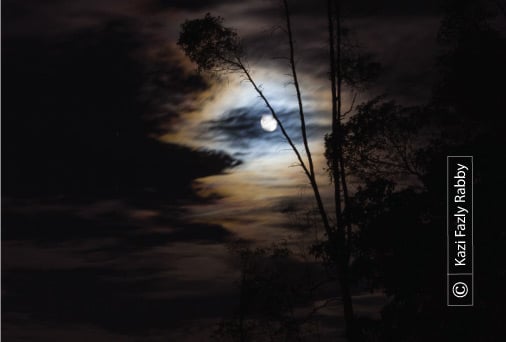
Captured during the final night Kazi Fazly Rabby spent with his Canon 550D, this long-exposure photograph serves as a poignant farewell to both a camera and a cherished home. Drawn to the ethereal glow of a full moon filtering through the dense, tropical canopy of Sarawak, the photographer utilized a 30-second exposure to transform the moonlight into a serene, painterly composition. This image is award-worthy for its technical patience and its ability to evoke a deep sense of nostalgia, successfully translating the quiet, rhythmic beauty of a Malaysian night into a visual sonata that balances light, shadow, and personal memory.
Kazi Fazly Rabby
Originally from Bangladesh and currently based in the state of Sarawak, Malaysia, Kazi Fazly Rabby is a dedicated photographer whose creative journey began with a Kodak film camera in 1998. After a hiatus, he rediscovered his profound passion for the craft in 2007, finding renewed inspiration in the natural world. He is best known for his contemplative approach to nature photography, often wandering alone through landscapes to capture the intricate beauty of his surroundings with a keen, observant eye.
Resonance Score Breakdown
Transparency Note: The resonance score (12.2/20) is calculated based on social engagement metrics collected before the award announcement.
Expert Photography Reviews · 4
The Weight of Leaving
We carry our histories in the objects we touch. A tool, a pen, a heavy coat—they absorb the shape of our hands and the temperature of our days. When the time comes to set them down, there is a sudden, sharp silence.
Read the reflection →The Weight of Leaving
I spent this morning packing the last of my books into cardboard boxes. It is strange how heavy paper becomes when you have to carry it from one life to the next.
Read the reflection →Reviews & Comments
Share your thoughts about this award-winning photograph. Your reviews contribute to the community engagement score.
Before the eye identifies the canopy, a sudden stillness settles in the chest. The thirty-second exposure doesn’t just capture light; it stretches time until the pulse slows to match the rhythm of the Sarawak night. I’ve found myself returning to this glow, feeling that familiar, hollow ache of leaving a place you’ve loved. It’s a quiet farewell that lingers, haunting the edges of my own memory long after I’ve turned away from the frame.
30 seconds at f/22, ISO 400. That aperture is a tactical error. Diffraction has softened the entire frame, turning the moonlight into a muddy smear rather than a crisp point source. It’s a technical failure that undermines the intent. I’ve spent years looking at these files, and honestly, the loss of sharpness here actually hurts to see. You don’t trade resolution for a long exposure when the optics can’t handle the diffraction limit.
The canopy’s density provides a necessary anchor against the long exposure’s diffusion. It’s a rigid geometry that prevents the light from dissolving into mere sentiment. The frame holds because the vertical trunks dictate the rhythm, forcing the eye to navigate the negative space with precision. I’ve grown tired of soft, nocturnal blur, yet the structural discipline here earns my respect. It doesn’t collapse under the weight of its own atmosphere. The architecture remains intact.
Stopping down to f/22 forces the light into a diffraction-limited state, softening the fine details of the canopy. It’s a risky choice, yet here, the resulting starbursts from the moonlight are physically mesmerizing. I’m genuinely moved by how the sensor’s noise at ISO 400 mimics the grain of film, softening the transition between shadow and glow. It’s a fragile, optical farewell; the physics of the aperture haven’t just captured light, they’ve distilled a memory.