Plain Tiger by Saniar Rahman Rahul
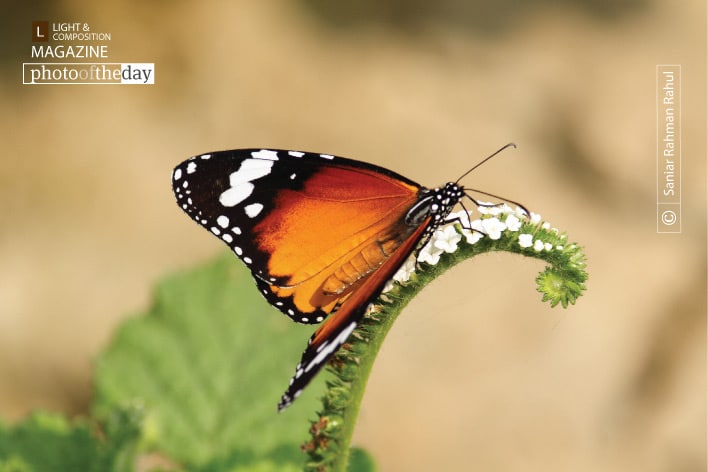
Captured in 2009 within the serene marshlands of Hakaluki Haor, this photograph documents the delicate presence of a Plain Tiger butterfly. As the day waned, the photographer observed the insect navigating the lush vegetation of the Eastern Bangladesh wetlands, seeking a secure spot to rest for the night. The image captures a fleeting, intimate moment of natural history, highlighting the butterfly's vibrant patterns against the soft, ambient light of the marsh. This work is award-worthy for its patient observation and the technical precision required to isolate such a fragile subject within its expansive, complex ecological habitat.
Saniar Rahman Rahul
Saniar Rahman Rahul is a dedicated nature and wildlife photographer based in Bangladesh, with a profound interest in documenting the rich biodiversity of the Indian Subcontinent. His work frequently explores the intricate ecological systems of marshlands and wetlands, showcasing a deep commitment to environmental storytelling. Through his lens, Rahul seeks to bridge the gap between scientific observation and artistic expression, bringing the subtle beauty of local flora and fauna to an international audience.
Resonance Score Breakdown
Transparency Note: The resonance score (13.5/20) is calculated based on social engagement metrics collected before the award announcement.
Expert Photography Reviews · 6
The Weight of a Breath
Why do we assume that stillness is the absence of life? We often mistake the quiet pause for a lack of purpose, as if existence must be defined by the frantic motion of the clock or the noise of our own ambitions.
Read the reflection →The Architecture of Rest
We spend our lives in a frantic choreography of movement, convinced that to be still is to be forgotten. Yet, the earth knows better. The roots of the willow do not rush to drink; the tide does not hurry to retreat.
Read the reflection →Reviews & Comments
Share your thoughts about this award-winning photograph. Your reviews contribute to the community engagement score.
The focal plane here is razor-thin, barely containing the Plain Tiger’s wing scales. At this magnification, the diffraction limit is a constant threat, yet Rahul has managed to resolve the intricate venation without sacrificing the soft, ambient bokeh of the marshland. It’s a delicate balance of glass and biology. I’m genuinely moved by how the light catches those translucent edges; it’s as if the lens has finally allowed us to see the butterfly’s true, fragile architecture.
Most macro shots of butterflies are just clinical records, but this one breathes. I’ve seen thousands of insect close-ups, yet Rahul’s work lingers because he didn’t just isolate the subject; he let the marshland’s soft, dying light wrap around those wings. It’s the way the Plain Tiger settles into the blurred green chaos that gets me—it feels like a quiet, final exhale. In thirty years, this intimacy will still matter more than any technical perfection.
Hakaluki Haor isn’t a place one visits for a quick snap; it’s a damp, mosquito-ridden endurance test. Rahul clearly didn’t just stumble upon this Plain Tiger. He’s waited for the light to soften, ensuring the butterfly’s wings didn’t blur against the marsh’s chaotic greens. I’ve spent enough nights in similar humidity to know the discomfort involved here. It’s a quiet, earned piece of work. One suspects he didn’t leave until the light was entirely gone.
Before the eye identifies the butterfly, a sudden stillness anchors the chest. The Plain Tiger’s orange wings against the muted marsh greens trigger a physiological slowing, a quietude I’ve rarely felt in such humid, expansive frames. It’s the weight of the coming night. When I return to this, I don’t see an insect; I feel the cooling air of Hakaluki Haor. It’s a fragile, held-breath moment that lingers in my mind long after I’ve walked away.
f/5.6 at 105mm, 1/125s, ISO 400. A macro lens choice that demands precision, yet the plane of focus is razor-thin. It’s a calculated risk that pays off. The butterfly’s wing scales are sharp, but the background bokeh is a bit noisy for my taste. I’ve spent years staring at these sensors, and honestly, the color rendition here is surprisingly clean. It’s a technically sound execution. You’ve managed the light well. It’s not perfect, but it works.
The light in Hakaluki Haor doesn’t just fall; it settles. He stood there in the cooling hour, waiting for the Plain Tiger to find its rest among the reeds. I’ve felt that same stillness, where the air grows heavy and the world narrows to a single, fragile wing. It’s a quiet communion. Looking at these vibrant, resting patterns, I feel a sudden, sharp ache for the simplicity of a marshland dusk. He listened well.