Starling’s Nest by Rahat Azim Chowdhury
Captured within the lush sanctuary of the National Botanical Garden of Bangladesh, this photograph highlights the delicate beauty of a Chestnut-tailed Starling. The photographer meticulously observed the bird’s behavior, seeking to document its nesting habits in a rare urban-adjacent habitat. By utilizing a long focal length, the photographer successfully isolated the subject against the natural backdrop, emphasizing the bird's charming features. This image is award-worthy for its patient wildlife observation and its ability to bring attention to the vital role of plant conservation areas in protecting local and migratory avian species.
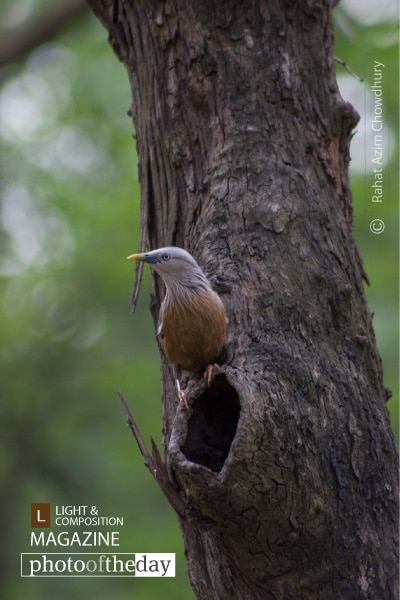
Rahat Azim Chowdhury
Based in Dhaka, Bangladesh, Rahat Azim Chowdhury is a computer engineer who transformed his lifelong appreciation for nature into a dedicated photographic pursuit. Inspired by his peers and a commitment to self-directed learning, he has honed his craft through formal training at the PRISM Photography Institute and extensive study of global photographic works. His portfolio spans a diverse range of subjects, including wildlife, architecture, and street photography, all unified by his desire to capture authentic social patterns and the unique character of the human experience.
Resonance Score Breakdown
Transparency Note: The resonance score (12.9/20) is calculated based on social engagement metrics collected before the award announcement.
Expert Photography Reviews · 6
The Architecture of Belonging
In the quiet corners of a garden, there is a frantic, rhythmic industry that goes largely unnoticed by those of us who walk with our heads full of tomorrow. We build our homes with bricks and mortar, assuming that permanence is the only way to secure a future.
Read the reflection →The Architecture of Belonging
How much of our identity is held together by the walls we build, and how much by the spaces we leave open? We spend our lives constructing sanctuaries, layering twigs and soft linings to ward off the vast, indifferent wind.
Read the reflection →Reviews & Comments
Share your thoughts about this award-winning photograph. Your reviews contribute to the community engagement score.

300mm at f/5.6, 1/400sec, ISO 800. The 75-300mm lens is a soft, entry-level glass that struggles at the long end. You’ve pushed the sensor to ISO 800, introducing noise that muddies the starling’s plumage. It’s a compromise. You needed the reach, but the optics couldn’t resolve the detail. I’ve spent years fighting this specific lens’s chromatic aberration; it’s frustrating. You captured the behavior, but the technical execution is just barely holding the frame together.
One suspects Chowdhury didn’t just stumble upon this starling. Wildlife photography is rarely a matter of luck; it’s a tax paid in sweat and stillness. I’ve spent enough hours in damp hides to know the ache of holding a 300mm lens steady while waiting for a bird to stop fidgeting. It’s a quiet, honest piece of work. I find myself genuinely envious of the patience required to capture that particular, fleeting turn of the head.
The starling sits. It’s a small weight against the vast, blurred green of the garden. I find myself holding my breath, waiting for a movement that doesn’t come. The frame is mostly air. It’s a quiet relief. I’ve spent hours looking at cluttered frames today, but this one lets me rest. Nothing here is accidental. The empty corner is not empty. It’s a pause. A rare, still moment in a loud city.
At 300mm, the EF 75-300mm struggles with micro-contrast, yet the focal plane here captures the starling’s plumage with surprising fidelity. The f/5.6 aperture creates a soft, creamy bokeh that isolates the subject, though I’d have preferred a tighter diffraction limit to sharpen those iridescent feathers. Still, the way the light catches the eye’s reflection is genuinely moving; it’s a tiny, brilliant spark of life that makes me catch my breath. It’s a beautiful, fragile optical moment.
The air in the Botanical Garden must have been heavy, humid with the scent of damp earth. Rahat waited until the light softened, listening for the flutter of wings against the foliage. It’s a quiet, intimate communion. I feel a sudden, sharp ache for that stillness, watching the starling settle into its sanctuary. He didn’t force this moment; he simply let the bird exist, holding his breath until the light finally agreed to reveal its grace.
The starling’s plumage, a muted, bruised plum, vibrates against the verdant, moss-choked bokeh of the Dhaka canopy, echoing the quiet, dusty stillness one finds in a Morandi still life. It’s a chromatic whisper, really, where the bird’s tawny tail feathers bleed into the soft, humid light of the garden. I’ve found myself quite breathless before such subtle, earthy harmonies; they don’t just exist, they breathe, grounding the viewer in a fragile, fleeting, and deeply resonant atmosphere.