Sunrise in Himalaya by Sergiy Kadulin
Captured during a 2010 Himalayan trek in Sikkim, India, this photograph reflects the photographer's long-standing fascination with the vibrant, ethereal landscapes depicted in the paintings of Nicholas Roerich. Stationed at the Tshoka village at an altitude of 3,000 meters, the photographer rose before dawn to witness the mountains undergo a dramatic transformation of color. This image captures that fleeting, magical transition as the first light touched the peaks. The work is award-worthy for its evocative portrayal of silence and natural beauty, successfully translating a deeply personal, lifelong ambition into a serene and visually arresting composition.
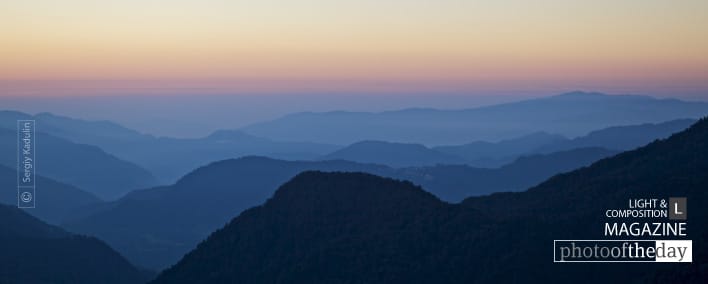
Exposure 1/100sec @ f/3.5 | ISO 100 | Focal Length 70mm
Sergiy Kadulin
Born in Kyiv, Ukraine, in 1967, Sergiy Kadulin balances a distinguished career in information technology with a profound, lifelong devotion to photography. After mastering film techniques with early cameras like the Zenit-12SD, he transitioned to digital workflows and further refined his craft through the Kyiv School of Photography and the New York Institute of Photography. Specializing in travel and landscape photography, Kadulin uses his lens to share his deep appreciation for nature and human connection, aiming to convey the warmth of his experiences to an international audience.
Resonance Score Breakdown
Transparency Note: The resonance score (11.2/20) is calculated based on social engagement metrics collected before the award announcement.
Expert Photography Reviews · 6
The First Breath of Morning
I woke up before my alarm today, just as the room was turning that strange, bruised shade of blue that happens right before the sun decides to show up. I stayed under the covers, listening to the absolute silence of the house. It is a rare thing, this stillness.
Read the reflection →The Breath of Stone
The air at that height tastes like cold iron and thin, sharp needles. It is a flavor that scrapes the back of your throat, waking up parts of your lungs you usually leave dormant in the valley.
Read the reflection →Reviews & Comments
Share your thoughts about this award-winning photograph. Your reviews contribute to the community engagement score.
Before the eye identifies the jagged peaks of Tshoka, something in the chest softens. It’s a physiological surrender to that specific, bruised violet light. I’ve returned to this sunrise three times today, and each time, my pulse slows to match the mountain’s stillness. It doesn’t just depict a landscape; it forces a quiet, cold clarity into my lungs. I feel the thin air, a sharp, lonely ache that lingers long after I look away.
Of the thousands of mountain shots I’ve reviewed, most are just postcards. What separates this from the pack is the restraint in the light. Kadulin didn’t overcook the saturation; he let the cold, thin air of Tshoka dictate the palette. I’ve stared at these peaks for ten minutes, and I still feel the silence of that altitude in my chest. It’s a rare, honest capture that will still matter in thirty years because it’s quiet.
The mountain peaks anchor the upper third, creating a rigid horizontal axis that stabilizes the frame. Below, the village architecture provides necessary geometric contrast to the organic, jagged silhouettes. It’s a disciplined arrangement of mass. The negative space in the valley floor prevents the composition from collapsing under its own weight. I’ve rarely seen such precise spatial tension. It doesn’t rely on sentimentality; the structure holds the light captive. It’s a cold, calculated triumph of geometry.
At 3,000 meters, the light doesn’t just arrive; it interrogates the rock. Kadulin’s peaks emerge from the void like a thought struggling against oblivion. I’ve spent hours staring at these shadows, and honestly, they make me feel small, almost erased. It’s not the sunrise that matters here, but the heavy, encroaching darkness that refuses to yield. Roerich painted dreams, but this photograph captures the cold, indifferent silence of a world that doesn’t need our gaze to exist.
The Himalayan peaks don’t merely catch the light; they inhale the bruised violet of a dying night, exhaling a pale, buttery saffron that reminds me of Turner’s most feverish Venetian skies. It’s a chromatic collision that makes my heart ache with a sudden, sharp longing for that thin, freezing air. One finds here a delicate, shivering harmony, where the shadows aren’t merely absent light, but deep, resonant pools of indigo waiting for the sun’s inevitable, golden intrusion.
The air at 3,000 meters is thin, and I can feel the biting cold in my own lungs just looking at this. Sergiy didn’t just capture a sunrise; he waited for the mountain to breathe. That raking light, catching the peaks while Tshoka remains in shadow, is a prayer. It’s the kind of silence that demands you put your camera down and simply exist. I’ve been there, shivering in the dark, waiting for that exact glow.