Changeable Lizard by Nazmul Shanji
While trekking through the Rema Kalenga Wildlife Sanctuary in search of leopards, the photographer encountered a remarkable changeable lizard. Intrigued by the creature's natural camouflage, the photographer attempted a close-up portrait, which provoked the lizard into an aggressive display. This sudden shift in behavior triggered a vibrant transformation in the lizard's skin color, a fascinating defense mechanism that defines the species. The resulting image captures this rare, fleeting moment of biological intensity, showcasing the photographer's patience and ability to adapt quickly to unpredictable wildlife encounters in the dense forest environment.
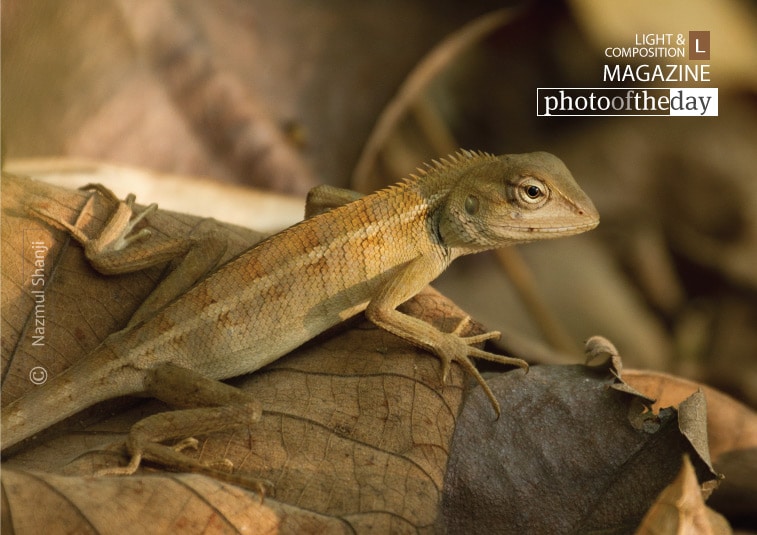
Exposure 1/200sec @ f/5.6 | ISO 400 | Focal Length 300mm
Nazmul Shanji
Born in Dhaka, Bangladesh, in 1986, Nazmul Shanji is an electrical power engineer who transitioned into photography as a dedicated creative pursuit. Inspired by his wife and a commitment to self-directed learning, he has rapidly developed his craft through formal coursework and extensive study of nature and human life. Shanji specializes in wildlife, architectural, and street photography, consistently striving to develop a unique artistic signature that reflects his personal observations of the world. He remains deeply committed to documenting the unseen diaries of life through his lens.
Resonance Score Breakdown
Transparency Note: The resonance score (11.0/20) is calculated based on social engagement metrics collected before the award announcement.
Expert Photography Reviews · 4
The Colors We Keep Hidden
I was walking through the park this morning when I saw a man arguing with a stranger over a parking spot. His face turned a deep, blotchy red, and his posture shifted from relaxed to rigid in a heartbeat.
Read the reflection →The Pulse Beneath the Bark
There is a specific heat that rises from damp earth after a long rain, a smell of wet minerals and decaying leaves that clings to the back of the throat.
Read the reflection →Reviews & Comments
Share your thoughts about this award-winning photograph. Your reviews contribute to the community engagement score.
Before the eye identifies the lizard, a sudden tension tightens the chest. It’s that visceral, reptilian alertness—the creature’s throat pulsing with a neon, warning orange that feels almost electric. I’ve found myself holding my breath, mirroring its defensive posture. When I return to this, the shock of that color still pricks at my nerves. It’s not just a portrait; it’s a confrontation that lingers, a flicker of wild, unyielding defiance that follows me into sleep.
The lizard’s diagonal spine bisects the frame, creating a rigid axis that anchors the chaotic foliage. It’s a sharp, geometric intervention. The saturated throat pouch provides the necessary tonal weight to counter the encroaching blur of the background. I’ve rarely seen such aggressive geometry in wildlife work. The composition holds, though the depth of field is dangerously thin. It doesn’t collapse under the pressure of the subject’s movement. It’s a cold, precise victory of structure.
1/200sec at f/5.6, 300mm, ISO 400. It’s a precarious balance. At 300mm, 1/200sec is asking for motion blur, yet the lizard’s display remains sharp. The f/5.6 aperture creates just enough separation from the chaotic Rema Kalenga foliage. I’ve spent hours in similar brush; getting this focus lock while the subject is mid-transformation is damn impressive. It’s a technically sound capture of a volatile moment. The numbers hold up. The photographer didn’t waste the opportunity.
At 300mm, the focal plane is razor-thin, yet Shanji’s hit is precise. The diffraction limit at f/5.6 preserves the lizard’s granular scales, revealing a biological intensity the naked eye would surely miss. I’m genuinely moved by how the chromatic aberration remains controlled against the dense Sylhet foliage. It’s a rare, fleeting intersection of optics and evolution. When the lizard’s skin shifts, the lens doesn’t just record the color; it captures the very physics of its defense.