Dholma is Her Name by Karan Zadoo
In the high-altitude, cold desert landscape of Kaza, Spiti Valley, the photographer encountered a young girl named Dholma. Captured with a 50mm lens, the portrait isolates the subject against the stark, rugged backdrop of the Western Himalayas. The image is a poignant study of childhood and cultural identity, reflecting the Buddhist traditions of the region. By focusing on the girl and her doll, the photographer creates an intimate, authentic connection that transcends the harsh environment. This portrait is award-worthy for its ability to transform a fleeting street encounter into a timeless, evocative narrative of life in one of India’s most remote regions.
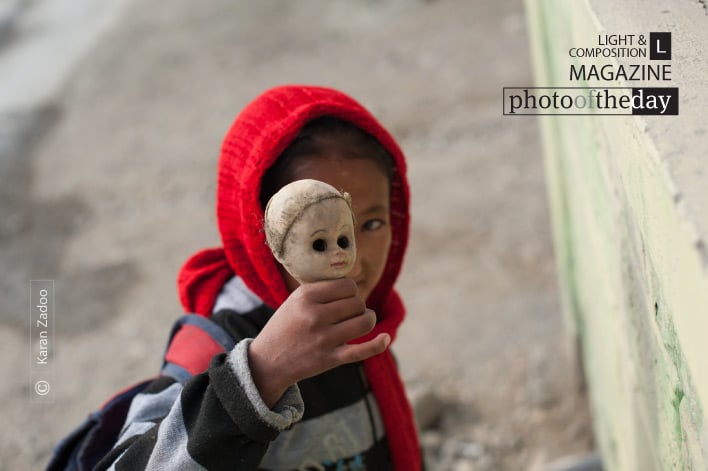
Exposure 1/1000sec @ f/3.5 | ISO 200 | Focal Length 50mm
Karan Zadoo
Born in Srinagar and raised in New Delhi, Karan Zadoo transitioned from a career in advertising to the world of professional photography after discovering a profound passion for the Himalayas. His work is defined by a deep curiosity for India's diverse landscapes and the untold stories of its people, ranging from bustling city lanes to remote mountain villages. Zadoo views photography as a continuous journey of learning and evolution, striving to document the human experience with sincerity and technical precision while remaining dedicated to his goal of becoming a significant voice in contemporary photography.
Resonance Score Breakdown
Transparency Note: The resonance score (12.6/20) is calculated based on social engagement metrics collected before the award announcement.
Expert Photography Reviews · 3
The Weight of Small Things
There is a quiet physics to the way we hold onto our earliest treasures. A stone from a riverbed, a frayed ribbon, a doll with a worn face—these are not merely objects. They are anchors.
Read the reflection →The Weight of Wool and Wind
The air in high places has a sharp, metallic tang, like licking a frozen spoon. It settles deep in the lungs, a cold weight that reminds you exactly where you are.
Read the reflection →Reviews & Comments
Share your thoughts about this award-winning photograph. Your reviews contribute to the community engagement score.
Dholma’s gaze doesn’t invite us; it interrogates the thin air of Spiti. Zadoo hasn’t just captured a girl; he’s mapped the silence between her doll and the void. I’ve stared at these shadows for an hour, and they feel like a heavy, cold weight against my own chest. It’s a brutal, honest geometry. When light refuses to soften the edges of her face, we finally see the world as it truly is: unyielding, lonely, and profoundly alive.
The subject’s placement within the frame is precise, yet the background’s rugged texture threatens to overwhelm the figure. It’s a precarious balance. The doll acts as a necessary fulcrum, anchoring the composition against the vast, indifferent Himalayan sprawl. I’m genuinely unsettled by how the negative space pulls the eye away from the girl’s gaze. It doesn’t quite resolve, but the structural discipline keeps the frame from collapsing into mere sentimentality. It holds, barely.
Before the eye identifies the child, something in the chest tightens. It’s the altitude, I think, or perhaps the way Dholma clutches that doll against the vast, indifferent Spiti cold. My pulse slows, mirroring her stillness. When I return to this a year later, the rugged backdrop feels less like geography and more like a quiet, internal weight. It’s a haunting, fragile activation of memory—I’ve felt that specific, lonely ache of childhood before.