Beyond Lines by Andrea Migliari
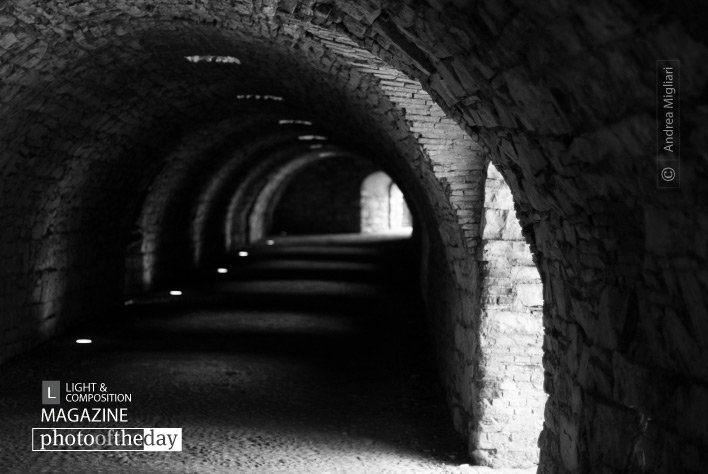
Captured within the historic walls of the Castle of Brescia, this photograph explores the interplay of geometry and shadow. The photographer focused on the stark contrast between illuminated surfaces and deep black voids, using the architectural lines of the ancient structure to create a compelling visual rhythm. By utilizing a wide aperture of f/1.4, the image achieves a shallow depth of field that isolates specific structural elements, emphasizing the interplay of light. This work is award-worthy for its minimalist approach, transforming a traditional architectural subject into a study of abstract form and tonal balance.
Andrea Migliari
Born in Italy in 1981, Andrea Migliari is a dedicated photographer currently based near Bergamo. After early experiences in carpentry and time spent living in London, he returned to Italy to pursue his passion for visual storytelling, transitioning from traditional film and darkroom techniques to digital mastery. His diverse portfolio, which spans landscapes, portraits, and live music, has earned recognition in prestigious publications like Overart and success in national competitions. Migliari continues to explore the beauty found in everyday surroundings, sharing his unique perspective through a refined, disciplined post-processing workflow.
Resonance Score Breakdown
Transparency Note: The resonance score (14.0/20) is calculated based on social engagement metrics collected before the award announcement.
Expert Photography Reviews · 8
The Weight of Stone
The smell of damp limestone always brings me back to the cellar of my childhood home. It is a scent that clings to the back of the throat, cool and mineral, like the taste of a river stone held under the tongue.
Read the reflection →The Architecture of Silence
In the quiet corners of an old house, shadows behave differently than they do in the open air. They do not merely hide; they define. There is a geometry to solitude that we rarely acknowledge until we are forced to sit still.
Read the reflection →Reviews & Comments
Share your thoughts about this award-winning photograph. Your reviews contribute to the community engagement score.
Before the eye identifies the stone, something in the chest tightens. It’s the silence of the Brescia shadows, pulling the breath inward. Migliari’s aperture choice creates a blur that feels like a fading memory, a soft ache I’ve carried since I first saw it. Returning a year later, the void doesn’t feel empty; it feels like a place I’ve hidden parts of myself. It’s a quiet, geometric trap that refuses to let me go.
Stone walls in Brescia. They’ve been stripped of history, reduced to a sharp, singular edge. Light doesn’t fall here; it carves. I’m struck by the weight of the black void. It’s heavy. It’s quiet. The shallow focus pulls my eye toward the blur, forcing me to linger in the nothingness. Nothing here is accidental. The empty corner is not empty. It’s a breath held in the dark. I’ve rarely felt such stillness in stone.
The stone of Brescia’s castle doesn’t just hold history; it breathes. Andrea waited for the light to carve these voids, choosing an aperture that softens the world into a whisper. I’ve stood in such silence, feeling the cold masonry against my palm while the sun retreats. It’s a quiet, rhythmic prayer of shadow and form. Looking at this, I feel a sudden, sharp ache for that stillness. He didn’t rush; he simply listened to the walls.
1/160sec at f/1.4, 50mm. ISO 200. Using f/1.4 on architecture is an aggressive gamble. Most would stop down to ensure the entire structure remains sharp, but Migliari forces the eye to commit to a single plane. It’s a risky isolation of geometry. I’ve spent years looking at these files, and honestly, the way the focus drops off into that void actually works. It’s technically reckless, yet the precision of the plane is undeniable. Correct choice.
At f/1.4, the 50mm lens pushes the focal plane into a razor-thin slice, forcing the Castle of Brescia’s stone into a soft, ethereal blur. It’s a daring choice; the diffraction limit is irrelevant here, replaced by the creamy bokeh of a wide-open aperture. I’m genuinely moved by how the light bleeds across those ancient edges. It’s not just architecture anymore; it’s a study of pure, luminous geometry that the human eye simply can’t resolve.
Shooting at f/1.4 in a fortress suggests a photographer who didn’t just stumble upon a shadow and click. It’s a risky game, isolating those stone edges while the light shifts. I’ve spent enough afternoons shivering in similar ruins to know that depth of field this thin demands a steady hand and a stubborn heart. One suspects Migliari returned until the geometry finally behaved. It’s a sharp, disciplined piece of work. I’m genuinely impressed.
It’s the way the light bleeds across those ancient stones, a pale, chalky ochre reminiscent of a Morandi still life, that truly arrests one’s breath. The shadows aren’t merely absent light; they’re deep, velvety voids of charcoal that swallow the architecture whole. I’m utterly captivated by how these tones collide, creating a rhythmic, almost musical dissonance that feels less like a building and more like a quiet, sun-drenched prayer whispered against the encroaching dark.
Most architectural shots in Brescia lean on the grandeur of the stone, but Migliari ignores the history to hunt for geometry. By shooting at f/1.4, he forces the ancient castle into a modern, abstract rhythm. It’s a risky choice that nearly collapses into mere blur, yet the sharp edge of that single pillar anchors the chaos. I’ve looked at thousands of these, and honestly, this one still makes me catch my breath. It’s built to last.