The Scent of the Past by Andrea Migliari
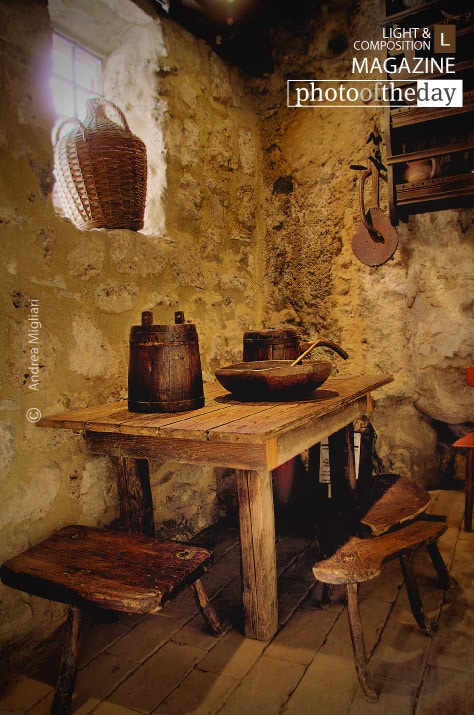
The Scent of the Past captures a nostalgic atmosphere, evoking a time when life moved at a slower pace and craftsmanship defined the everyday. The photographer was drawn to the deliberate arrangement of objects left upon a table, illuminated by the soft, diffused light filtering through a tiny window. This interplay of light and shadow breathes life into the scene, transforming mundane items into a poignant reflection on history. The image is award-worthy for its masterful composition and the evocative, painterly quality of the lighting, which successfully transports the viewer into a quiet, bygone era.
Andrea Migliari
Born in Italy in 1981, Andrea Migliari is a passionate photographer based near Bergamo. After early experiences in carpentry and a formative period in London, he cultivated his artistic vision through film photography and darkroom processing before transitioning to digital in 2009. Migliari’s work, which spans landscapes, portraits, and live music, has been featured in the Italian art magazine Overart and recognized with the 'Passione Italia' photography award. He remains dedicated to discovering the profound beauty hidden in everyday life, sharing his unique perspective through a refined post-processing workflow.
Resonance Score Breakdown
Transparency Note: The resonance score (13.0/20) is calculated based on social engagement metrics collected before the award announcement.
Expert Photography Reviews · 7
Echoes in the Dust
There is a particular kind of grace found in things that have been set aside. When an object is no longer needed for its original purpose, it begins to belong to time itself. It gathers the quiet, settling like fine silt upon the surfaces of our lives.
Read the reflection →The Weight of Dust
In the quiet corners of an old house, time does not move in a straight line. It settles. It gathers in the creases of a tablecloth or the hollow of a ceramic bowl, turning the air thick with the residue of things once held.
Read the reflection →Reviews & Comments
Share your thoughts about this award-winning photograph. Your reviews contribute to the community engagement score.
0.6sec at f/4.0, 17mm, ISO 100. A long exposure for a still life. It’s a calculated risk. The 17mm focal length pulls the viewer into the frame, but the f/4.0 aperture keeps the background soft enough to maintain focus on the objects. I’ve spent years staring at sensors, and honestly, the lack of noise here is refreshing. It’s a precise technical execution. The light doesn’t lie; it’s captured exactly as it fell. Correct choices.
The ochre of the worn wood table bleeds into the bruised, bruised violet of the shadows, creating a chromatic ache that reminds me of Morandi’s quietest still lifes. It’s a melancholic, dusty light, the colour of a forgotten afternoon in Krka, where the golden-grey tones don’t just sit there; they vibrate with a heavy, tactile silence that makes my own heart stutter with a sudden, sharp longing for a time I’ve never actually known.
Dust settles on wood. A window offers light, not clarity. I’ve spent minutes watching the shadows stretch across the grain. It’s quiet here. The objects aren’t clutter; they’re anchors. They hold the room in place. I feel a sudden, sharp ache for a home I’ve never visited. Nothing here is accidental. The empty corner is not empty. It’s a breath held in the dark. Silence, finally, has a shape. It’s enough.
The light here doesn’t just illuminate; it exhales. Andrea waited for that soft, filtered glow to settle upon the wood, turning simple objects into relics of a forgotten rhythm. I’ve spent enough hours in the stillness of old stone rooms to recognize the weight of that silence. It’s a haunting, intimate patience. Looking at these textures, I feel a sudden, sharp ache for a life I never lived. The land is finally breathing through the dust.
One wonders how long Migliari sat in that Krka stone room, waiting for the light to soften just enough to kiss those edges. It’s a quiet, deliberate piece of work. I’ve spent enough afternoons shivering in similar ruins to recognize the patience required to let shadows settle properly. It doesn’t feel rushed, which is a rare compliment these days. I’d have liked to be there, though I suspect I’d have been far less patient than he was.
Most still lifes I review this year feel like staged clutter, but this one breathes. The 17mm perspective pulls you into the frame, making that tiny window’s light feel like a secret I’m not supposed to see. It’s the dust motes dancing in the shadows that get me; they make the silence feel heavy. It’s not just a collection of old things; it’s a quiet, aching reminder that beauty survives long after we’ve left the room.
At f/4, the 17mm focal plane renders the table’s texture with a crispness that defies the soft ambient light. It’s a delicate balance; the diffraction limit hasn’t compromised the fine grain of the wood, allowing the light to pool naturally across the objects. I’m genuinely moved by how the lens resolves those subtle shadows. It’s not just a still life; it’s a precise capture of photons dancing through history. It’s simply beautiful optics.