Smoky Aircraft by Oscar Garcia
Captured during the Wings over Houston air show at Ellington Field, this striking image features the Douglas A-26B-30-DL Invader as it executes a dramatic flyby. The photographer masterfully timed the shot to catch the aircraft emerging from a simulated bombing run, emphasizing the raw power and historical significance of the machine. By utilizing a fast shutter speed to freeze the motion against the atmospheric backdrop, the photographer highlights the intricate details of the Invader. This photograph is award-worthy for its technical precision in capturing high-speed aviation and its ability to evoke the excitement and nostalgia of classic air show displays.
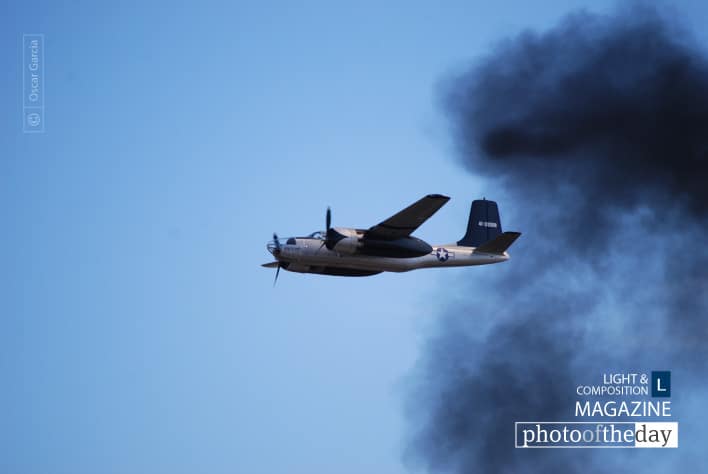
Exposure 1/800sec @ f/5.6 | ISO 200 | Focal Length 200mm
Oscar Garcia
Born in Mexico City and raised in a large family, Oscar Garcia eventually settled in Houston, Texas, where he built a successful career in the petroleum equipment industry. His lifelong fascination with photography began in the 1960s with his mother's camera and evolved through various digital formats before he found his creative home with Nikon systems. A seasoned traveler who has visited over 30 countries, Garcia balances his professional life with a deep-seated passion for capturing aviation and motion, earning recognition from various newspapers and international aviation organizations for his evocative work.
Resonance Score Breakdown
Transparency Note: The resonance score (11.3/20) is calculated based on social engagement metrics collected before the award announcement.
Expert Photography Reviews · 8
The Architecture of Echoes
In the quiet hours of the morning, I often think about how we leave our signatures upon the air. A bird cuts through a cloud, a runner disturbs the stillness of a park, or a heavy door swings shut, leaving a wake of vibration that lingers long after the movement has ceased.
Read the reflection →The Grit of Gravity
The smell of burnt oil always brings me back to the summer my father worked on the old tractor. It is a thick, metallic scent that clings to the back of the throat, tasting faintly of copper and ancient, tired earth.
Read the reflection →Reviews & Comments
Share your thoughts about this award-winning photograph. Your reviews contribute to the community engagement score.
The sky isn’t a backdrop. It’s a weight. The A-26 cuts through the gray, yet it’s the smoke that lingers. It’s heavy. It’s deliberate. I feel a sudden, sharp cold watching the machine vanish into that vast, pale void. Nothing here is accidental. The empty corner is not empty. It’s a breath held too long. Garcia doesn’t just freeze motion. He lets the silence of the clouds swallow the roar. It’s quiet. Finally.
The Invader tears through the Texas sky, yet it’s the smoke that truly haunts. It’s not merely exhaust; it’s a shroud, a deliberate obscuration of history’s violence. I find myself shivering, not from the cold, but from the realization that we’re watching a ghost machine consume its own presence. Garcia doesn’t just freeze motion; he traps the aircraft in a purgatory of soot. It’s a dark, heavy meditation on how we weaponize the horizon.
The bruised, slate-grey exhaust trailing the Invader evokes the melancholic, muted palette of a Morandi still life, yet it’s the sudden, violent intrusion of that burnt-sienna smoke against the pale, bleached-bone sky that truly arrests one’s breath. It’s a jarring, visceral collision of tones; I’ve found myself mesmerized by how the machine’s metallic sheen quarrels with the atmosphere, turning a simple air show maneuver into a haunting, chromatic study of industrial decay and fleeting light.
The roar of the Invader fades, leaving only the heavy, lingering ghosts of smoke. He stood there, amidst the heat of the Texas tarmac, waiting for the machine to carve its path through the haze. It’s a violent, mechanical intrusion, yet I find a strange, quiet stillness in the way the light clings to the metal. I’ve felt that same tension, that breathless pause before the shutter clicks, letting the land—and the sky—dictate the moment.
1/800sec at f/5.6, ISO 200. The shutter speed is adequate, but f/5.6 on a 200mm lens creates a shallow plane that barely holds the Invader’s fuselage. It’s a gamble. The D40X sensor struggles with the dynamic range of the smoke, yet the exposure holds. I’ve spent years watching these air shows, and the mechanical precision here actually makes me lean in. You didn’t overreach. The technical constraints were respected, and the result is sharp.
Before the eye identifies the Invader, the chest tightens. It’s the sudden, visceral activation of a threat response, that held-breath moment when the sky turns violent. I’ve always felt a strange, metallic ache in my throat looking at this smoke. It doesn’t just freeze motion; it traps the noise of the engine in your marrow. When you return a year later, that phantom roar still follows you into sleep, lingering like a half-remembered dream.
Most aviation shots are just glorified technical logs, but this one hits differently. By framing the Invader emerging from its own smoke, Garcia turns a mechanical flyby into a ghost story. I’ve seen thousands of air show frames, yet this one lingers because the smoke obscures the machine just enough to make it feel alive. It’s not just a plane; it’s a memory of power. I’d bet people will still feel that rumble in thirty years.
At f/5.6, the Nikon’s glass struggles against the diffraction limit, yet it resolves the A-26’s rivets with startling clarity. The shutter speed of 1/800sec effectively arrests the airframe, though I’m haunted by the chromatic aberration bleeding into the smoke plumes. It’s a fascinating collision of mechanical precision and turbulent fluid dynamics. Honestly, seeing the light refract through that exhaust haze makes my heart race; it’s a rare, visceral glimpse into the physics of flight.