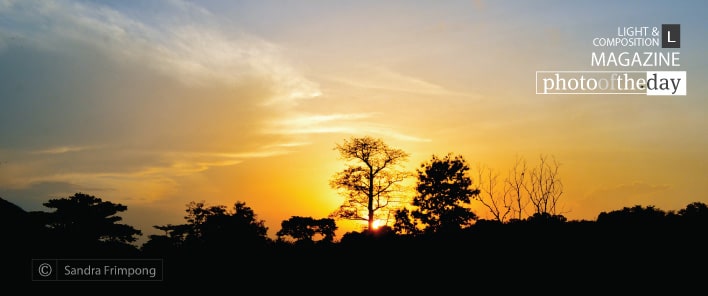
Sunset in Ghana by Sandra Frimpong
Captured in the vibrant landscape of Kumasi, Ghana, this photograph explores the universal magic of the setting sun. Sandra Frimpong masterfully frames the golden hour, highlighting how the light glistens across the African terrain to create a moment of profound tranquility. By utilizing a wide 18mm focal length, she emphasizes the vastness of the horizon, inviting viewers to witness the daily transformation of the sky. This image is award-worthy for its ability to elevate a common natural phenomenon into a poignant, evocative study of light, showcasing the photographer's keen eye for the simple yet breathtaking beauty found in everyday life.
Sandra Frimpong
Born and raised in Ghana, Sandra Frimpong later moved to the United States, where she served in the Navy and pursued higher education in business. Her global travels during her military service ignited a passion for photography, leading her to document the simple, often overlooked beauty of life across Africa, Asia, Europe, and America. Now residing in Italy, Frimpong continues to refine her artistic vision through formal study and community-focused projects, specializing in capturing intimate family moments and the diverse landscapes she encounters throughout her international journeys.
Resonance Score Breakdown
Transparency Note: The resonance score (13.7/20) is calculated based on social engagement metrics collected before the award announcement.
Expert Photography Reviews · 8
The Architecture of the End
In the quiet hours of the late afternoon, the world seems to hold its breath, as if waiting for a permission slip to finally close its eyes.
Read the reflection →The Debt of the Day
Why do we feel a sudden, quiet ache when the light begins to fail? It is as if the day itself is a borrowed thing, and the evening is the inevitable moment when we must return what we never truly owned.
Read the reflection →Reviews & Comments
Share your thoughts about this award-winning photograph. Your reviews contribute to the community engagement score.
Yes, I have lied. I have broken my heart as I broke yours. But it wasn’t my fault. Ours was never meant to have a natural demise! It collapsed of blindness and blunders and betrayals. Yes, we have tried. Yet we forgot to remember that our ego giants Could never sleep too soundly; And our senses of worth were the witches That often betrayed by their craves; And our warmth was always being well-hidden As we gave them up with our tongues! Yes, you were confused. As our bond wound and it was a slip-up That you took it for granted and let our tie die of sneering. Yet the brutal thing is it felt like the slip was mine. For trusting you!
At f/9.5, the Nikon’s sensor captures a crisp transition across the Kumasi horizon. The 18mm focal length pushes the diffraction limit just enough to soften the sun’s edge, creating a gentle, luminous bloom. I’m genuinely moved by how the light refracts through the atmospheric haze; it’s a rare, tactile warmth that feels almost physical against the retina. It’s not just a sunset; it’s a precise calibration of photons hitting the sensor at exactly the right moment.
Before the eye identifies the Kumasi horizon, something in the chest softens. The wide 18mm frame pulls the breath outward, mimicking the vast, cooling exhale of the earth itself. It’s a quiet activation of the nervous system. When I return to this, I feel a phantom heat against my skin. It doesn’t just document a sunset; it anchors a lingering, golden stillness in the body that stays long after the screen goes dark.
The light in Kumasi doesn’t just fall; it settles, heavy and golden, against the earth. Sandra waited for that precise, fleeting friction between day and night. I’ve stood in similar heat, feeling the air thin as the sun dips, and it’s a humbling silence. She didn’t rush the horizon. By choosing that wide 18mm view, she let the land breathe. It’s a quiet prayer of a photograph, and honestly, it makes me miss the dust of the road.
The ochre light here doesn’t merely sit upon the Kumasi horizon; it bleeds into the earth like the bruised, molten pigments of a Turner sunset. It’s a chromatic ache, that specific, dusty gold of a dying day, and honestly, it makes my chest tighten with a sudden, quiet longing. One finds the tonal transitions so fluid, so Morandi-esque in their restraint, that the vast, glowing sky feels less like a photograph and more like a prayer.
The horizon in Kumasi doesn’t demand attention. It simply exists. The sky bleeds into the earth, a quiet transition of light. I find myself holding my breath, waiting for the sun to finish its descent. It’s a rare stillness. The wide frame doesn’t feel empty; it feels heavy with the weight of the day. Nothing here is accidental. The empty corner is not empty. It’s a pause. I’ve never felt such peace in a sunset.
1/180sec at f/9.5, ISO 400, 18mm. The aperture choice is efficient; it keeps the Kumasi horizon sharp without introducing diffraction. ISO 400 is a lazy compromise, though. It’s noisy for a static landscape. I’ve seen better signal-to-noise ratios in far cheaper sensors. The composition is wide, yet the light feels thin. It doesn’t quite capture the heat I’d expect from Ghana. It’s technically competent, but it lacks the necessary grit to truly move me.
Most sunset shots are forgettable clutter, but this one holds. Of the thousands I’ve reviewed, few capture the specific, heavy heat of Kumasi like this. The 18mm lens doesn’t just show the horizon; it forces you to feel the scale of the earth beneath that fading light. It’s the way the shadows stretch across the terrain that gets me—I actually felt a pang of homesickness looking at it. It’ll matter in thirty years.
The 18mm focal length stretches the horizon, yet the composition lacks a definitive fulcrum. It’s a wide, diffuse expanse that fails to anchor the eye. The light doesn’t hold the frame; it bleeds into the periphery, dissolving the necessary spatial tension. I’m frustrated by the lack of geometric discipline here. Without a structural anchor, the vastness is merely empty. It’s a missed opportunity for rigor. The frame simply doesn’t contain the weight it demands.
I like the clouds coming in and it seems to amplify the yellow!