A Story of Happiness by Shahnaz Parvin
Captured on a crisp winter afternoon at the Keranigonj dockyard in Bangladesh, this poignant image features two young boys whose resilience shines through their circumstances. Despite their thin clothing and the harsh realities of poverty, the subjects offer a genuine, joyful expression that challenges the viewer's perception of hardship. The photographer masterfully utilized a 28mm lens to bridge the distance, creating an intimate connection that captures the true essence of happiness. This photograph is award-worthy for its powerful documentary approach, transforming a scene of social struggle into a profound, universal narrative of human spirit and optimism.
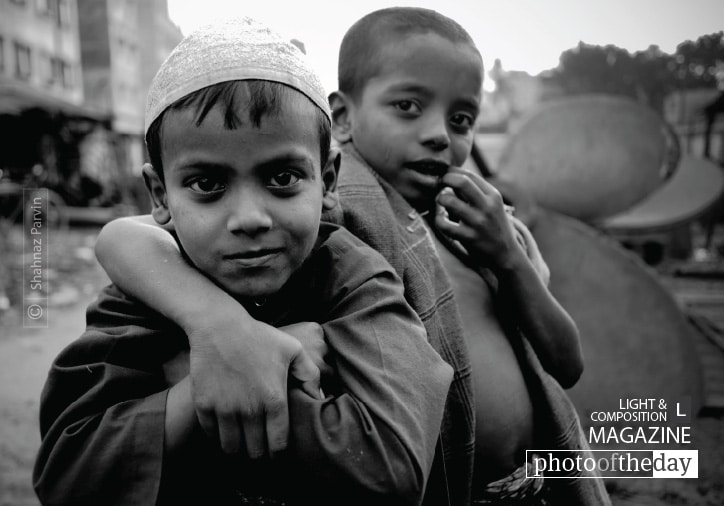
Exposure 1/400sec @ f/3.5 | ISO 200 | Focal Length 28mm
Shahnaz Parvin
Shahnaz Parvin was a celebrated award-winning photojournalist based in Dhaka, Bangladesh, whose work garnered international acclaim. Recognized as one of the world's top photographers, she dedicated her career to documenting the culture, conflicts, and daily life of her homeland with profound empathy and technical precision. As a prolific contributor to Light and Composition, she left a lasting legacy through her evocative documentary photography before her untimely passing in 2016. Her portfolio remains a testament to her commitment to storytelling and her deep connection to the people of South Asia.
Resonance Score Breakdown
Transparency Note: The resonance score (12.1/20) is calculated based on social engagement metrics collected before the award announcement.
Expert Photography Reviews · 5
The Currency of Light
In the quiet corners of a house, we often mistake possession for wealth. We count the objects we have gathered, the layers of comfort we have built against the world, as if these things could anchor us against the inevitable drift of time.
Read the reflection →The Currency of Light
We often mistake wealth for the weight of what we carry, forgetting that the richest among us are those who have learned to travel light. There is a specific kind of alchemy in childhood, a way of transmuting the dust of the road into gold.
Read the reflection →Reviews & Comments
Share your thoughts about this award-winning photograph. Your reviews contribute to the community engagement score.
Most documentary work from the Keranigonj docks relies on the easy pity of rags and grime. What separates this from the field is the boys’ unforced, genuine laughter. It’s rare to see poverty captured without turning the subjects into props. I’ve stared at these faces for years, and their joy still feels like a punch to the gut. It’s not just a snapshot; it’s a reminder that resilience isn’t a performance. It’s simply existing, beautifully, despite everything.
It’s easy to snap a shutter when the light hits, but getting this close requires more than a 28mm lens. You don’t earn that level of trust from two boys in a dockyard without spending hours in the dust, becoming part of the furniture. I’ve spent enough time in the cold to know when someone’s been patient. It’s a rare, honest bit of work. I’d have liked to stay there with them myself.
The dockyard air feels thin. Two boys occupy the frame, yet it’s the vast, grey expanse behind them that pulls at me. I’ve spent minutes staring at that void. It’s heavy. It’s quiet. They don’t need the clutter of their struggle to be seen. The space between them holds their joy better than any context could. Nothing here is accidental. The empty corner is not empty. It’s where the silence lives. I’m breathless.
The ochre dust of Keranigonj clings to these boys like a Morandi still life, yet it’s the sudden, piercing cerulean of their shirts that truly undoes one. It’s a chromatic defiance against the muted, sun-bleached exhaustion of the dockyard, a vibrant, saturated joy that I’ve found myself weeping over in the quiet of the gallery. They’ve captured a light so tactile, so thick with warmth, that it feels like the very breath of a winter afternoon.
1/400sec at f/3.5, 28mm, ISO 200. The shutter speed is overkill for static subjects, but it freezes the grit in the air. At f/3.5, the depth of field is thin enough to isolate the boys from the dockyard clutter. It’s a calculated risk that pays off. I’ve spent years staring at histograms, but these faces actually made me look twice. The technical execution is precise. It doesn’t waste a single pixel on ambiguity.