Street Lights in Bordeaux by Henri Coleman
Captured during a quiet evening walk in Bordeaux, this image highlights the interplay between historic architecture and modern illumination. The photographer was drawn to the rhythmic placement of street lights along an ancient, winding street, which perfectly complemented the city's signature ornamental iron balconies. By focusing on the interplay of light and shadow, the image transforms a simple urban scene into a narrative of passage and history. This photograph is award-worthy for its evocative atmosphere and the photographer's ability to find profound beauty in the quiet, overlooked corners of a storied city.
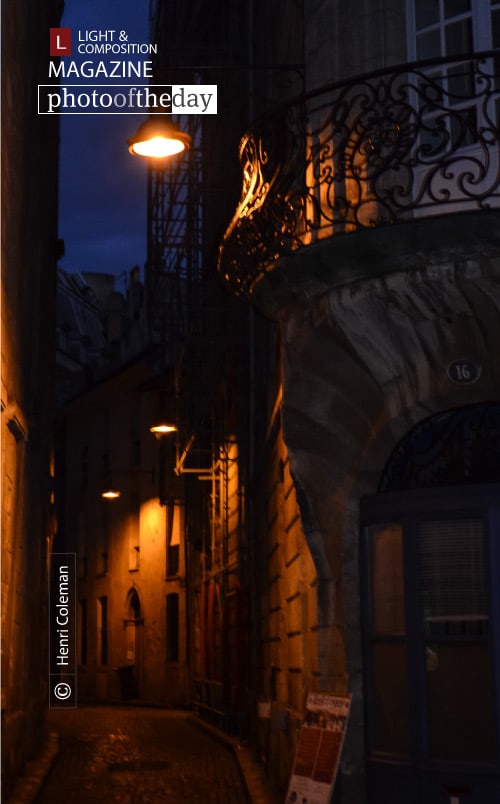
Exposure 1/60sec @ f/5.3 | ISO 1600 | Focal Length 40mm
Henri Coleman
A native of the Fort Worth area and a graduate of Texas State University, Henri Coleman transitioned into photography after a transformative trip to Europe. Following a career in fashion merchandising and family business, she discovered a passion for visual storytelling that led her to document her extensive travels, particularly her deep connection to Paris. Now based between Austin and Las Vegas, Coleman continues to refine her technical skills with her Nikon D5100, focusing on capturing the beauty and fleeting moments she encounters while exploring the world.
Resonance Score Breakdown
Transparency Note: The resonance score (13.1/20) is calculated based on social engagement metrics collected before the award announcement.
Expert Photography Reviews · 8
The Hum of Stone
The air tonight tastes of cold iron and damp pavement, a metallic tang that settles at the back of the throat.
Read the reflection →The Architecture of After Hours
There is a peculiar silence that descends upon a city once the day has been folded away. It is not an absence of sound, but a shift in the quality of the air, as if the stone walls and iron railings have finally stopped holding their breath.
Read the reflection →Reviews & Comments
Share your thoughts about this award-winning photograph. Your reviews contribute to the community engagement score.
Great!!
The sodium-vapor glow bleeds into the limestone, creating a bruised, ochre warmth that reminds one of Morandi’s dustier palettes. It’s a melancholic, flickering amber, clinging to the ironwork like a ghost of the nineteenth century. I’m utterly undone by how the shadows swallow the street, turning the darkness into a velvet void. It doesn’t just capture Bordeaux; it breathes the heavy, humid air of a city caught between the dying light and the encroaching, silent night.
The street lamps hum with a golden, heavy silence. Henri stood here as the city exhaled, waiting for the shadows to soften against the ironwork. It’s a quiet, patient observation of how light clings to stone. I’ve felt that same stillness in my own bones, that moment when the architecture finally stops being a structure and becomes a memory. It doesn’t rush; it simply waits for the night to settle into its rightful place.
Most night photography relies on cheap neon thrills, but this captures the actual weight of Bordeaux’s silence. I’ve seen thousands of street scenes, yet the way those iron balconies slice into the artificial glow feels genuinely lonely. It’s the restraint that wins here; Coleman didn’t over-process the shadows. I felt a sudden, sharp ache for a city I’ve never visited. That’s the mark of a keeper. In thirty years, this quiet street will still matter.
Before the eye identifies the iron balconies, a sudden stillness settles in the chest. It’s the weight of the Bordeaux night, that specific hum of ISO grain mimicking a held breath. When I return to this, I feel the damp chill of the stone against my own skin. Coleman’s street lights don’t just illuminate; they anchor a phantom memory of walking home alone, where the shadows feel like a quiet, persistent pulse.
The street lamps pull the eye toward the dark. I’ve spent minutes watching the shadows stretch across the stone. It’s quiet here. The iron balconies don’t crowd the frame; they breathe. I feel a sudden, sharp ache for that stillness. Nothing here is accidental. The empty corner is not empty. It’s a pause. A breath held in the middle of Bordeaux. It’s rare to find a frame that knows when to stop.
The rhythmic placement of the street lights creates a necessary cadence, yet the frame struggles to contain the architectural weight. It’s a precarious balance. The iron balconies disrupt the verticality, pulling the eye toward the periphery where the composition falters. I’ve found myself wishing for a tighter crop to resolve this spatial tension. It doesn’t quite hold. The geometry is promising, but the lack of a singular fulcrum leaves the picture plane feeling adrift.
At f/5.3, the Nikon’s kit lens struggles with the diffraction limit, yet it’s precisely this softness that renders the Bordeaux street lights as ethereal, blooming orbs. The chromatic aberration bleeding into the ironwork creates a haunting, painterly fringe. I’m genuinely moved by how the sensor’s noise at ISO 1600 mimics the grain of historical film. It’s a fragile, optical dance where the focal plane barely holds the architecture, leaving the rest to beautiful, luminous decay.
1/60sec at f/5.3, ISO 1600, 40mm. It’s a compromise that fails the physics of the scene. At 1600, the Nikon 5100 sensor produces noise that muddies the ironwork details. You’ve traded sharpness for a handheld shutter speed you didn’t need. I’m genuinely annoyed by the missed potential here. A tripod would’ve allowed a lower ISO and tighter aperture. You had the composition, but the technical execution is just lazy. It’s a blurry, noisy disappointment.