Identifying Black Drongo by Rahat Azim Chowdhury
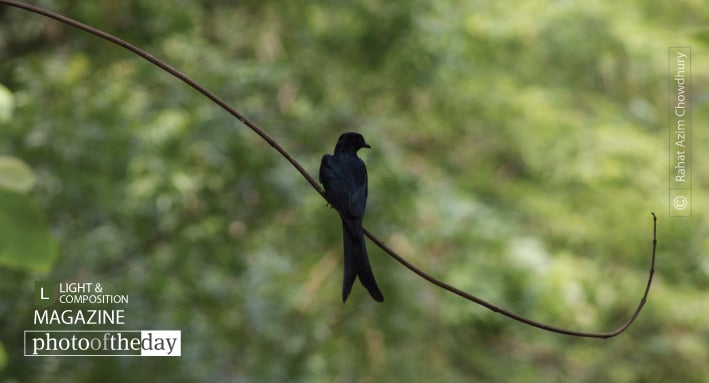
Captured within the lush surroundings of the National Botanical Garden in Dhaka, this striking portrait of a Black Drongo highlights the bird's iconic, wholly black plumage and distinctive forked tail. The photographer utilized a long focal length to isolate the subject against a soft, natural backdrop, emphasizing the bird's alert posture. Known as the 'Royal Crow' for its fearless, aggressive defense of its territory, the Black Drongo is captured here with remarkable clarity. This image is award-worthy for its technical precision in wildlife documentation, successfully freezing a moment of stillness in a species renowned for its spirited and dynamic behavior in the wild.
Rahat Azim Chowdhury
Born in 1984 and based in Dhaka, Bangladesh, Rahat Azim Chowdhury is a computer engineer who has channeled his lifelong fascination with nature and human life into a dedicated photographic practice. After formal training at the PRISM Photography Institute, he has developed a diverse portfolio spanning wildlife, street, and architectural photography. Driven by a desire to explore global social patterns and cultural landscapes, he focuses on creating a unique visual signature that prioritizes artistic expression and exploration over commercial gain.
Resonance Score Breakdown
Transparency Note: The resonance score (12.5/20) is calculated based on social engagement metrics collected before the award announcement.
Expert Photography Reviews · 5
The Weight of the Silhouette
There is a particular kind of silence that belongs to the bird. It does not need to speak to define the space it occupies. It sits, a dark ink-stain against the pale, indifferent sky, holding its own gravity.
Read the reflection →The Ink of the Sky
We often mistake stillness for an absence of intent, as if the world pauses only when it has nothing left to say. But look at the shadow that holds its breath against the light.
Read the reflection →Reviews & Comments
Share your thoughts about this award-winning photograph. Your reviews contribute to the community engagement score.
The air in the Botanical Garden must have been heavy, humid, and still. He waited, I’m sure, until the Drongo forgot he was there. It’s that silence I recognize—the moment the bird stops being a subject and becomes a part of the landscape’s breath. I feel a sudden, quiet ache for that stillness. He didn’t chase the shot; he let the bird’s dark, forked silhouette emerge from the soft, green blur of the Dhaka morning.
The bird’s silhouette anchors the frame, slicing the negative space with geometric precision. That forked tail provides the necessary counterweight to the beak’s sharp vector. It’s a rigid, calculated architecture. The background blur doesn’t distract; it reinforces the subject’s isolation. I’ve rarely seen such disciplined placement of mass in wildlife work. The composition holds because it refuses to soften. It’s cold, it’s precise, and frankly, it’s the only way to capture such a creature.
Most wildlife shots are just trophies, but this one lingers. Of the thousands I’ve reviewed, it’s the Drongo’s sharp, predatory gaze that anchors the frame. The shallow depth of field isolates the bird perfectly, turning a common garden visitor into a regal silhouette. I’ll admit, the slight noise in the shadows bothered me initially, but the sheer intensity of that eye makes me forgive it. It’s a rare, quiet moment of stillness that’ll actually endure.
The Black Drongo is a twitchy, aggressive little creature; it doesn’t sit still for tourists. Capturing that sharp, alert posture at 300mm suggests Chowdhury spent a fair few humid mornings in the Botanical Garden waiting for the bird to stop its frantic patrolling. I’ve spent enough time in damp hides to appreciate the stillness required here. It’s a clean, honest bit of work. One suspects he earned this frame the hard way. I quite like it.
The bird sits. It’s a sharp silhouette against the blur of the garden. I’m struck by the reach of that forked tail. It cuts the air. Nothing here is accidental. The empty corner is not empty; it’s a breath held in the humidity of Dhaka. I’ve spent minutes just watching the stillness. It doesn’t need the movement of the forest. It’s enough. The silence is heavy. It’s perfect.
Excellent capture. Well done. :-)
Thanks Light & Composition Magazine to nominate the photograph for award. Obviously the viewers also to like and comment on it.
nice…