Weaver’s Hand by Shahnaz Parvin
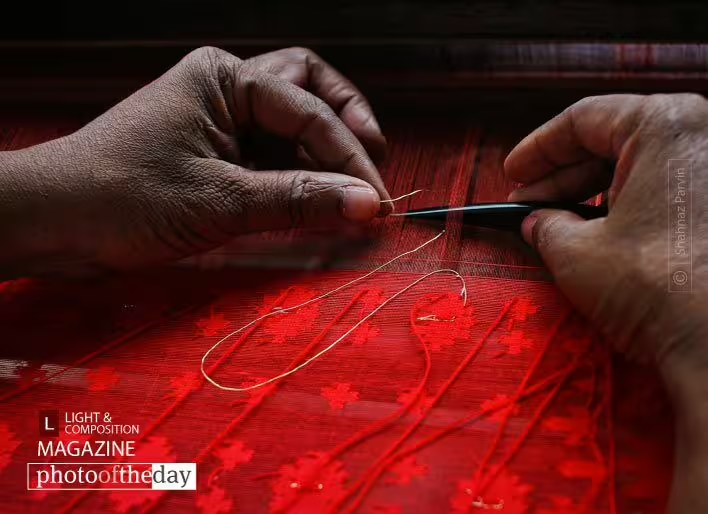
At the Sonargaon Folk Art and Culture Museum, the photographer captured the intricate artistry of traditional Jamdani weaving. The image focuses on the rhythmic, labor-intensive process of creating these historic textiles, which have served as a symbol of Bengali pride for millennia. By positioning the camera to highlight the weaver's hands at work on a rickety loom, the photographer emphasizes the human connection to a vanishing craft. This award-winning shot is celebrated for its authentic portrayal of cultural heritage, effectively bridging the gap between ancient artisanal traditions and the modern visitor experience in Sonargaon.
Shahnaz Parvin
Shahnaz Parvin was an acclaimed photojournalist based in Bangladesh, recognized as one of the premier photographers of her generation. Her work, which frequently highlighted the cultural landscape and documentary narratives of South Asia, earned her a place among the world's top 100 photographers. A dedicated contributor to Light & Composition, she utilized her lens to preserve the essence of her homeland until her untimely passing in 2016.
Resonance Score Breakdown
Transparency Note: The resonance score (13.8/20) is calculated based on social engagement metrics collected before the award announcement.
Expert Photography Reviews · 7
The Architecture of Memory
We are all woven from threads we did not spin. There is a quiet, rhythmic persistence in the way a life gathers itself, knot by knot, until a pattern emerges from the chaos of loose ends.
Read the reflection →The Rhythm of the Thread
I spent this morning trying to fix a loose button on my favorite coat. It sounds simple, but my fingers felt clumsy and impatient. I kept pulling the thread too hard, tangling the knot, and sighing at the clock.
Read the reflection →Reviews & Comments
Share your thoughts about this award-winning photograph. Your reviews contribute to the community engagement score.
In ‘Weaver’s Hand’, shadow is not merely the absence of light—it is where the psychological weight of the image resides. The rich contrast and textured darks sculpt the contours of the subject with dramatic intensity. The interplay between luminous highlights and contemplative shadows creates an atmosphere that invites sustained, thoughtful reflection. It is an image that acknowledges the complexity of existence.
What strikes me immediately in ‘Weaver’s Hand’ is the raw, unforced authenticity. Shahnaz Parvin has a rare gift for stepping into a community and capturing moments of profound human dignity without intrusion. The subject’s expression and posture speak with complete honesty; there is no performance here, only life witnessed with deep empathy and respect. You waited for the exact right second, and the result is timeless.
Optically and technically, ‘Weaver’s Hand’ delivers exceptional execution. The depth of field is measured to isolate the vital textural details while maintaining context in the background. Exposure values are tightly controlled, retaining subtle highlight gradations without crushing the shadow details. The shutter speed captures the organic cadence of the environment cleanly, proving that intentional camera craft is the bedrock of powerful imagery.
Most entries in this category rely on sentimental blur to hide a lack of focus. Parvin avoids that trap. By pinning the frame to the weaver’s calloused thumb against the taut, geometric warp of the loom, she forces us to confront the friction of labor. It’s a tactile, aching reminder of human persistence. I’ll admit, seeing those worn knuckles makes my own hands ache. In thirty years, this grit will still matter more than any polished portrait.
The loom’s geometry dictates the frame. Vertical warp threads establish a rigid grid, forcing the eye into the weaver’s tactile rhythm. It’s a disciplined spatial tension. The hands occupy the fulcrum, anchoring the chaotic motion of the shuttle. I’m struck by how the depth of field isolates the weave, refusing to let the background dissolve into sentiment. It doesn’t need narrative fluff. The structure holds. It’s a rare instance where the frame actually earns its weight.
The ochre of the loom’s weathered timber bleeds into the bruised, indigo threads, creating a chromatic tension that feels like a Morandi still life caught in the humid, breathless heat of Sonargaon. It’s the way the light catches the weaver’s skin—a dusty, sun-baked terracotta—that truly breaks my heart; one can’t help but feel the weight of centuries pressing against the vibrant, rhythmic pulse of those tireless, indigo-stained fingers moving through the warp.
One suspects the weaver didn’t appreciate the intrusion, but the rhythm here is undeniable. It’s a quiet, claustrophobic frame. I’ve spent enough time in cramped workshops to know that getting this close without disrupting the loom requires a rare, invisible patience. Parvin clearly sat there until she was part of the furniture. It’s a rare thing to see such respect for the labor itself. She didn’t just snap a picture; she earned the seat.