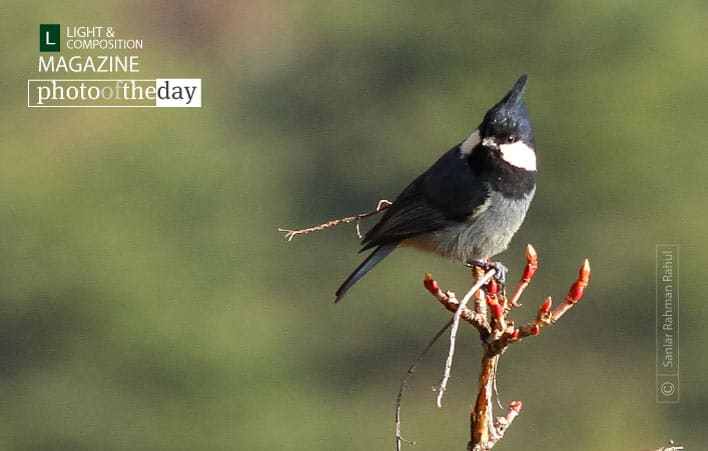
Coal Tit by Saniar Rahman Rahul
Captured at the high-altitude Chalela Pass in Bhutan, this portrait of a Coal tit showcases the delicate beauty of a bird barely 11.5cm in length. Amidst the Himalayan Hemlock and rhododendron forests, the photographer utilized a 300mm lens to isolate the subject against its natural habitat at 3,000–3,800 meters. The image captures the bird's distinct, spirited character, reminiscent of its 'Angry Birds' namesake. This photograph is award-worthy for its technical precision and the photographer's ability to document a common yet elusive resident of the subtropical zone with such intimate clarity and compositional balance.
Saniar Rahman Rahul
Based in Dhaka, Bangladesh, Saniar Rahman Rahul is an accomplished Art Director at Grey Worldwide with a career deeply rooted in the creative arts. His journey into photography began in childhood, inspired by his father, and was later refined through his extensive professional background in graphic design and advertising. Since rediscovering his passion for the lens in 1997, Rahul has established himself as a prominent figure in the photography community, earning recognition as an early winner of the Photo of the Month Award in 2010.
Resonance Score Breakdown
Transparency Note: The resonance score (12.0/20) is calculated based on social engagement metrics collected before the award announcement.
Expert Photography Reviews · 5
The Weight of Small Things
We often mistake size for significance, assuming that only the vast—the mountain range, the storm, the wide-reaching forest—holds the truth of a landscape. Yet, there is a quiet, fierce gravity in the small.
Read the reflection →The Weight of Small Things
There is a particular silence that belongs to high places. It is not the absence of sound, but the presence of a cold, thin air that demands everything from the lungs. To exist at such an altitude is to be small.
Read the reflection →Reviews & Comments
Share your thoughts about this award-winning photograph. Your reviews contribute to the community engagement score.
At 3,800 meters, the air is thin and the silence heavy. Saniar waited in the biting cold of the Himalayan hemlocks, listening for the flutter of wings. It’s a quiet, intimate communion. I’ve felt that same stillness, where the world narrows to a single, spirited life. The Coal Tit doesn’t pose; it simply exists, and he was there to catch its breath. It’s a fragile, beautiful reminder that nature reveals itself only to the patient.
The bird occupies a sliver of the frame. It’s a tiny weight against the vast, blurred hemlock. I find myself holding my breath, afraid to disturb the stillness of the pass. Rahul hasn’t crowded the subject. He’s let the forest breathe. The negative space isn’t just background; it’s the cold, thin air of Bhutan. Nothing here is accidental. The empty corner is not empty. It’s a pause. A rare, quiet grace.
Most bird photography is just taxidermy with a pulse, but this Coal Tit hits differently. I’ve seen thousands of avian portraits, yet the way Rahul isolates that tiny, frantic energy against the blurred Himalayan greens is rare. It’s not just the technical sharpness; it’s the bird’s defiant posture. I actually laughed when I first saw it. It’s a small, stubborn life captured in a vast, cold pass. That’s why we’ll still care in thirty years.
The subject’s placement within the frame is precise, yet the background bokeh lacks the necessary structural density to anchor the bird. It’s a precarious balance. The diagonal branch provides a necessary fulcrum, though the negative space feels slightly hollow. I’ve grown weary of such soft, unearned backgrounds in wildlife portraiture. It doesn’t quite hold the tension required for true rigor. Still, the alignment of the beak against the blurred foliage creates a sharp, undeniable visual clarity.
At 3,800 meters, the light doesn’t just illuminate; it interrogates. Rahul’s Coal Tit exists in a precarious suspension, caught between the biting clarity of the lens and the encroaching void of the Himalayan forest. It’s a small, frantic pulse against the silence of the peaks. I’ve stared at its eye for an hour, and I’m unsettled by the darkness reflected there. It isn’t just a bird; it’s a tiny, defiant refusal to vanish into the shadows.